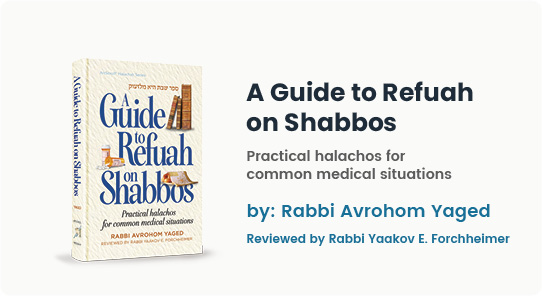
AS: What prompted you to write about the halachos of medicine on Shabbos?
RAY: I realized there was a void in this subject. Families with children, especially, have many questions, and those who must spend Shabbos in a hospital are sure to have halachic questions. It shouldn’t happen that when a medical situation arises it is surrounded with uncertainties, especially since a Rav may not be immediately available.
AS: Refuah on Shabbos is an easy-access guidebook for every home. Yet it also includes hundreds of source notes for those who want a deeper understanding. Tell us about the process of writing both for laymen and talmidei chachamim.
RAY: My goal was to make it as simple as possible, imagining actual people going through a medical scenario, what they need to know, and what other possible questions might arise. The sefer also gives introductions to many subjects, explanations of various halachos, and footnotes that range from simple references to detailed information. The sefer has been reviewed by Harav HaGaon Yaakov Forchheimer shlita, who enhanced the sefer with his many years of experience and acknowledged expertise in answering medical questions — from simple ones like giving Tylenol to an infant to complex questions of life and death.
AS: What are some of the features that make this sefer so user-friendly?
RAY: The topics are clearly organized by chapter. For example, one chapter walks an expectant mother through the entire birth process, from calling her doctor when she is in labor through being discharged on Shabbos, with everything in between. The ArtScroll staff worked very hard to prepare an extensive index. In addition, a chart lists close to 100 common ailments, illnesses, and injuries in alphabetical order. It tells the reader how to classify the problem — that is, is it life-threatening or not, etc.? — and then it directs the reader to the page where the topic appears.
AS: What are some of the topics that you cover?
RAY: From birth to end of life and everything in between: common illnesses, life-threatening diseases, fractures, stitches, mental health, carrying medical devices outside of an eruv, birth, physical therapy, child care and safety, visiting the sick on Shabbos, hygiene, and when hilchos Yom Tov differ from the halachos of Shabbos.
It is my hope that Mashiach will come speedily in our days, and there will be no more illness. But until then, we need a Guide to Refuah on Shabbos.
 The Official ArtScroll Blog