A Conversation With Libby Lazewnik: Author of The Starlight Sisters Volume 1: — Ora’s Story — Second Fiddle

AS: A new Libby Lazewnik series! Great news! Tell us a little about the characters of Starlight Sisters — and why readers are going to love them.

LL: There are four Starlight Sisters — not actual sisters, but friends — to start with, with a fifth to make her appearance later in the series. Each of the four girls has a particular talent, a particular kind of family situation, and a particular middah that she needs to work on. The girls are not perfect — I’ve tried to make them very real, very relatable. Each of the girls narrates “her” book, so we get to know them all really well — inside and out. By the time you’re done, they’ll be your best friends! This first volume begins with Ora’s story. Ora has a gorgeous voice, a wonderful family, excellent marks in school … and a problem that’s going to take her an entire book to solve!

AS: You chose an interesting setting: a Bais Yaakov-type school for super-talented girls. Is that something you always dreamed of?

LL: Although I did belong to my school’s dance group, performing as a dancer was not my dream. My own “superpower” was always writing …. But I was definitely fascinated by the idea of kids putting on professional-quality performances and what goes on behind the scenes. And I know that many, many girls long to be in productions and performances.

AS: What age group are you writing for?

The Starlight Sisters are in seventh grade, so these books are aimed at my usual young-adult crowd, age approximately 10-14.

AS:  The question everyone asks you: After writing so many books and articles, how do you keep finding such fresh and original plots?

LL: Life is constantly fresh and original. I just keep my eyes open … and daven!

AS: Without giving away any secrets — what can we expect in future books in the series?

As I said, we’re looking at a fifth Starlight Sister to join the group after a very dramatic sort of introduction to our old friends. Apart from that, there’ll be more performances, more “family and friends stuff,” more character growth — and a super-exciting trip to London, where they’ll be giving a command performance, to top it all off!

Order your copy TODAY at ArtScroll.com

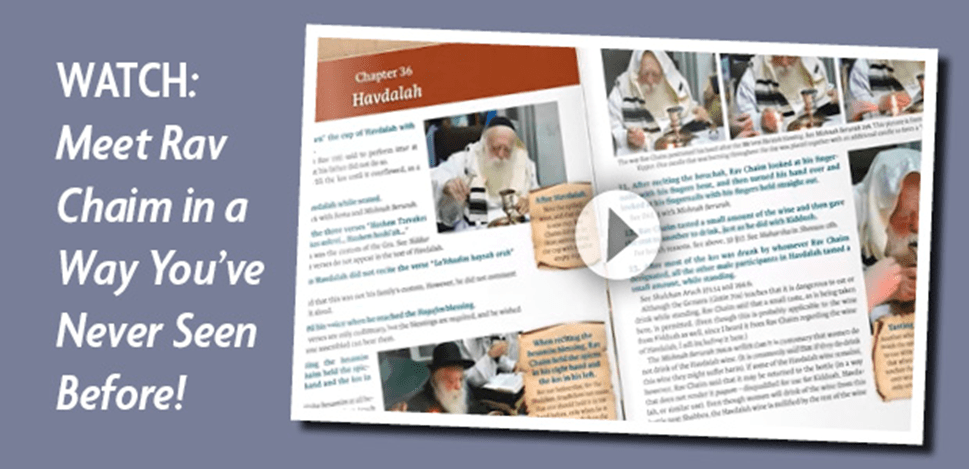
Meet Rav Chaim, in a Way You’ve Never Seen Before: A Conversation with Rav Avraham Yeshaya Steinman, author of Rav Chaim: A Life of Halachah

No doubt you’ve read and been amazed and inspired by ArtScroll’s biography of Rav Chaim Kanievsky ztz’l, by Rabbi Naftali Weinberger. (If you haven’t, go right now and start reading!) You may also have studied ArtScroll’s sefarim that present Rav Chaim’s Torah thoughts on different topics. And, of course, you’ve heard the countless stories about his berachos, his compassion, and his extraordinary diligence.

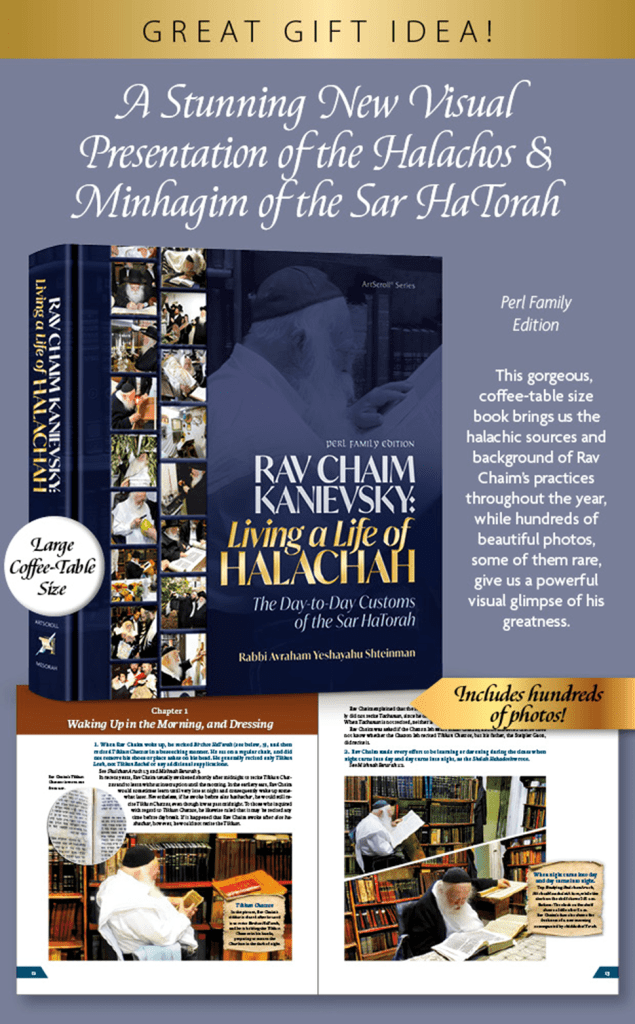
Now, ArtScroll proudly shares another book about Rav Chaim, which looks at his life and teachings in a wholly new, unique way: through the prism of his customs and practices, as seen and recorded by Rav Avraham Yeshaya Steinman, grandson of both Rav Chaim and Rav Aharon Leib Steinman.

Rav Chaim: A Life of Halachah brings us the halachic sources and background of Rav Chaim’s practices, with hundreds of beautiful photos that give us a powerful visual glimpse of his greatness. We follow the Sar HaTorah from Tikkun Chatzos through his first moments of awakening; from donning his tallis to reciting Kriyas Shema before his few hours of sleep. We sit with him at his Shabbos table, in his succah, and at his Seder.

ArtScroll was privileged to speak with Rav Avraham Yeshaya about the sefer and his relationship with his Saba:

AS: What is the backstory of this fascinating and unusual sefer?

RAYS: I merited being near my grandfather R’ Chaim from when I was a young child. One of my rebbeim told me after my bar mitzvah that I should write down all the distinct halachic customs that my grandfather followed, and I should ask him for his reasoning behind them.

AS: This full-color book has such beautiful, evocative photos of the Sar HaTorah, many of them rare. What went into finding such a variety?

RAYS: When ArtScroll came out with the book on my grandmother, Rebbetzin Batsheva, the author asked me to collect as many pictures as possible. Many of the pictures matched the exact halachic customs my grandfather followed and are included in this sefer.

AS: Please share something about your two sabas — Rav Chaim and Rav Aharon Leib Steinman.  

RAYS: They were extremely close to each other and appreciated each other immensely. In the later years, when each was overburdened, helping many individuals as well as the Klal, they would frequently send regards and warm berachos to each other through me or one of their other mutual grandchildren.

Order your copy TODAY on ArtScroll.com!

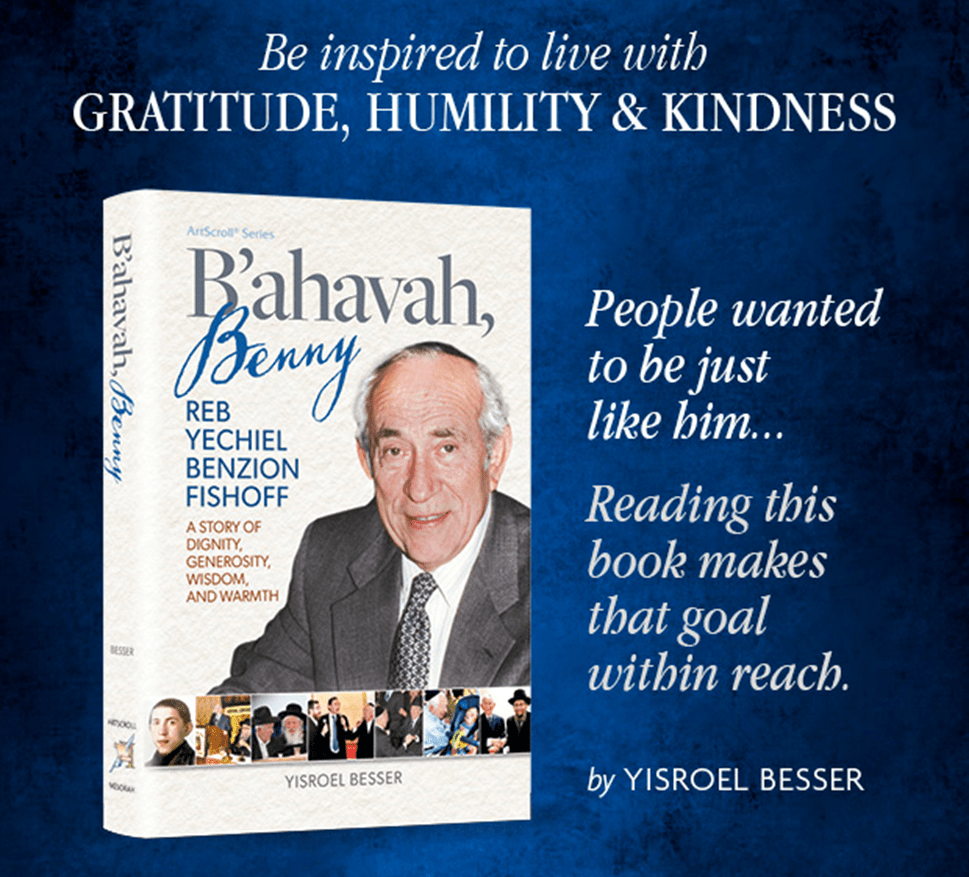
A Conversation with Yisroel Besser – Author of B’Ahavah, Benny

AS: To those who knew him, Benny Fishoff was a legend and a shining example. Can you tell us, briefly, a little about him, for those not privileged to have ever met him?

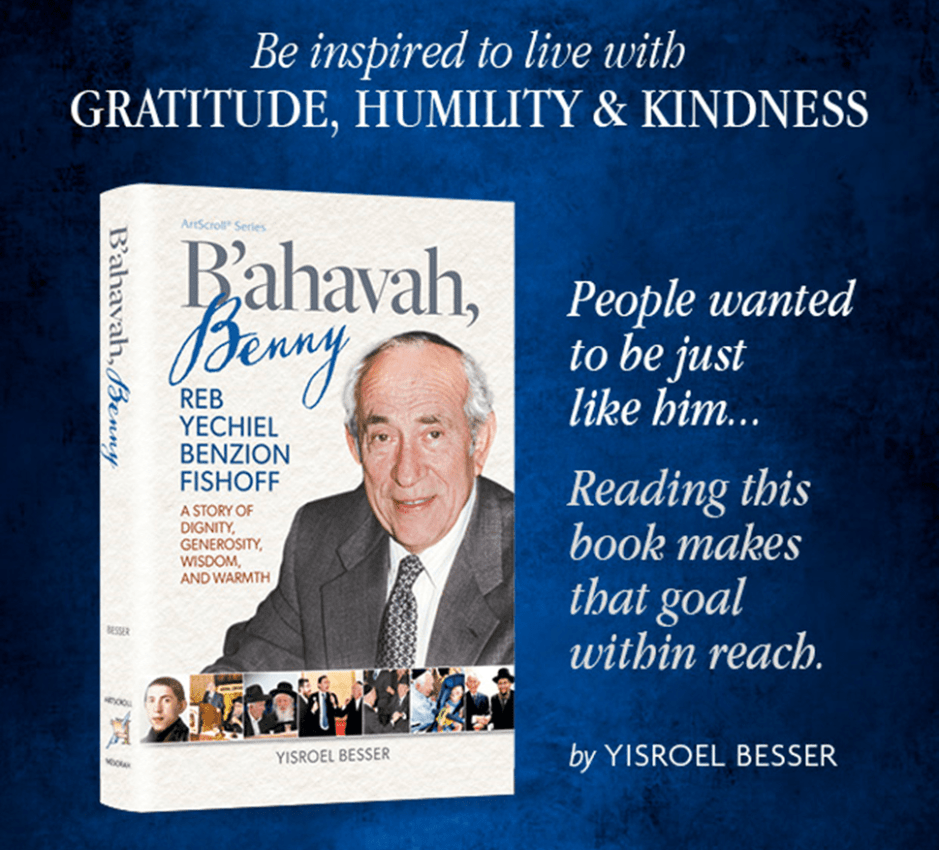
YB: Holocaust survivor turns businessman turns generous and caring askan. Baruch Hashem, Klal Yisrael has been gifted with many who fit that description. Benny Fishoff stood out in the way he related to people — to all people, VIPs and parking lot attendants. His genuine love and caring for others, profound emunah, and fantastic business savvy made a unique and unforgettable combination. Rabbi Meir Zlotowitz z’l told people, “When I grow up, I want to be Benny Fishoff.” How’s that for unique?

AS: Rabbi Moshe Sherer called Benny Fishoff the “malach of shalom.” Tell us about his amazing ability to make peace between people.

YB: I’ll let him tell you himself, in his own words: “The most important lesson I learned is that machlokes doesn’t pay: it simply is not worth the time or the energy.” He was a master of listening and understanding, bringing people who were at each other’s throats to make compromises and move away from hate. His messages of ahavas Yisrael and empathy are something that we all must hear, especially in these times.

AS: The book is a departure for you: partially memoir, told in Benny’s voice; partially stories told about him by others. How did you go about writing this unusual work?

YB: I met Benny Fishoff when researching another book, and I was immediately captivated by his endearing personality and fascinating stories. He told me he wanted his story written down so that his grandchildren would know about the family that they’d never met, all of them victims of the Holocaust. That mushroomed into tales about building his business, with an emphasis not on his successes but on when he’d failed and how he’d learned and grown from his failures. Benny fell ill not long after we’d finished his memoir, but the manuscript was printed for his grandchildren. Other people read it and said how much it had fascinated and influenced them. Then, after Benny’s passing, more and more stories about his amazing accomplishments came to light. We added the stories, and the result was this book.

Order your copy TODAY at ArtScroll.com

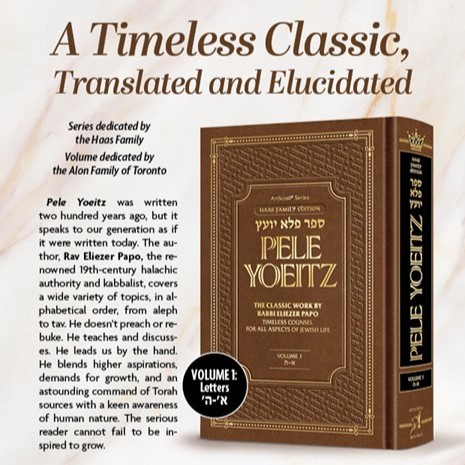
Timeless Counsel for all Aspects of Jewish Life: The Haas Family Edition Pele Yoeitz

Imagine an encyclopedia — or, in 21st-century terms, a Wikipedia — of Torah thought, wisdom, and hashkafah. You can read this encyclopedia through from A to Z — or, in this case, from Aleph to Tav. You can also use it as a reference on specific topics. Or you might want to just riffle through the entries, broadening your knowledge and enriching your understanding.

And imagine that you can go to that encyclopedia and find not only facts and wisdom, but also brilliant and practical advice for living, as well as gentle mussar designed to strengthen your connection to Hashem and His Torah.

You don’t have to imagine it. That encyclopedic collection of Jewish wisdom and guidance has been available and beloved for two centuries. It’s called Sefer Pele Yoeitz. And it is now available and accessible to ArtScroll readers, with a flowing translation and elucidation, in the Haas Family Edition Pele Yoeitz: The Classic Work by Rabbi Eliezer Papo.

Pele Yoeitz was authored by the renowned halachic authority, ethicist, and kabbalist Rav Eliezer Papo. The work, which has achieved universal popularity, is arranged alphabetically; it covers themes that range from philosophy to halachah to practical advice. Topics discussed in this first of the projected four-volume series range from advice on chinuch to interpersonal relationships, conducting a business, developing personal integrity, and how to build a home, look for a shidduch, or publish a sefer … the list goes on and on.

This first volume also features a comprehensive 70-page discussion of dibur, speech, and how a person can sanctify his words, with separate sections on “mitzvah” speech, permitted speech, and forbidden speech. Like the rest of the book, each section is a beautiful blend of hashkafah and practical, down-to-earth advice that displays a profound understanding of human nature.

This is a book of “pele yoeitz” — wondrous guidance — that has illuminated Jewish life for two centuries and continues to bring Torah wisdom to us now.

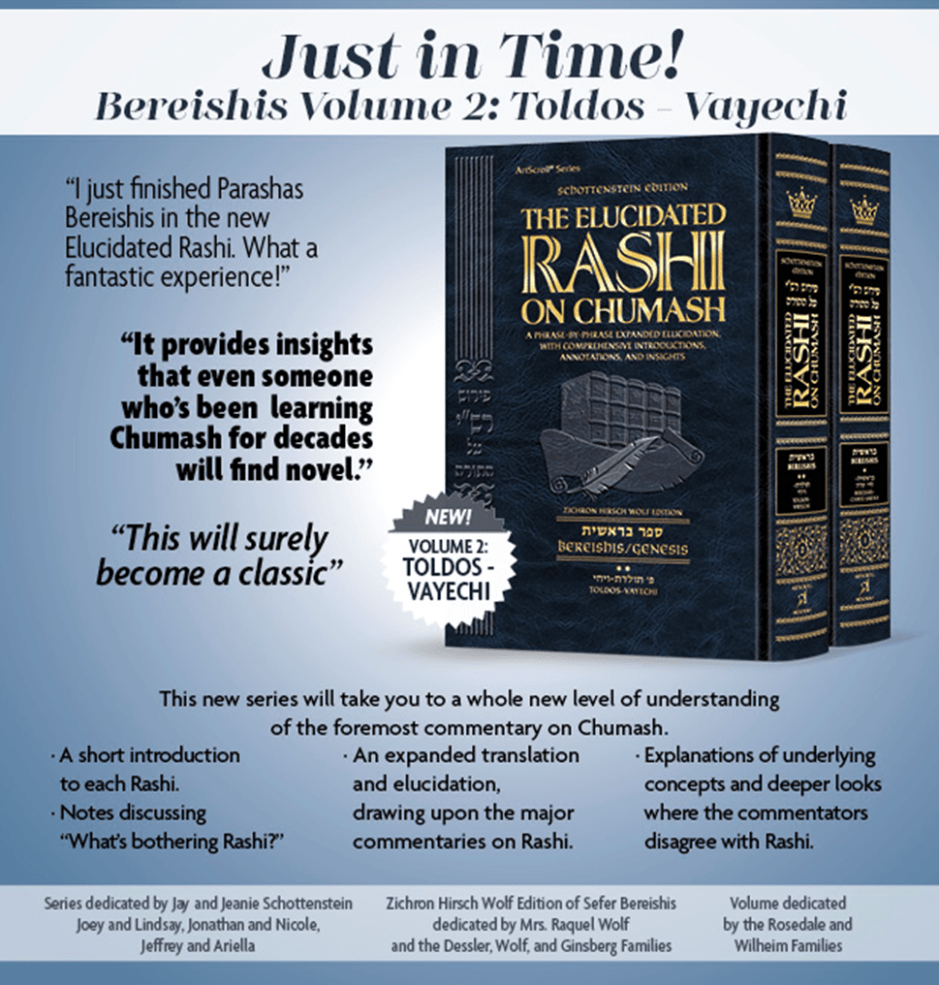
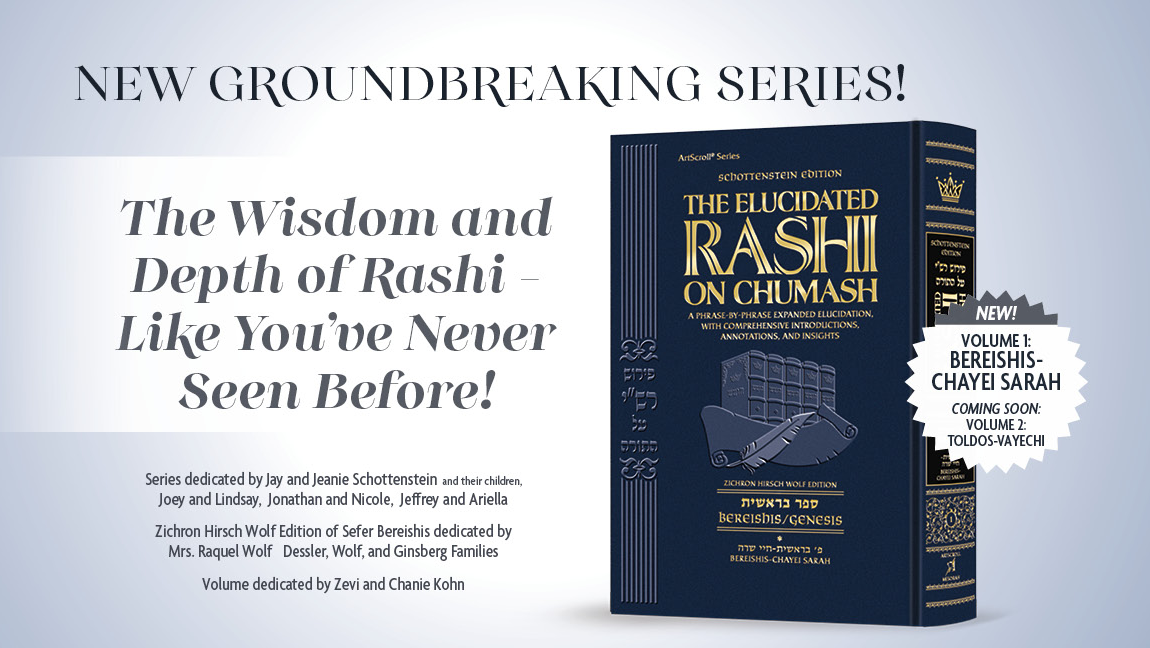
First there was the Schottenstein Edition Talmud. Then there was the Schottenstein Edition Mishnah Elucidated. Today, ArtScroll presents the Schottenstein Edition Elucidated Rashi on Chumash!

For centuries, the brilliant light of Rashi has illuminated the world of Torah. Behind his seemingly simple words lie treasures of knowledge and profound thought. The study of the Torah through the lens of Rashi has become a sacred tradition for generations, allowing us to “sit in Rashi’s beis medrash” and partake of his explanation of the Torah’s words and his exploration of its depths.

For decades, English speakers have relied on the Sapirstein Edition Rashi for a translation and basic explanation of the Torah’s foremost commentary. Baruch Hashem, the world of Torah has grown. There are more people studying Torah today than in many centuries, and they want more. They wish to dig deeper, understanding not just what Rashi says, but the underlying concepts, along with enlightening glimpses into Rashi’s thought process. What motivated this comment? What counterargument does the Ramban put forth, and how might Rashi respond? How do the Torah’s words prompt Rashi’s interpretation? Beneath the deceptively straightforward exterior of Rashi’s commentary lies a depth that has captivated talmidei chachamim for more than eight centuries.

Enter The Elucidated Rashi on Chumash.

The first volume in this groundbreaking 10-volume series, on Parashiyos Bereishis through Toldos, presents Rashi’s wisdom with unexcelled depth and clarity. Explanatory words ensure the seamless flow of his commentary, clarifying his points and connecting them with the text of the Chumash. Comprehensive notes offer additional insights into Rashi’s ideas and provide clarifications from other commentators.

The Elucidated Rashi culls from literally hundreds of commentaries,” says Rabbi Eliezer Herzka, General Editor of the project, “distilling them into a clear, comprehensive approach to Rashi. The work is designed to give a broad and in-depth presentation of Rashi, clear enough for even the student to understand, yet thorough enough for even the talmid chacham to appreciate.”

The Elucidated Rashi on Chumash is unlike anything published before in any language, Hebrew, English or otherwise,” says Rabbi Gedaliah Zlotowitz, president of the Mesorah Heritage Foundation. “Calling it ‘revolutionary’ is not an overstatement. No work on Rashi has ever been produced on this level.”

Order your copy TODAY on artscroll.com!

Chazak, Chazak, V’Nischazeik! Mazel Tov on the Siyum of The Haas Family Edition Zera Shimshon

It began, as so many good things do, with a story.

It was the story of a great talmid chacham who, lo aleinu, lost his only son. And how he took that personal tragedy and turned it into a gift for future generations, by writing a Torah commentary in memory of his son — and including in his Introduction a promise: “… [those who learn my Torah] will see children, and children’s children … wise and discerning, and homes filled with everything good, and wealth and honor ….”

We’re talking, of course, about Rav Shimshon Chaim Nachmani, the Zera Shimshon, whose sefarim and the segulah connected with them have become household words.

But the story — and the many stories of people who were helped through this segulah — was just the beginning. Because when word of the recently rediscovered commentary came out, thousands flocked to learn it. They realized that the commentary, written in 18th-century Italy, was a hidden treasure of Torah thought. A treasure indeed, but one difficult to access, since the commentary is complex, with countless allusions to concepts and texts from all over the vastness of the Written and Oral Torah.

Again and again, we at ArtScroll heard the request: Give us an elucidated translation so that we, too, can truly understand this beautiful but difficult commentary!

And so began the Haas Family Edition Sefer Zera Shimshon — an elucidation of the Zera Shimshon on Torah, which has just celebrated the release of the final edition in the 10- volume project. (An additional three volumes cover Zera Shimshon on Megillas Esther, Rus, and Eichah. Koheles and Shir HaShirim are in advanced stages of preparation.)

It wasn’t easy. The style of the commentary often included complex reasoning and esoteric ideas, difficult to make understandable. “The very excellent staff was notfamiliar with the sefer — we all learned on the job!” says Rabbi Shmuel Kirzner, General Editor of the project. But the huge effort was successful: One who learns Zera Shimshon is immediately catapulted to the realms of Derush and Remez, usually in the framework of an exquisite tapestry of interwoven ideas. The combination of breadth and depth make the sefer truly unique — and ArtScroll’s elucidation makes it very understandable.

The story of Zera Shimshon’s author does not end. It lives on, in the eternal words of his Torah.

Order your copy today on artscroll.com

Stories and insights to enrich this wonderful time of year, and our lives as well.

Unwrapping Our Gifts: Days of Reflection, Days of Awe, by Rabbi Yaakov Feitman

It’s in the air, everywhere. The feelings of closeness to Hashem. The awe of the upcoming Rosh Hashanah and Yom Kippur. The excitement of Succos. The fear and the love, the teshuvah and the tefillah. The children singing songs of apples and honey; the daily sound of the shofar, awakening all of Klal Yisrael.

And, as Rabbi Yaakov Feitman tells us in his inspiring and important new book: It’s all a gift. The gift of Elul, the gift of the Yamim Noraim, the joyous gift of Succos. A gift that his new and important book, Days of Reflection, Days of Awe, will help us unwrap and enjoy.

For over twenty-five years, Rabbi Feitman, a leading talmid of Rav Hutner, has served as  Rav of  Kehillas Bais Yehudah Tzvi in Cedarhurst, NY, a flourishing shul with a full-time kollel. He has been featured as a speaker and scholar-in-residence in cities all over the U.S., Israel, and Europe. As a writer, Rabbi Feitman makes profound ideas relatable and practical. He weaves together stories and insights from across the spectrum of our gedolim to give us a deeper appreciation of the holy days and the unique nature and power of each. Every essay is summarized in a practical takeaway that can help readers make the most of this meaningful time of year.

What is, according to some of our greatest Torah leaders, the most important middah of Elul? What does the British monarchy have to teach us about (l’havdil) crowning Hashem as our King? Where does the joy of Succos come from, and how did Jews manage to find that simchah even in the direst situations? Here is the wisdom of so many gedolim — Ramchal, R’ Yisrael Salanter, Rav Dessler, the Chazon Ish, and Rav Hutner, to name just a few — together with stories and insights that will enrich this wonderful time of year, and our lives as well.

ArtScroll Welcomes the Newest Edition of Selichos:

Let’s welcome the newest volume to our Selichos family — Selichos Siach Levaveinu: All-Hebrew Selichos with English instructions (Nusach Lita – Ashkenaz). Like all ArtScroll Selichos, it features easy-to-follow typography and explanatory notes. And, of course, the Thirteen Middos are written in full each time they appear, for ease of use.  

A Conversation with Yisroel Besser Author of Around the Year with Reb Meilech

AS: You met with Reb Meilech before embarking on this sefer. What was it like, meeting this unique Torah personality?

YB: It wasn’t exactly like a meeting. It was more like joining him on his nightly route, as he moved quickly from a shivah house R’l, to a wedding, to the simchah of an orphan, and then on to the next simchah — while snatching conversations in between.

AS: Reb Meilech’s Torah — and stories! — speak to Jews of all types. Where does that power come from?

YB: I certainly can’t answer that, but every sort of Jew — gedolim and simple Jews whom I would never have pegged as “Reb Meilech people” — told me that Reb Meilech’s Torah carries them through the week.

AS: In Around the Year with Reb Meilech, you combine Reb Meilech’s Torah and stories with descriptions of how he transmits them — his body language, gestures, and songs. How does that enhance the reader’s experience?

YB: It’s an attempt to convey some of the magic and “chein” of his shiurim and gatherings, though of course there is a “baal peh” aspect that cannot be completely described.

AS: The sefer follows the Jewish calendar: a full year of inspiration. Since we’re at the beginning of Chodesh Elul, can you share a brief vort from Reb Meilech to take with us as we approach the Yamim Noraim?

YB: The pasuk in Tehillim (126:2-3) describes the reaction of the nations to Mashiach’s arrival: Az yomru ba’goyim, higdil Hashem laasos im eileh. They will say among the nations, the Lord has done great things with these.

When the great day will come, the Lelover Rebbe said, the nations will wonder, “Why them? What made the Jewish nation deserving?”

And our response will be: Higdil Hashem laasos imanu. Do you know why Hashem performed great deeds for us? Because hayinu se’meichim — we were happy.

We are not the only nation that is happy, but we are the only nation that toils to be happy, that makes simchah a goal, that has the courage and valor to work to be happy even when it not easy. And that zechus will give us the right to genuinely rejoice.

Teshuvah, too, should be done with simchah — joy because Hashem gives us the gift of becoming close to Him — and these days of awe should be approached with this simchah, for it is our eternal zechus.

Order your copy TODAY at: ArtScroll.com

One of the Great Chassidic Classics: Kedushas Levi: The classic work by the Chassidic master, Rav Levi Yitzchak of Berditchev, translated and elucidated

Who among us has never heard of — and marveled at and been inspired by — Rav Levi Yitzchak of Berditchev? He was “the defender,” who found the good in every Jew, and whose passionate avodas Hashem was combined with an unparalleled love for His people. Known as an ilui from youth, Rav Levi Yitzchak was a close talmid of the Maggid of Mezeritch and one of the foundational figures of Chassidus.

But perhaps his greatest influence was not in the wondrous stories that grew around him — rather, it was in his classic work, Kedushas Levi. Profound, incisive, and stimulating, Rav Levi Yitzchak’s commentary has been treasured and studied even by scholars and gedolim for more than two centuries.

Finally, this classic commentary on Chumash is available in a groundbreaking translated and elucidated ArtScroll/Mesorah edition.

Reb Moyshe Silk has devoted more than a decade both working on and organizing a team of scholars  to translate and elucidate Kedushas Levi. He describes Kedushas Levi as “… one of the most profound Torah commentaries of our recent history …. Its messages and lessons are hopeful, heartening, and uplifting, and they seek to motivate the reader toward greater and more devoted service of Hashem.”

As important and beautiful as it is, Kedushas Levi is not a simple sefer to learn. It assumes the reader has a thorough knowledge of classic sources, and it is often written in a cryptic style. The new elucidation includes the original text, a flowing translation, and commentary and explanatory notes incorporated into the text. As an important service to the reader, there is an introductory chapter that explains basic concepts that appear throughout the sefer. The sefer also includes a biography of  Rav Levi Yitzchak, as well as fascinating sections on the Yamim Tovim. 

Kedushas Levi is available in three separate volumes (Bereishis, Shemos, and Vayikra-Devarim) or in one magnificent three-volume slipcased set.

You know all about the Berditchever’s unflinching faith and love for his people. You may even recite his beautiful tefillah, G-t Fun Avrohom, every Motza’ei Shabbos. But to really know Rav Levi Yitzchak of Berditchev and to truly appreciate his greatness, you must study his masterpiece, Kedushas Levi.

And now you can.