Simply Gourmet Summers!

Ahh, summer. Time of pools and bungalows and road trips and hiking and cooking.

Cooking?

That’s right, cooking. Because even if we’re all in vacation mode, everybody is hungry. We’ve got guests dropping in for an hour, a weekend, or half the summer. We’ve got teens back from yeshivah, bringing their laundry and their endless appetites home with them. We’ve got the little ones’ “Mommy I’m hungry” mantras every hour, on the hour (and in between!).

We want to feed our families and guests well, with food that is nutritious, delicious, and a delight to the eye. And we don’t want to spend lots of time preparing it.

So does that mean pizza and hot dogs every night? Not quite, according to Rivky Kleiman, author of the bestselling new cookbook, Simply Gourmet. There are so many fabulous, creative, and, yes, gourmet dishes you can prepare without spending hours in the kitchen.

Summer, says Rivky, is the perfect time to try the many recipes in Simply Gourmet that are marked with a “Simple Supper” icon.” To be dubbed a “simple supper,” a recipe had to meet very strict criteria: Prep time could be no longer than 10 minutes total, and the food had to be ready, prep to table, in less than an hour.

How does General Tso’s Chicken and Broccoli Bake sound for dinner? Fifty minutes, from prep to plate. Your Garlic Mayo Skirt Steak Dinner can be ready in (no kidding!) 25 minutes, including cooking time. Poached Mediterranean Flounder and Quinoa Crusted Branzino are two fabulous Nine Days’ “simple suppers.” And there are so many more, quick to prepare, delicious to eat, perfect for your summer schedule.

There’s one kind of cooking that everyone loves in the summer — barbecues! Simply Gourmet is a fabulous resource for unforgettable barbecues. Try the Simple Savory Lamb Chops or Sweet Chili-Glazed Chicken Wings with a side of Grilled Vegetable and Kale Salad — the memory of that barbecue meal will keep you warm when the winter winds blow in!

Wishing all of our readers a great — and delicious — summer vacation.

Get your copy of Simply Gourmet TODAY at artscroll.com!

A Torah Insight from the Chasam Sofer on Parshas Pinchas

Parashas PinchasThe Righteousness of Pinchas

פִּינְחָס בֶּן־אֶלְעָזָר בֶּן־אַהֲרֹן הַכֹּהֵן

Pinchas, son of Elazar, son of Aharon the Kohen (25:11).

            After Pinchas killed Zimri, the people protested: Since Pinchas was (maternally) a descendant of Yisro, who fattened calves to be sacrificed as idols, he should not have had the audacity to kill Zimri, a prince in Israel. In response, the Torah emphasizes that Pinchas was (paternally) a descendant of Aharon, who was known for his pursuit of peace (Rashi).

            But this is difficult to understand. Didn’t everyone realize that in killing Zimri, Pinchas had acted zealously for the sake of Hashem’s Glory? Why would the fact that he was descended from an idol-worshiper diminish the significance of his great deed?

            To address this, let us analyze the events that led to Pinchas’s deed. At the end of previous parashah, the Torah describes how the Jews became attracted to the Moavite women and their idols. Moshe set up tribunals to punish the sinners, and then a Jewish man (Zimri) came forward with a Moavite woman (Cozbi), and consorted with her in front of Moshe and the entire assembly. How could Zimri have been so brazen as to publicly engage in sin even while the sinners were being judged? Furthermore, Rashi tells us that when Moshe told Zimri that the Moavite woman was forbidden to him, he responded, “If so, who permitted you to marry the daughter of Yisro, a Midianite?” But did Zimri not know that Tzipporah had converted to Judaism? How could he use Moshe’s precedent as an excuse for sinning with the non-Jewish Cozbi?

            It seems correct to explain that Zimri was aware of the prohibition against having relations with a non-Jewish woman, but he believed that the prohibition applied to the other Jews who sinned with the Moavites, but not to him. The Torah says (above, 25:2) that the Moavite women invited the Jews to join the feasts of their gods, indicating that the Jews who sinned had left the Jewish Camp and joined the Moavites in their camp. In that case, Zimri felt, having relations with the Moavite women was surely forbidden, since it would enable the women to entice the men into worshiping their idols. His case was different, though, since Cozbi had entered the Jewish Camp. Zimri therefore argued that she was not seeking to lure him into idolatry. To the contrary, she was apparently seeking to convert to Judaism, so he should be permitted to live with her!

            Therefore,even as the other sinners were being sentenced to death, Zimri was unafraid to engage in his act; he felt that their punishment would not apply to him. And he further pointed out that Moshe himself married the daughter of Yisro, meaning to insinuate that just as she had converted, Cozby too could convert! Although Cozby might have an ulterior motive for converting, who could prove that her intentions were not sincere? Perhaps she would become an upstanding Jewess and produce righteous offspring. Claiming that his act was justified, he was unafraid to carry it out in public.

            The people were swayed by Zimri’s argument and stood by while he sinned. Pinchas, however, understood that it had no merit, for Cozbi had surely entered the Jewish camp with the intent of helping the Moavite cause by seducing Zimri. Knowing that Zimri’s act could not be justified, Pinchas killed both him and Cozbi.

            We can now understand the people’s reaction to Pinchas’s act of zealous revenge. Thinking that Zimri had a valid argument, they told Pinchas: You yourself are descended from an idol-worshiper who converted, yet you turned out righteous. How could you be so sure that Cozbi would not also have converted and produced righteous offspring, just as your ancestor Yisro did?

            Hashem responded and validated Pinchas’s act, turning the focus to his paternal lineage from the perfectly righteous Aharon. Furthermore, the Torah stresses below (v. 18) that Cozbi was slain on the day of the plague for the matter of Pe’or. With this it clarifies that Pinchas’s judgment was correct. Cozbi could not have entered the Jewish camp with good intentions, for she did so on that terrible day when her people were actively luring the Jews into the worship of Pe’or. Clearly, she was part of their plot and both she and Zimri deserved to be put to death (Chasam Sofer al HaTorah, p. 131 ד”ה פינחס א).

In Memory of
R’ Yakov ben R’ Shmuel Yosef
and R’ Shimon ben R’ Moshe ע”ה 
© Copyright 2019 by MESORAH PUBLICATIONS, Ltd.

To download a printable copy, click here: Chasam Sofer – Pinchos

ArtScroll Books for the Three Weeks, Nine Days, and Tishah B’Av

Chazal tell us that those who mark the Churban will merit seeing the Geulah. ArtScroll’s Three Weeks titles can help make this time of year meaningful and relevant. Here is a sampling:

Rav Chaim on the Three Weeks: Written by Rabbi Avraham Yehayah Shteinman, grandson of Rav Aharon Leib Steinman zt’l and y’blcht Rav Chaim Kanievsky shlita, this classic work includes Rav Chaim’s piskei halachah on the Three Weeks, Nine Days, and Tishah B’Av ; the personal practices of Rav Chaim, the Chazon Ish, and the Steipler; Rav Chaim’s comments on Megillas Eichah, the haftarahs of the Three Weeks, and selected Kinnos; as well as his teachings on mourning, consolation, and the coming of Mashiach. Interspersed throughout are stories Rav Chaim has told, and stories about the Steipler, the Chazon Ish, and Rav Shteinman zt’l, and Rav Chaim himself.

The ArtScroll Eichah, translated and with commentary by Rabbi Meir Zlotowitz: One of ArtScroll’s first classics, and still a bestseller, this work makes Megillas Eichah accessible like none other. Includes an Overview by Rabbi Nosson Scherman.

The ArtScroll Kinnos/Tishah B’Av Siddur: If anything captures the tragedy of the Churban, it is the Kinnos composed to lament the Temple’s destruction and other tragedies in our history. This translation and commentary make the Kinnos accessible and meaningful, and the siddur includes the full prayer service for the entire Tishah B’Av.

The Schottenstein Edition Interlinear Kinnos/Tishah B’Av Siddur: With its word by word translation directly beneath the original Hebrew, the reader can recite the Kinnos in Hebrew while easily following the translation. Also includes the complete interlinear prayer service for Tishah B’Av, interlinear Megillas Eichah, Torah readings for Tishah B’Av, and laws of the fast.

The Kleinman Edition Midrash Rabbah on Megillas Eichah: In the Midrash Rabbah on Megillas Eichah, we share the Sages’ profound insights on the dreadful moments when the Temple burned and on the events that led to the catastrophe.

The Laws of Daily Living: The Three Weeks, Tishah B’Av, and Other Fasts: Rabbi Simcha Bunim Cohen examines the laws of fast days (except Yom Kippur), the restrictions of the Three Weeks and Nine Days, and the laws of Tishah B’Av.

Touched by Their Tears: A Kinnos Companion: Bestselling author Rabbi Yechiel Spero explains these carefully selected Kinnos and illustrates their message with powerful true stories that bring them to life.

Order TODAY at artscroll.com!

A Torah Insight from the Chasam Sofer on Parshas Balak

Parashas Balak – The Merit of Yaakov Avinu

  וירא בלק בן צפור את כל אשר עשה ישראל לאמרי

Balak son of Zippor saw all that Yisrael had done to the Emorite (22:2).

  ויגר מואב מפני העם מאד כי רב הוא ויקץ מואב מפני בני ישראל

Moav feared the nation greatly because it was numerous, and Moav was disgusted on account of the Children of Yisrael (22:3).

In the first verse above the Torah refers to the Jews as ישראל Yisrael, but in the second verse it refers to them as בני ישראל, the Children of Yisrael. What is the significance of these two titles?

This can be explained on the basis of Ramban’s comment on why Yaakov Avinu described Eretz Yisrael as a land אשר לקחתי מיד האמרי בחרבי ובקשתי, which I have taken from the hand of the Emorite with my sword and with my bow (Bereishis 48:22). Noting the past tense of the words “I have taken,” Ramban explains that already during his lifetime, more than two hundred years before the Jews entered Eretz Yisrael, Yaakov conquered the Land on a spiritual level, by waving his sword and shooting arrows toward it. After Yaakov subdued the Canaanites spiritually, it was easy for his descendants to do so physically after the Exodus.

Accordingly, we understand the two descriptions of the Jewish people. When Balak saw what “Yisrael had done to the Emorite,” it does not mean that he saw the physical conquest of Sichon and Og. Rather, it means figuratively that he understood, that Yisrael — our forefather Yaakov — must have been behind the Jewish victory over the Emorite kings. They were the mightiest kings of the region, and other nations sought their protection, yet the Jews had managed to defeat them without a single casualty. It could only be that these kings had already been defeated on a spiritual level, and that the Jews had simply completed the task on the practical level. He therefore dreaded the advance of the “Children of Yisrael.” Having recognized that their victory over the Emorites was not due to their military prowess, but rather the product of Yaakov’s symbolic conquest of the Land, he was concerned that his army would be no match for the Jews, as his own defeat might have already been accomplished by Yaakov.

***

    On the basis of this, we can resolve a number of difficulties with the second verse above: The Torah indicates that Moav experienced two distinct sentiments with regard to the Jews: they feared them and they were disgusted on account of them. What is the idea behind each of these sentiments? Also when discussing Moav’s fear, the Torah refers to the Jews as “the nation,” but when discussing how Moav was disgusted on account of them, the Torah calls them “the Children of Yisrael.” Why the difference? Finally, the Torah says that Moav feared the Jewish nation “because it was numerous,” but it doesn’t give a reason to explain why Moav was disgusted! Is no reason necessary? On basis of the above, these difficulties disappear. Moav feared the Jews on the practical level, because they were so numerous that they could overwhelm the much smaller Moavite army. With regard to this concern, though, there was a solution: Moav could form an alliance with another nation, and together achieve victory. But, as the verse continues, Moav was “disgusted, on account of the Children of Yisrael,” meaning, on account of the descendants of Yaakov, who would be coming with the merit of their forefather, who had spiritually conquered the Moavites just as he had conquered the Emorites. They were therefore disgusted with themselves, as they realized that they had no prospects for victory. No alliance could help them overcome the spiritual defeat they had already suffered. Thus, the words “on account of the Children of Yisrael” are indeed the reason for their disgust. The Moavites were disgusted with their own prospects, because they would be fighting against the descendants of Yisrael. In response to their fear of the Jews’ might and Yaakov’s merit, the Moavites took two actions. On the mundane level, they formed a military alliance with Midian. In addition they engaged the services of Bilaam, whose spiritual powers, they hoped, would nullify the merit of Yaakov (Chasam Sofer al HaTorah, p. 113 ד”ה וירא א.)

In Memory of
R’ Yakov ben R’ Shmuel Yosef
and R’ Shimon ben R’ Moshe ע”ה 
© Copyright 2019 by MESORAH PUBLICATIONS, Ltd.

To download a printable copy, click here: Chasam Sofer – Balak

Faith Amid the Flames: The Story of Reb Yosef Friedenson

ArtScroll spoke with Rabbi Yosef Chaim Golding, who compiled and edited the autobiography of his father-in-law, Reb Yossel Friedenson.

AS: Faith Amid the Flames is a stunning autobiographical portrait of Reb Yossel Friedenson z”l. We get to know him through his writings and speeches, and through interviews conducted with him over the years. How did you go about compiling all these different sources into one work?

RYCG: I viewed about 100 hours of video interviews, editing, compiling, and editing some more … plus I worked from 6 hours of transcribed cassette tape discussions between us. And, of course, I had his extensive writings to draw upon.

AS: Where did Reb Yossel’s incredible moral courage and emunah have its roots?

RYCG: Unquestionably, they were from his father, Rav Eliezer Gershon Friedenson Hy’d, who accomplished so much for Klal Yisrael, all before he was incarcerated in the Warsaw Ghetto at the age of 39.

AS:  There is so much suffering in these pages, yet this book is uplifting and, yes, even optimistic. How did you (and Reb Yossel) make that happen?

RYCG: It wasn’t me; it was all him. He always spoke about the positive things that he witnessed; he let the secular historians dwell on the pain and suffering.

AS: Reb Yossel was the unofficial spokesman of the entire generation of survivors. What was the overriding message that Reb Yossel left for the generations that followed?

RYCG:  In his own words:

“The first thing I learned is that there is a Hashgachah Elyonah on every one of us, at all times. If I personally survived, it is because there is an Ayin roeh, a watchful Eye, Who kept me alive in spite of the reshaim who wanted to kill me.

“Secondly, I saw how Jews differ from the other nations. We are an am hanivchar. We are rachmanim and gomlei chassadim. Even those who, chalilah, go astray still have in them some of these elevated middos tovos.

“The third, and by far the most important, lesson that I internalized was that Klal Yisrael is truly eternal, indestructible, and will always outlive their oppressors and those who wish to destroy them. The same is true for our eternal Torah.

“The secular world lauds the Jews who physically resisted the Germans. But much greater was the spiritual resistance of those whose faith in Hashem never wavered, even under the most torturous conditions.”

Get your copy of this phenomenal book today at artscroll.com

A Torah Insight from the Chasam Sofer on Parshas Chukas

CHASAM SOFERCHUKAS

The Divine Wisdom

זאת חקת התורה

This is the decree of the Torah (19:2).

            Inpresenting the laws of Parah Adumah, the Red Cow, the Torah describes it as the “decree of the [entire] Torah.” Why doesn’t it say simply “This is the decree of the Parah Adumah”?

            We can explain this on basis of the verse אמרתי אחכמה והיא רחוקה ממני, I thought I could become wise, but it is beyond Me (Koheles 7:23). The Sages (Yoma 14a) teach that Shlomo HaMelech said this in reference to Parah Adumah. He said that although he had understood the reasons and significance of all the other mitzvos, the meaning of this mitzvah eluded him. It seems, however, that when Shlomo said, “… but it is beyond me,” he did not merely mean that this one mitzvah was too deep for him to grasp. He meant, rather, that his failure to fathom this mitzvah proved to him that even his comprehension of the other mitzvos was incomplete. He realized that the depth of Divine wisdom in each of the mitzvos is beyond the capacity of human intellect. Thus, Shlomo said, “I thought I was wise,” because I had a comprehension of all the mitzvos and thought that I understood them fully. “But”— in truth — “it is beyond me”; I now recognize that even what I thought I understood is actually beyond me. The mitzvos have depths of meaning that even the wisest of men could not fathom.

            This is why the parashah begins with a statement that reflects on the entire Torah — This is the decree of the Torah. As Rashi explains, the term חקה, decree, indicates that the subject defies human comprehension: It is Hashem’s decree, which we must follow even though we cannot understand it. But it is not only the mitzvah of Parah Adumah that is Hashem’s decree. This mitzvah shows us that the entire Torah is actually His decree, for even if we think we understand something, the depths of Divine wisdom are in truth unfathomable (Toras Moshe HaShalem, p. 86 ד”ה זאת חקת התורה (ג)).

In Memory of
R’ Yakov ben R’ Shmuel Yosef
and R’ Shimon ben R’ Moshe ע”ה 
© Copyright 2019 by MESORAH PUBLICATIONS, Ltd.

To download a printable copy, click here: Chasam Sofer – Chukas

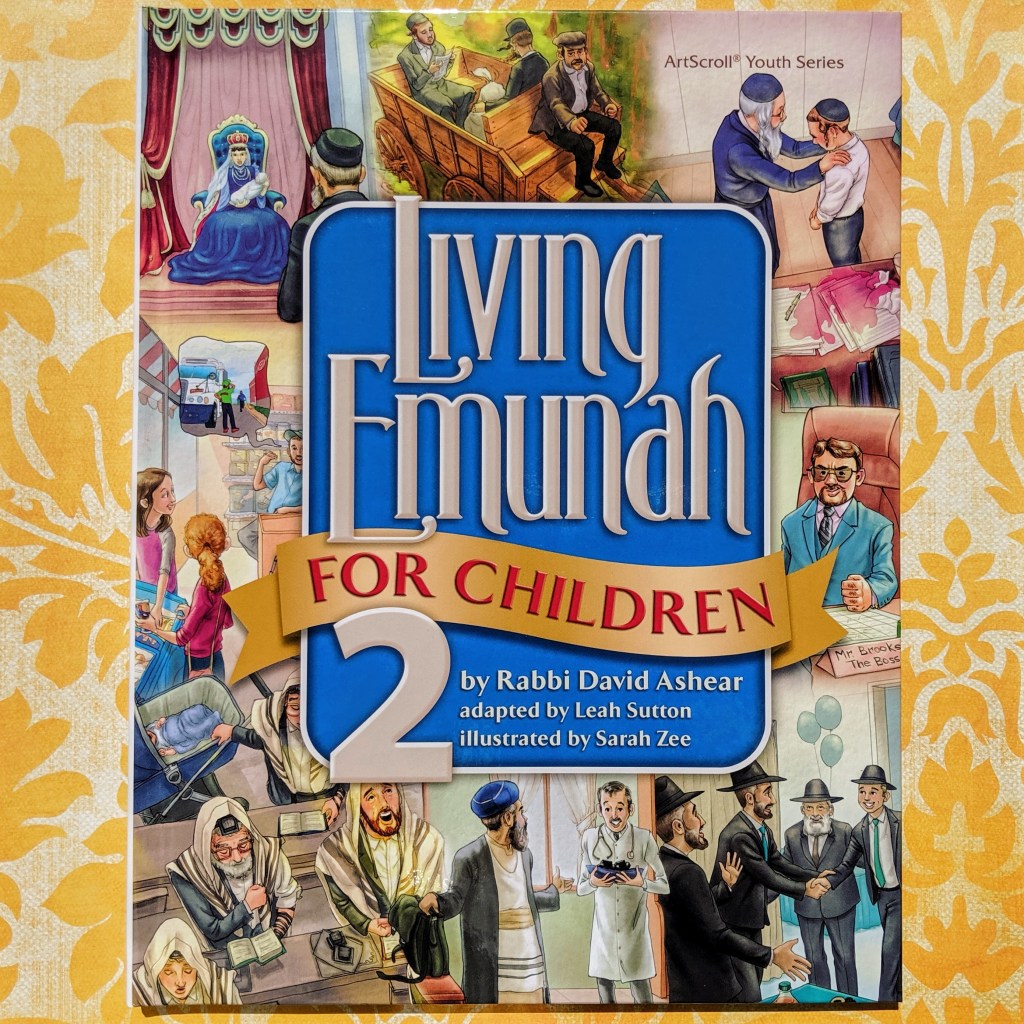
A Conversation with Leah Sutton Author of Living Emunah for Children 2

It’s never too early to show our children how much Hashem loves them and to begin instilling within them the incredible power of emunah. Following the very successful first volume of Living Emunah for Children, ArtScroll is proud to present Living Emunah for Children 2, a brand-new collection of fun and kid-friendly stories, carefully chosen and adapted from the Living Emunah series by Leah Sutton for youngsters ages 4 – 8, with delightful, full-color pictures by Sarah Zee.

We spoke with Mrs. Sutton about children, emunah, and her new book:

AS: How did you go about choosing stories from among the hundreds in the Living Emunah series?

LS: I reread some of the books that I’d loved when I was young, including many of ArtScroll’s children’s books. I thought about my childhood favorites, the books I still remember today, and I analyzed what made me love them so. Then I read through all of Rabbi Ashear’s Living Emunah books, looking for stories that could work for young people. A story with a child at its center, a story with one focus, not with many complicated details, a story with an exciting turn of events. And, of course, I got input from Rabbi Ashear.

AS: How can we inculcate even young children with emunah?

LS: Children have a certain simplicity and acceptance that makes emunah very special to them. When they hear these stories, they see themselves in them. Children often see themselves as the heroes, and in these stories the heroes are ba’alei emunah. And the heroes of these stories are often simple, everyday people, so children feel it could have been them.

AS: What is your personal favorite from among the many stories?

LS:  I love the story called “The Cry of the Baby.” Such simple hashgachah, the very day a person needed to hear a baby cry, Hashem sent that baby. Also, the story “Friendly Competition,” about a famous ice-cream manufacturer coming to the rescue of his competitor. The story was such a kiddush Hashem, it made me proud, and children love ice cream, so it was so appropriate.

AS: What was the feedback you received on the first volume of Living Emunah for Children?

LS: It was really amazing. The number of books that were sold kept going up. People who’d gotten so much out of Rabbi Ashear’s Living Emunah books had been waiting for something like this for their children.

Get your copy today at artscroll.com!

A Torah Insight from the Chasam Sofer on Parshas Korach

CHASAM SOFERKORACH

What’s in a Name

וְיִקַּח קֹרַח בֶּן־יִצְהָר בֶּן־קְהָת בֶּן־לֵוִי

Korach took — the son of Yitzhar, son of Kehas, son of Levi (16:1).

       The name Korach first appears in the Torah in Parashas Vayishlach (36:5), as the name of one of Eisav’s sons. Since that Korach presumably followed in the wicked ways of his father, it seems astonishing that Yitzhar, a righteous member of the Levi family, would give his son the same name. The Gemara (Yoma 38b) states that one should not give his child the name of a wicked person! It seems reasonable to suggest that Yitzhar in fact erred in giving his son the name Korach, for it planted seeds of evil within him, which ultimately led him to instigate the ill-fated rebellion against Moshe.

      Accordingly, we can explain why the Torah identifies Korach by listing three generations of his forebears — his father, grandfather, and great-grandfather — and why the Torah uses the particular expression וְיִקַּח קֹרַח, Korach took. The Gemara teaches that once a family has three consecutive generations of righteous people, it is natural for the succeeding generations to also be righteous (see Bava Metzia 85a; Kesubos 62b). As the verse says, וְהַחוּט הַמְשֻׁלָּשׁ לֹא בִמְהֵרָה יִנָּתֵק, A three-layer cord is not quickly severed (Koheles 4:12). Since Korach was descended from three generations of righteous men (Yitzhar, Kehas, and Levi), one would expect him to be righteous as well. Why did he turn out otherwise? Our verse addresses this question and says, ויקח קרח, Korach took. What did “Korach” take?בן יצהר בן קהת בן לוי, the son of Yitzhar, son of Kehas, son of Levi. The verse means to tell us that the name Korach, because it was originally a name of a wicked person, “took” — i.e., robbed — from this child all the sanctity that he should have attained by being the son of Yitzhar, son of Kehas, and son of Levi. His name caused him to be deprived of the merit of his illustrious forebears and to turn out the way he did (Chasam Sofer al HaTorah p. 75-76 ד”ה קרח בן יצהר).

In Memory of
R’ Yakov ben R’ Shmuel Yosef
and R’ Shimon ben R’ Moshe ע”ה 
© Copyright 2019 by MESORAH PUBLICATIONS, Ltd.

To download a printable copy, click here: Chasam Sofer – Korach

The Architect Of A Revolution – R’ Meir Zlotowitz z”l

Today, the 30th of Sivan 5779, marks the second yartzeit of R’ Meir Zlotowitz z”l. He devoted his enormous talent and indefatigable energy to spreading the light of Torah – and he succeeded in illuminating the world. He was the greatest marbitz Torah of our era, the rebbi of hundreds of thousands, the dynamo who inspired and led the “ArtScroll Revolution” that is changing the Jewish world.

Watch the video biography “The Architect Of A Revolution” and you will walk away immensely inspired.

Yehi Zichro Baruch.

Please click here to view the video: The Architect Of A Revolution

As Incredible As…. Incredible! Incredible 2! From Corporate LA to Arachim Seminars: More of the amazing true story of Rabbi Yossi Wallis by Rabbi Nachman Seltzer

Three years ago, Incredible! From the Bronx to Bnei Brak: The amazing true story of Rabbi Yossi Wallis by Rabbi Nachman Seltzer burst upon the Jewish literary scene. Tens of thousands of readers were amazed by Rabbi Yossi Wallis’s fascinating (incredible!) story of his metamorphosis from Bronx gang member to head of one of the world’s largest kiruv organizations. Readers were also astonished by the mesiras nefesh of Yossi’s family:  his grandfather, who chose death over betraying his deepest convictions; his father, who defied the Nazis with his tefilin wrapped proudly on his head as he awaited to be executed on the gallows; and – five hundred years earlier – his ancestor, who was burned in the Inquisition’s auto-da-fe.

Yes, Incredible, with more than 30,000 copies in print, left readers inspired, engaged, fascinated – and clamoring for more.

And now here it is – Rabbi Seltzer’s incredible sequel, Incredible 2! From Corporate LA to Arachim Seminars : More of the amazing true story of Rabbi Yossi Wallis.

In Incredible 2 we will join Yossi on his journey from successful weapons dealer to totally committed Torah Jew. We’ll be astonished by the hashgachah that he experiences as he decides to pay back anything that he’d taken in a manner that was against halachah. We’ll meet the people who helped him on the way: an old man who vanishes as mysteriously as he’d appeared; an even more mysterious laughing rabbi; great men such as Rav Shach zt’l and Rav Chaim Greineman zt’l, who had to restrain their eager student in his quest for greatness in Torah, until he was ready for it.

When it comes to Yossi Wallis, we know to expect the unexpected, and that’s just  as true when he’s CEO of Arachim as it was when he was a young man trying to cut his ties to the Mafia. We will see him boldly take on the “fake news” of the Israeli media when they libel the Torah community. We’ll be with him as Rav Chaim Greineman instructs him to refuse a $400,000 donation (and we’ll be astounded by the wisdom of our gedolim as we read the startling reason why). In Rabbi Wallis’s world, everything turns into a kiruv opportunity – even an FBI investigation!

Incredible 2. It’s as incredible… as Incredible!

Get your copy today at artscroll.com!