


Adapted from: The Light and the Splendor by Rabbi Daniel Glatstein
The Gemara tells us that the mitzvah of ner Chanukah is ner ish u’beiso, a candle for each man and his house. The primary obligation is that in each house a ner, candle, should be lit. Regardless of how many people reside in a specific home, one candle suffices for all of them. The obligation, in essence, is on the house; it is a chiyuv habayis.
When it comes to most other mitzvos, however, it is not so.
Pirsumei – For example, hearing the Megillah on Purim is similar to ner Chanukah in that it, too, has the objective of parsumei nisa, publicizing the miracles that occurred, yet each individual must hear the Megillah in its entirety. The obligation can never be discharged by one person in the house hearing the Megillah. Why is the mitzvah of ner Chanukah different?
I heard from Rav Isaac Bernstein in the name of one of the Roshei Yeshivah of Yeshivas Kol Torah a breathtaking insight that sheds light on this unique aspect of ner Chanukah.
Iggeres HaShmad, a letter authored by the Rambam, discusses the gezeiros that the Yevanim had enacted toward Klal Yisrael in order to sever their connection to Hashem. The Yevanim declared it illegal to learn Torah, keep Shabbos, observe Rosh Chodesh, or perform bris milah. The Rambam then introduces an additional, lesser-known gezeirah that had also been enacted.
The Rambam tells us that the Yevanim decreed that no Jew was permitted to close the door to his home. They knew that as much as they could prevent us from performing mitzvos publicly, we would still continue to perform mitzvos in the privacy of our own home. To prevent this, they outlawed closing the door. Open front doors, they felt, could prevent us from doing any mitzvah.
The Midrash L’Chanukah states that the Yevanim decreed that any Jew who locked his door would receive the death penalty. A closed door provides security, dignity, privacy, modesty, and a sense of freedom. The Yevanim wanted to deprive us of all of these. Without a door, any passerby is welcome to enter uninvited at any time. The Midrash states that any house that has no door has no dignity or modesty.
When this decree went into effect, the Jews removed all their doors. They were unable to eat or drink, out of fear of Yevanim who could enter at any time. They did not sleep at all, concerned that Yevanim thieves would rob them while they slept.
We can now fully appreciate why Chazal decreed that the mitzvah of ner Chanukah should be on the home rather than on the individual. In addition to trying to abolish Torah and mitzvos, the Yevanim waged an all-out assault on kedushas habayis, the dignity of the Jewish home. Therefore, through the mitzvah of ner Chanukah, it is incumbent on each person to restore the sanctity of the Jewish home.
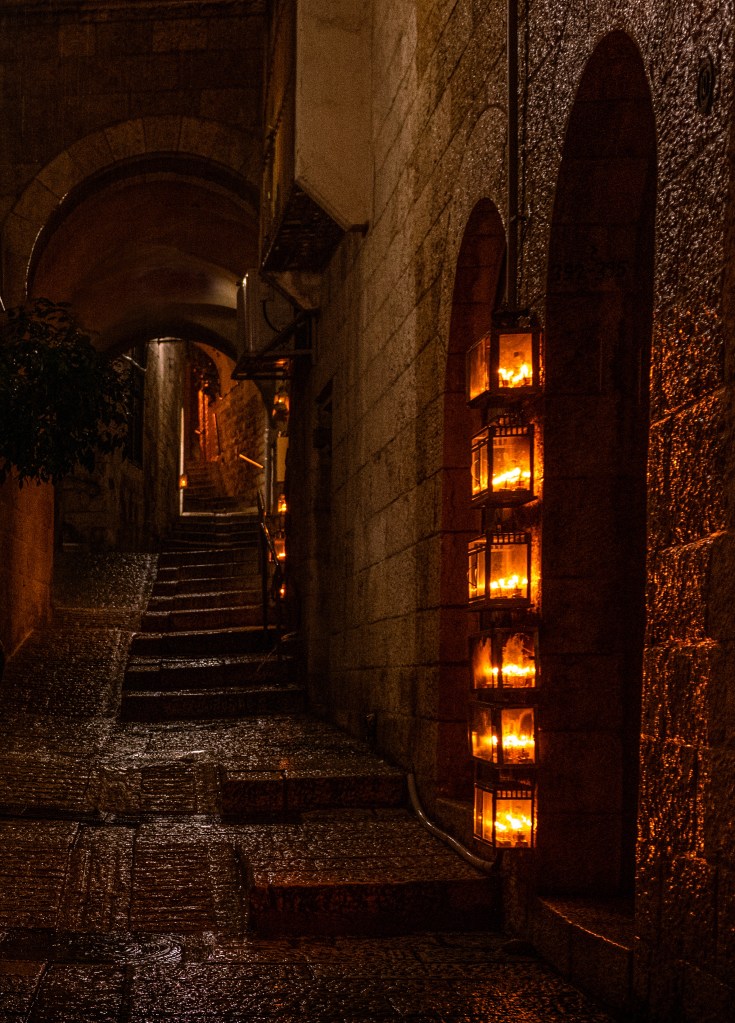
Furthermore, the mitzvah was originally designed to place the menorah at the doorpost, in the home’s entryway. The Yevanim sought to destroy the sanctity of our homes, which is preserved by the door and our ability to lock it to block entry of that which is antithetical to our faith. On Chanukah, we therefore demonstrate restoration of the kedushah by placing the menorah right next to our front doors, the very doors that they had prevented us from locking.







 The Official ArtScroll Blog