

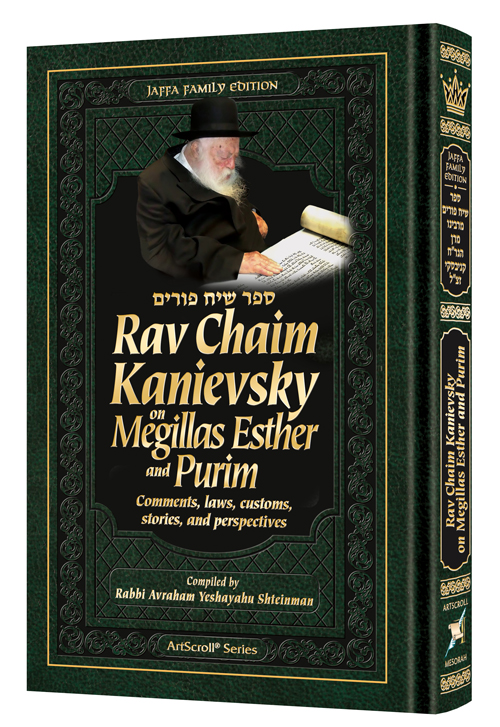
Adapted from: Rav Chaim Kanievsky on Megillas Esther and Purim compiled by Rabbi Avraham Yeshayahu Shteinman
When Rav Shteinman taught at the yeshivah in Kfar Saba, he wrote the following lecture as a bar mitzvah speech for a student of his; the bar mitzvah took place on the Shabbos before Purim (Parashas Zachor), 1947. [It is presented here in abridged form.]
The Torah commands us (Devarim 25:17): Remember what Amalek did to you. This mitzvah is one of the sheish zechiros, the six remembrances, the six matters that the Torah instructs us to remember every day [the six remembrances are found in most siddurim after Shacharis]. However, remembering what Amalek did does not seem to be at all like the other five remembrances. The other remembrances are those that apply at all times, and we are thus instructed to remember them at all times. For example, we are instructed to Remember the Shabbos day (Shemos 20:8); we do this by preparing for Shabbos the entire week. We are commanded to Remember what Hashem, your God, did to Miriam (Devarim 24:9); we do this by recalling that Miriam was punished with tzaraas when she spoke lashon hara about her brother Moshe (Bamidbar Ch. 12), and we are inspired to refrain from lashon hara. The commandment to destroy the memory of Amalek, though, is not a mitzvah that is relevant to us every day; it is a mitzvah that can be fulfilled only when we have a Jewish king who will declare war against the nation of Amalek. Why does the Torah instruct us to remember Amalek every day?

The answer can be found in the Gemara’s description of an encounter between Mordechai and Haman. The Gemara relates (Megillah 16a) that when Haman came to Mordechai, at the behest of Achashveirosh to dress him in royal robes, Haman found Mordechai teaching his students. Haman asked Mordechai what he was teaching. Mordechai responded, “I am teaching the laws of kemitzah. When the Beis HaMikdash was standing, a person would bring a measure of flour as a minchah-offering. The Kohanim would bend the three middle fingers over his palm, scoop out flour, and burn it on the Altar; this scoop of flour, known as a kemitzah, would atone for the person bringing the offering.” Haman responded, “Your three-fingersful of flour has overpowered the 10,000 talents of silver I was willing to pay Achashveirosh to have your people annihilated.”
With this exchange, Chazal taught us how Mordechai succeeded in overpowering Haman: As Haman said, it was the three-fingersful of flour that outweighed Haman’s money. That is, it was Mordechai’s study of Torah — teaching the laws of the kemitzah — that overpowered Haman’s plot. The study of Torah was the weapon Mordechai used — the weapon that the Jews are to use — in the battle against Amalek. Of course, the fight against Amalek has a physical component as well — the obligation of destroying the people of Amalek — but that component applies only at specific times: when there is a Jewish king who declares war against Amalek. Perhaps the primary element of the fight against Amalek, though, is the spiritual aspect; that aspect of the battle applies at all times, and that is what we are commanded to remember every day.

What is this spiritual aspect? Amalek was the nation who attacked the Jews when they left Egypt, with no provocation, simply to show that it is possible to attack Hashem’s nation. Amalek thus represents the fight against Hashem. Our means of fighting this is by strengthening our service of Hashem and our trust in Hashem. This weakens the negative spiritual force that Amalek represents in the word.
In truth, without succeeding in this spiritual fight, we cannot even succeed in the physical war against Amalek. Thus, when Yehoshua led the Jewish people in their initial battle against Amalek, Moshe sat above them with his hands raised to the heaven. As long as Moshe’s hands were upraised, the Jews were victorious against Amalek (Shemos 17:11). The Mishnah (Rosh Hashanah 3:8) explains this phenomenon: Can the hands of Moshe make or break [their success in] battle? Rather [Moshe’s hands inspired the Jews to look heavenward.] When the Jews would look heavenward, they would humble their hearts to their Father in Heaven and they would be victorious. This Mishnah teaches that the Jews could not be successful in the physical battle against Amalek unless they were also succeeding in the spiritual aspect of the battle.


 The Official ArtScroll Blog