

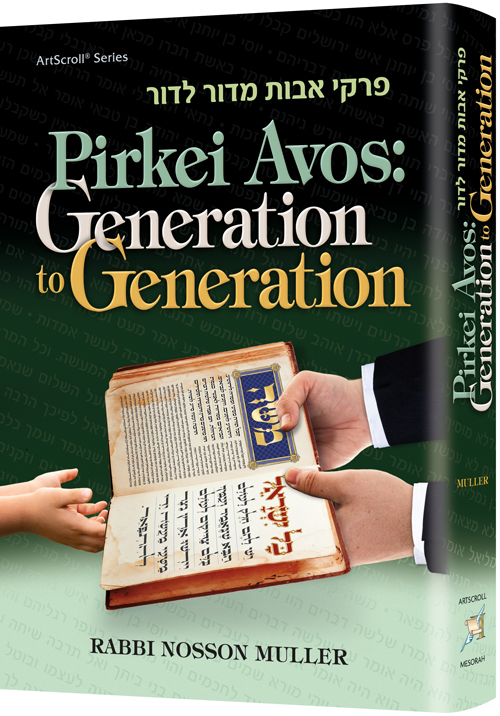
Adapted from: Pirkei Avos: Generation to Generation by Rabbi Nosson Muller
אַשְׁרֵי יוֹלַדְתּוֹ — praiseworthy is she who bore him. (Pirkei Avos 2:11)
There can be no nicer words in the dictionary that one can tell a parent in regard to their child than these two words the mishnah states here about R’ Yehoshua. Rashi explains that these words describe a person who is highly accomplished in both his Torah learning and interpersonal abilities. Rabbeinu Yonah expounds on how we find throughout Scripture that the word “ashrei” signifies an all-encompassing title of the finest character traits man can attain. In short, R’ Yehoshua was someone any parent would be proud to call their son.
The mefarshim go on to explain that it was actually the great merits and sacrifice of R’ Yehoshua’s mother that enabled her to raise such a model child. Even before he was born she would go from beis medrash to beis medrash, pleading with the Rabbis to please pray that the child she was carrying in her womb would grow up to be a talmid chacham.

Additionally, the Yerushalmi (Yevamos 1:6) recounts that when R’ Yehoshua was a young child still in a carriage, his mother would wheel him to the study halls where the chachamim were learning so that the sounds of the holy words of Torah would enter her young child’s ears.
What a powerful lesson! Chinuch does not begin when our child displays his ability to pronounce the alef-beis for the first time. It starts way before then — even before he is born! It is only with parents’ consistent and uncompromised commitment to do everything in their power to ensure that their children are being brought up with the utmost care and kedushah that, with Hashem’s help, they will ultimately succeed in raising their children to be the best they can be.
The following few paragraphs were adapted from the sefer, Relevance, written by my dear friend, R’ Dan Roth. They are well worth the read as the penetrating message they contain is a crucial and ever-so-relevant key to creating a true Jewish home:

A young child might be unable to talk, walk, or behave appropriately, but these are all aspects of his physical immaturity. His soul, however, is not limited by these physical constraints and discerns every bit of kedushah, benefiting from even the smallest pinpoint. Similarly, it discerns every bit of impurity and is impoverished accordingly.
Hosting a shiur, learning with a chavrusah, or having father and son learn aloud together in one’s home creates an atmosphere that is literally contagious and impactful beyond the actual minutes the learning lasts. It can be life altering. Unfortunately, the opposite effect can happen as well. People really convince themselves that no harm can be done when the children see or hear things when they are very young. Yet Chazal clearly teach us otherwise, as the harmful impact that is cemented into a child during his adolescent and most crucial developmental years is immense and everlasting. Everything a child sees and hears affects him eternally.
Researchers are just beginning to discover what Chazal have known all along: that fetuses are affected by outside influences. Read on.

Anthony Casper, a psychologist at the University of North Carolina, had expectant mothers read aloud Dr. Seuss’s classic book, The Cat in the Hat, twice a day to their unborn child. A few days after their birth, the newborns were given the opportunity to hear a different Dr. Seuss story from their mothers in addition to The Cat in the Hat. The babies were outfitted with a special feeding contraption that measured their familiarity and attention through the rhythm of their sucking.
As demonstrated by their sucking speed, the newborns 1) remembered The Cat in the Hat 2) liked it better than the second story 3) adjusted their sucking upon hearing the familiar story over the newer story 4) preferred to hear the story when it was read to them by their mother 5) showed preference when it was read to them in order rather than backward.
Need we say more?

 The Official ArtScroll Blog