


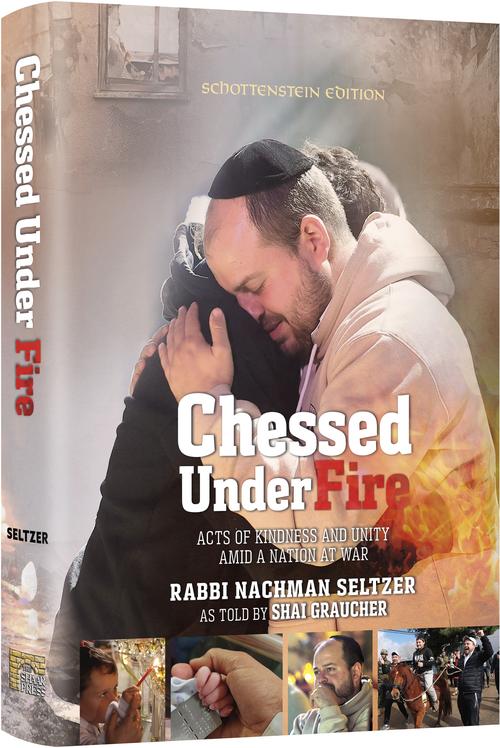
Adapted from: Chessed Under Fire by Rabbi Nachman Seltzer
Just because there was a war going on and Israel was fighting on five different fronts didn’t mean that the terrorists inside the country had stopped trying to harm Jews. With the army preoccupied, they saw opportunities to attack innocent civilians. And while most plots were stopped — some slipped through.
One such attack took place at the entrance to Yerushalayim. Several were killed, and others badly injured.
“On the day of the attack,” Shai recalls, “I was at Hadassah Hospital and entered the room of a chareidi girl who had been wounded in the attack earlier that day. Her mother sat at her bedside.
“What can I do for you that will cheer you up?” he asked gently.
He expected her to ask for a computer, or perhaps a new jacket — hers had been ripped by a bullet. But her answer caught him completely off guard.
“There’s only one thing I want,” she said, eyes brimming with tears. “My father is a rosh kollel. He travels to America often to raise funds. It’s hard when he’s away, for us and for him. If you could somehow help him stay in Israel without needing to travel, I’d be so happy.”
Shai was deeply moved. Of all the things she could have asked for, she chose something so selfless — to give her father peace of mind so he could stay home and learn.
“First things first,” Shai said with a smile. “I’m giving you money to buy a new jacket. And now, what’s your father’s phone number?”
She gave it, and moments later, Shai was speaking with him.
“Shalom aleichem. I’m here with your daughter. She didn’t ask for anything for herself — she just wants to help you. How many avreichim are in your kollel?”
The man gave the number.
“Great. We’re wiring you twenty-six thousand dollars right now. It’s 2:30 p.m. You’ll see it in your account by 4:30.”
Shai had helped distribute millions for Rav Chaim Kanievsky zt”l over the years, especially before Yom Tov. But the joy he felt in transferring those $26,000 was unlike anything else. It was a zechus — an honor — to help a rosh kollel spend more time at home and learning Torah.
As he hung up, the hospital room filled with spontaneous song. Everyone — family, visitors, Shai’s helpers — burst into “Mah Ashiv LaShem,” praising Hashem for the opportunity to bring happiness to a girl who’d been shot for no reason other than being a Jew — and to her father, who devoted himself to Torah.
But that was just the beginning.
Someone in Lakewood who had followed Shai’s updates reached out. “I saw you gave $26,000 to a rosh kollel. I want to match it.” Soon after, a campaign was launched, and it didn’t take long to raise the full amount. Now the rosh kollel had been gifted a total of $52,000 — enough support to remain focused on learning for months.
Months later, while biking with his sons in Har Nof, Shai stopped for a rest. A yeshivah bachur approached and suddenly burst into tears.

Shai jumped off his bike. “What’s wrong? Do we know each other?”
The bachur shook his head. “No. But I have to tell you something.”
He explained how, even before the war, he had been spiraling spiritually. Learning had become difficult. He eventually left yeshivah, deciding instead to cook for soldiers and find other ways to help.
“One day I found out about the girl who was shot — and how all she wanted was help for her father’s kollel. That changed me. I felt something spark inside. I dropped everything and returned to yeshivah.”
He smiled. “I’ve been back for seven months now. I’m learning three sedarim a day, and today I’m one of the top boys in my yeshivah — all because you shared that story.”
Two days later, Shai spent Shabbos in Petach Tikvah. After davening, while waiting for his mother, a woman approached him.

“Are you Shai Graucher?”
He nodded.
“My son met you in Yerushalayim and told you how that story changed his life.”
“I remember.”
“You don’t understand,” she said. “He doesn’t just learn now — he loves it. That girl could’ve asked for anything. But she asked for Torah support — and that changed my son forever.”
As Shai walked home with his mother, he reflected on how one act of kindness, one moment of selflessness, could ripple across the world, transforming people he had never even met. It felt like a kiss from Hashem — a clear message to keep going, keep helping, and keep spreading light.



 The Official ArtScroll Blog