
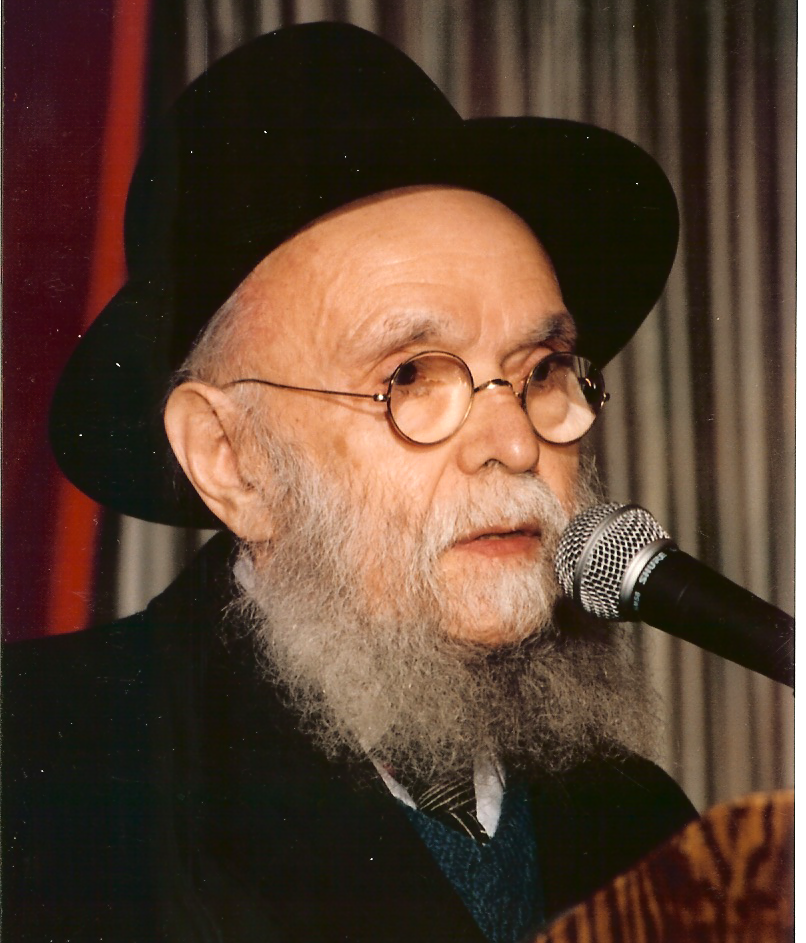
Adapted from: Rav Pam on the Parashah by Rabbi Sholom Smith
וְאֶעֶשְׂךָ לְגוֹי גָּדוֹל וַאֲבָרֶכְךָ וַאֲגַדְּלָה שְׁמֶךָ וֶהְיֵ’ בְּרָכָה. — I will make of you a great nation; I will bless you, and make your name great, and you shall be a blessing (Bereishis 2:2).
Rashi notes that when Hashem commanded Avraham to leave his country, his birthplace, and his father’s house, He gave him three blessings to counteract three detrimental effects of long-distance travel: The diminishment of the possibility of having children, the loss of wealth, and the loss of fame. Hashem blessed him that he would become the father of a great nation, would be blessed with enormous wealth and would gain world-wide renown.
The first two berachos are easy to understand. Avraham longed for a son who would continue his life’s work of publicizing the existence of a Creator, and who would in turn produce a great nation of believers in Hashem.
Avraham needed wealth as the means of continuing his remarkable chesed activities, his hachnasas orchim and tzedakah. All these things required large sums of money to uphold and expand. But why did Avraham need to have a great name? Can it be that Avraham was hungry for publicity and renown, things that seem to be the very antithesis of all that he stood for?
It must be that until the time when Avraham left his birthplace, his name commanded little respect in the eyes of the populace. If anything, he was considered a radical and revolutionary who wished to overthrow the system of pagan belief that most people held. He had destroyed the idols of his father and had defied the mighty King Nimrod (see Rashi 11:28) who had thrown him alive into the fiery furnace of Ur Kasdim. He was Avram the Ivri (14:13); the Midrash (Bereishis Rabbah 42:8) says that he was called this because the whole world was on one side, while Avraham alone was on the other side. He refused to practice idolatry like everyone else, instead espousing belief in one G-d. Thus, his name was certainly not mentioned with honor or reverence.

However, now that he was moving to a new land and was beginning a new phase of his life, he needed the blessing of a good name to attract followers and bring them under the wings of the Shechinah. No more do we find Avraham destroying idols or boldly defying people like Nimrod. Now, as the Torah recounts in the following parshiyos, Avraham became a N’si Elokim, prince of G-d (23:6) in the eyes of the neighboring people and was treated with great respect and reverence by many of them.
The Chofetz Chaim comments on a Mishnah in Pirkei Avos (4:17) that teaches that the crown of a good name surpasses even the crowns of Torah, Kehunah, and malchus. The crown of a good name was Avraham’s most effective tool in his efforts to bring people to a recognition of their Creator. With Avraham’s exceptional trait of chesed, his goodness of heart, and his concern for his fellow human beings, coupled with his warm, pleasant, caring personality, he was able to attract many thousands of people to a belief in One G-d.
In our time the same holds true. In order to be effective in kiruv rechokim (outreach efforts), one must have exemplary middos and true ahavas Yisrael. These traits serve as a magnet to attract people to Yiddishkeit, because the seekers see in him what Torah observance makes a person into, and they wish to be close to him and to emulate his lifestyle. This is the value of a “good name” with which Hashem blessed Avraham and which is a necessity in our times to bring fellow Jews back to their roots.



 The Official ArtScroll Blog