A Conversation with Rabbi Heshy Kleinman Author of Living With Hashgachah Pratis

AS: We all have heard what are called “hashgachah pratis stories” — like the man who went to minyan and missed the plane that crashed — but there’s so much more to it. Can you briefly tell us what hashgachah pratis is — and what it means to our lives?

RHK: Hashgachah pratis is our awareness of Hashem’s constant involvement in our world. What does it mean to our lives? Let’s look at a paraphrased quote from Living With Hashgachah Pratis:

When we internalize Hashem’s perpetual influence in our lives, it can reshape our perspective on life, turning every experience into a moment of gratitude, enabling gratitude to become second nature. Life — every breath, heartbeat, and fleeting moment — becomes a wondrous journey, enhanced by Hashem’s omnipresent care and love …. Even struggles and adversities are not mere hurdles; rather, they are specifically designed challenges meant to mold us, enabling growth and resilience, making us stronger and greater in the process …. When we feel Hashem’s hashgachah pratis in our daily struggles, it enables us to convert them into eternally rewarding spiritual growth.  

AS: The book contains more than 125 stories about hashgachah pratis in everyday life. How did you go about finding so many fascinating stories?

RHK: I don’t mean to give a “cute” answer, but it was hashgachah pratis. I heard some stories, experienced some, “accidentally” came across some, read some, researched some. But the fact that they all wound up in this book is truly Hashem’s hashgachah pratis, to be mechazek us in Living With Hashgachah Pratis.  

AS: Do you have any tips to help us strengthen our awareness of Hashem’s hashgachah pratis?

RHK: It is important for people to be mechazek themselves by keeping a personal journal of their own hashgachah pratis stories. Rav Moshe Feinstein, Rav Yaakov Kamenetsky, and Rav Yechezkel Levenstein advocated keeping a personal journal of hashgachah pratis stories in one’s daily life, as an effective means for personal chizuk. And readers can inspire others with their personal hashgachah pratis stories by sending them to HPratisStories@gmail.com, or by visiting https://vanitefillah.org, for inclusion in the next volume on hashgachah pratis. (Personal identifying information will be removed upon request.)

Order your copy TODAY on ArtScroll.com

Life — every breath, heartbeat, and fleeting moment — becomes a wondrous journey….

WATCH: Inside ArtScroll Season 5:4: Rabbi Joey Haber – Vayimaen

In this entertaining Inside ArtScroll Interview, Rabbi Joey Haber, rabbi of the Magen David shul in Flatbush and the Beit Yosef shul in Deal who has inspired tens of thousands of people worldwide with his talks, discusses the impact of the Vayimaen movement and the new book by Rabbi Yechiel Spero based on the inspiration of the renowned speakers of the global Vayimaen initiative.

Purchase your copy of Vayimaen on ArtScroll.com

On the go? Also available to stream on all major Podcast platforms!

The Vayimaen Revolution Continues!

Vayimaen, the newly-released book by Rabbi Yechiel Spero, captures a revolution — and helps to strengthen it even more!

In just one year since its inception, more than 60,000 people have learned how to see a better world by joining the Vayimaen revolution. They’ve signed up for daily inspiration from 100+ world-renowned rabbanim and personalities who offer daily insights on beautifully crafted and incredibly inspiring video clips.  

Members of this Vayimaen revolution have learned about the greatness — and the satisfaction and happiness — that comes from accessing the strength and, yes, the kedushah that dwells within us all. As Yosef HaTzaddik did so many generations ago, they’ve discovered the power of “vayimaen” — the happiness and serenity that we achieve when we live our own authentic lives, not seeking them elsewhere.

Now Rabbi Yechiel Spero, who has engaged and inspired us with so many bestselling and beloved books, moves the revolution forward with a new book based on the stories, anecdotes, and divrei Torah of the Vayimaen speakers, and including his own novel ideas and stories.

In Vayimaen, we will learn not to compare our lives with others and to live the best life we can. We’ll discover how to look at the world, and the people around us, with positivity and caring, to overcome roadblocks and seize opportunities for personal growth. We will learn from a large variety of Torah sources how every moment of rising above temptation is laden with untold blessings and salvations. We’ll learn how to dream of greatness and, yes, how to achieve it, one challenge at a time.

This book reawakens the truth that authentic happiness lies not in the allure of society, but rather in the haven of purity that exists within us.

More than 60,000 people have learned how to see a better world by joining the Vayimaen revolution.

Order your copy of Vayimaen today on ArtScroll.com

Watch: Rav Moshe Tuvia Lieff On the Impact of the Vayimaen Movement!

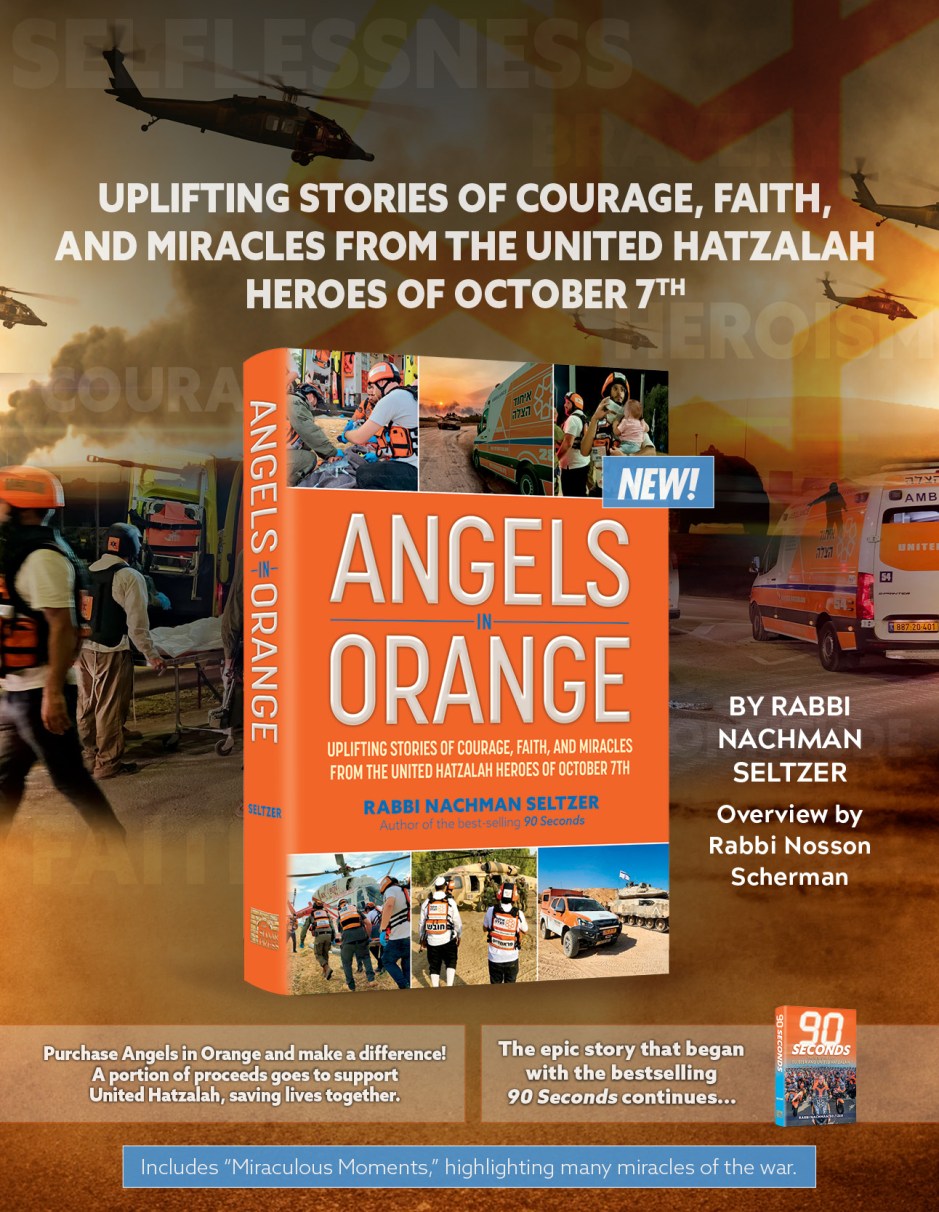
A Conversation with Rabbi Nachman Seltzer – Author of Angels in Orange

AS: How did you feel when United Hatzalah president, Eli Beer, first told you about the miracles that his volunteers — more than 1,700 (!) of them — experienced on October 7, when they raced to the battleground to rescue the wounded?

RNS: I was very proud of the volunteers for being willing to be moser nefesh for Klal Yisrael on such an incredible level!

AS: The subject of the book is so difficult, and yet this is a book that uplifts rather than frightens. How did you manage to make this so inspiring?

RNS: It’s about what you choose to focus on. I could have focused on how terrible the whole situation was (and still is). Instead, we look at and are truly inspired by the courage and caring of the volunteers, and by the amazing miracles that happened and continue to happen all the time.

AS: What was it like, speaking to people about their experiences under fire?

RNS: I conducted many, many interviews. Most of the volunteers wanted to talk. If someone did not want to speak about their experiences, we respected that and canceled the interview. Speaking to the volunteers was challenging at times, since some of them used our sessions as an informal type of therapy. Some of them were still shellshocked by what they’d been through, though it was a few weeks afterward. Others described what they had seen in graphic detail and I had to tone things down for my readers. We cried together and laughed together and they transported me to the places they had been and to the moments of great danger they experienced, and, of course, how Hashem helped them rescue hundreds of our brothers and sisters.

AS: Is there one lesson that you hope readers will take away when they read Angels in Orange?

RNS – That nothing random happened on Simchas Torah. Every person who was down there was there as part of Hashem’s plan. People whom Hashem chose to live were in the most dangerous situations — terrorists on all sides — being shot at — but they walked out without a scratch. Someone was in control and Someone had a plan, and we need to remember this and not to feel that we are helpless. Because we are not helpless. We have the greatest and most effective weapon on our side: Hashem.

We have the greatest and most effective weapon on our side: Hashem.

Buy your copy of Angels in Orange TODAY on ArtScroll.com

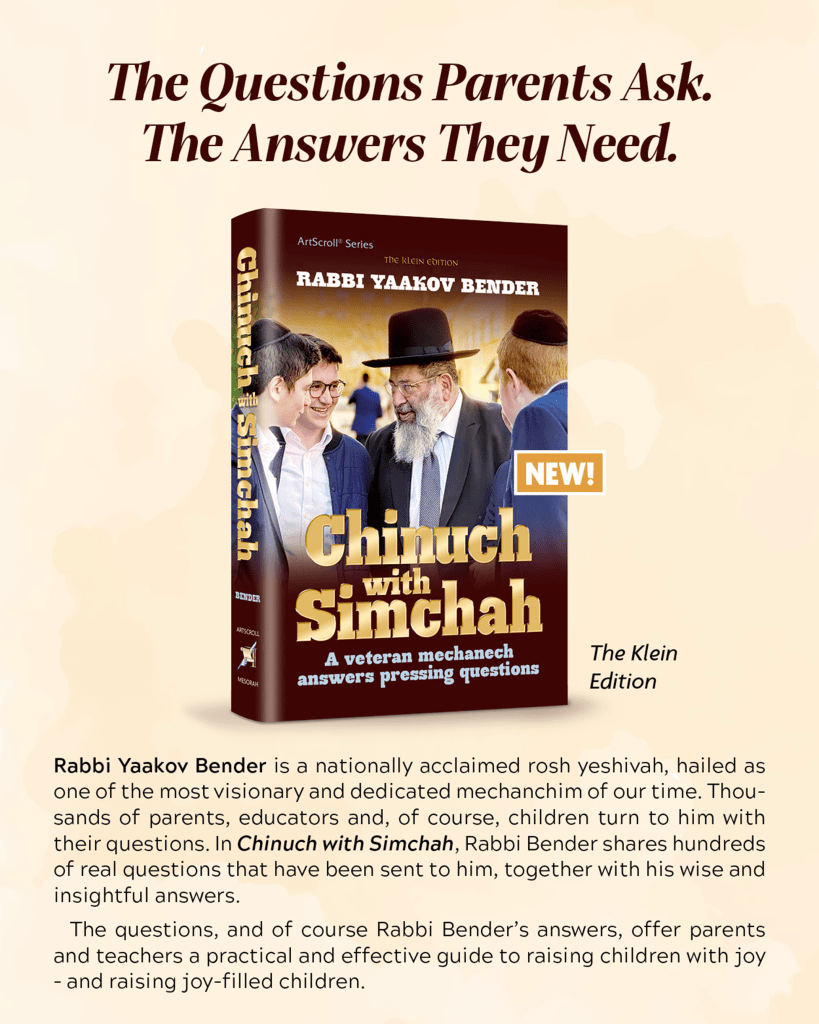
Short. Practical. And very, very wise. Chinuch with Simchah by Rabbi Yaakov Bender

Mothers and fathers. Morahs and rebbeim and even principals and menahalim. Especially in these challenging times, they have so many questions on chinuch. So many questions … and here is an address for all those looking for sensible and practical answers, firmly rooted in our Torah wisdom: Rabbi Yaakov Bender, Rosh Yeshiva of Yeshiva Darchei Torah in Far Rockaway.

Rabbi Bender is a nationally acclaimed Rosh Yeshivah who has made Darchei Torah one of the country’s premiere schools and who travels the world speaking about chinuch issues. Chinuch with Simchah, the fourth in his much-hailed series, once again allows parents to benefit from Rabbi Bender’s wisdom, experience, insight, and sensitivity.

Will giving a child a “kosher” MP3 player open the door to dangerous technology, or will it prevent the child from discovering more problematic devices? At what age is it appropriate for a child to go to the funeral of a grandparent? Eretz Yisrael is at war, and my twelve-year-old daughter wants to go to an ice-cream party. Should we tell her it’s inappropriate? How should I, as a parent, and my child deal with a playground bully? And what if the bully is an adult?

In Chinuch with Simchah, Rabbi Bender gives us answers to these, and to more than 200 other pressing questions. He includes both specific guidelines and also discuss the principles of chinuch and parenting on which his advice is based.

It is quite extraordinary how much is contained in these brief questions and answers. We learn when and how to discipline and when to look away, how to understand our children’s lives and worldview, how to foster respect without creating distance. And, yes, how to raise Torah-true, stable, happy and “mentschlich” children even in the 21st century. Though the answers are brief and to the point, we can feel the warmth and love Rabbi Bender has for every child — and his decades of experience in handling the myriad challenges of modern-day chinuch.

Purchase your copy of Chinuch with Simcha today on ArtScroll.com!