Faith Amid the Flames: The Story of Reb Yosef Friedenson

ArtScroll spoke with Rabbi Yosef Chaim Golding, who compiled and edited the autobiography of his father-in-law, Reb Yossel Friedenson.

AS: Faith Amid the Flames is a stunning autobiographical portrait of Reb Yossel Friedenson z”l. We get to know him through his writings and speeches, and through interviews conducted with him over the years. How did you go about compiling all these different sources into one work?

RYCG: I viewed about 100 hours of video interviews, editing, compiling, and editing some more … plus I worked from 6 hours of transcribed cassette tape discussions between us. And, of course, I had his extensive writings to draw upon.

AS: Where did Reb Yossel’s incredible moral courage and emunah have its roots?

RYCG: Unquestionably, they were from his father, Rav Eliezer Gershon Friedenson Hy’d, who accomplished so much for Klal Yisrael, all before he was incarcerated in the Warsaw Ghetto at the age of 39.

AS:  There is so much suffering in these pages, yet this book is uplifting and, yes, even optimistic. How did you (and Reb Yossel) make that happen?

RYCG: It wasn’t me; it was all him. He always spoke about the positive things that he witnessed; he let the secular historians dwell on the pain and suffering.

AS: Reb Yossel was the unofficial spokesman of the entire generation of survivors. What was the overriding message that Reb Yossel left for the generations that followed?

RYCG:  In his own words:

“The first thing I learned is that there is a Hashgachah Elyonah on every one of us, at all times. If I personally survived, it is because there is an Ayin roeh, a watchful Eye, Who kept me alive in spite of the reshaim who wanted to kill me.

“Secondly, I saw how Jews differ from the other nations. We are an am hanivchar. We are rachmanim and gomlei chassadim. Even those who, chalilah, go astray still have in them some of these elevated middos tovos.

“The third, and by far the most important, lesson that I internalized was that Klal Yisrael is truly eternal, indestructible, and will always outlive their oppressors and those who wish to destroy them. The same is true for our eternal Torah.

“The secular world lauds the Jews who physically resisted the Germans. But much greater was the spiritual resistance of those whose faith in Hashem never wavered, even under the most torturous conditions.”

Get your copy of this phenomenal book today at artscroll.com

A Torah Insight from the Chasam Sofer on Parshas Chukas

CHASAM SOFERCHUKAS

The Divine Wisdom

זאת חקת התורה

This is the decree of the Torah (19:2).

            Inpresenting the laws of Parah Adumah, the Red Cow, the Torah describes it as the “decree of the [entire] Torah.” Why doesn’t it say simply “This is the decree of the Parah Adumah”?

            We can explain this on basis of the verse אמרתי אחכמה והיא רחוקה ממני, I thought I could become wise, but it is beyond Me (Koheles 7:23). The Sages (Yoma 14a) teach that Shlomo HaMelech said this in reference to Parah Adumah. He said that although he had understood the reasons and significance of all the other mitzvos, the meaning of this mitzvah eluded him. It seems, however, that when Shlomo said, “… but it is beyond me,” he did not merely mean that this one mitzvah was too deep for him to grasp. He meant, rather, that his failure to fathom this mitzvah proved to him that even his comprehension of the other mitzvos was incomplete. He realized that the depth of Divine wisdom in each of the mitzvos is beyond the capacity of human intellect. Thus, Shlomo said, “I thought I was wise,” because I had a comprehension of all the mitzvos and thought that I understood them fully. “But”— in truth — “it is beyond me”; I now recognize that even what I thought I understood is actually beyond me. The mitzvos have depths of meaning that even the wisest of men could not fathom.

            This is why the parashah begins with a statement that reflects on the entire Torah — This is the decree of the Torah. As Rashi explains, the term חקה, decree, indicates that the subject defies human comprehension: It is Hashem’s decree, which we must follow even though we cannot understand it. But it is not only the mitzvah of Parah Adumah that is Hashem’s decree. This mitzvah shows us that the entire Torah is actually His decree, for even if we think we understand something, the depths of Divine wisdom are in truth unfathomable (Toras Moshe HaShalem, p. 86 ד”ה זאת חקת התורה (ג)).

In Memory of
R’ Yakov ben R’ Shmuel Yosef
and R’ Shimon ben R’ Moshe ע”ה 
© Copyright 2019 by MESORAH PUBLICATIONS, Ltd.

To download a printable copy, click here: Chasam Sofer – Chukas

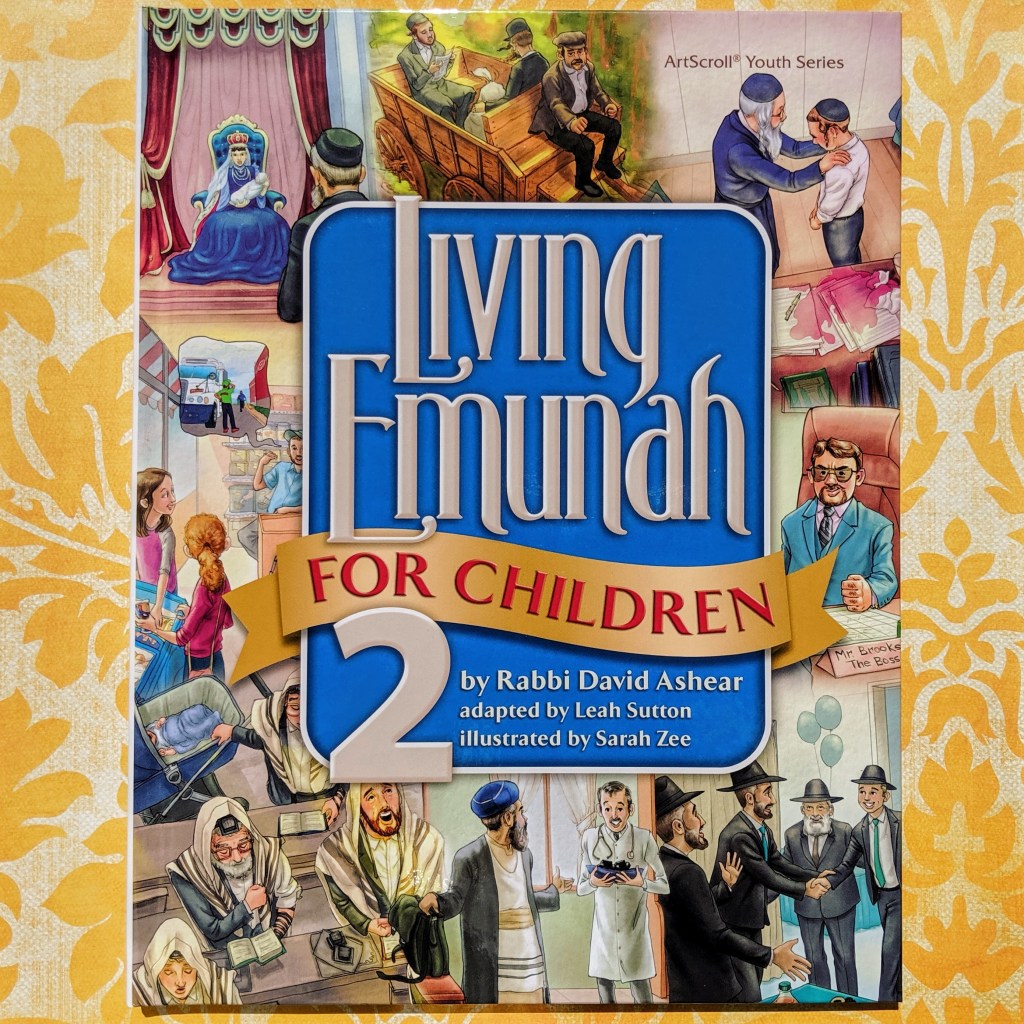
A Conversation with Leah Sutton Author of Living Emunah for Children 2

It’s never too early to show our children how much Hashem loves them and to begin instilling within them the incredible power of emunah. Following the very successful first volume of Living Emunah for Children, ArtScroll is proud to present Living Emunah for Children 2, a brand-new collection of fun and kid-friendly stories, carefully chosen and adapted from the Living Emunah series by Leah Sutton for youngsters ages 4 – 8, with delightful, full-color pictures by Sarah Zee.

We spoke with Mrs. Sutton about children, emunah, and her new book:

AS: How did you go about choosing stories from among the hundreds in the Living Emunah series?

LS: I reread some of the books that I’d loved when I was young, including many of ArtScroll’s children’s books. I thought about my childhood favorites, the books I still remember today, and I analyzed what made me love them so. Then I read through all of Rabbi Ashear’s Living Emunah books, looking for stories that could work for young people. A story with a child at its center, a story with one focus, not with many complicated details, a story with an exciting turn of events. And, of course, I got input from Rabbi Ashear.

AS: How can we inculcate even young children with emunah?

LS: Children have a certain simplicity and acceptance that makes emunah very special to them. When they hear these stories, they see themselves in them. Children often see themselves as the heroes, and in these stories the heroes are ba’alei emunah. And the heroes of these stories are often simple, everyday people, so children feel it could have been them.

AS: What is your personal favorite from among the many stories?

LS:  I love the story called “The Cry of the Baby.” Such simple hashgachah, the very day a person needed to hear a baby cry, Hashem sent that baby. Also, the story “Friendly Competition,” about a famous ice-cream manufacturer coming to the rescue of his competitor. The story was such a kiddush Hashem, it made me proud, and children love ice cream, so it was so appropriate.

AS: What was the feedback you received on the first volume of Living Emunah for Children?

LS: It was really amazing. The number of books that were sold kept going up. People who’d gotten so much out of Rabbi Ashear’s Living Emunah books had been waiting for something like this for their children.

Get your copy today at artscroll.com!

A Torah Insight from the Chasam Sofer on Parshas Korach

CHASAM SOFERKORACH

What’s in a Name

וְיִקַּח קֹרַח בֶּן־יִצְהָר בֶּן־קְהָת בֶּן־לֵוִי

Korach took — the son of Yitzhar, son of Kehas, son of Levi (16:1).

       The name Korach first appears in the Torah in Parashas Vayishlach (36:5), as the name of one of Eisav’s sons. Since that Korach presumably followed in the wicked ways of his father, it seems astonishing that Yitzhar, a righteous member of the Levi family, would give his son the same name. The Gemara (Yoma 38b) states that one should not give his child the name of a wicked person! It seems reasonable to suggest that Yitzhar in fact erred in giving his son the name Korach, for it planted seeds of evil within him, which ultimately led him to instigate the ill-fated rebellion against Moshe.

      Accordingly, we can explain why the Torah identifies Korach by listing three generations of his forebears — his father, grandfather, and great-grandfather — and why the Torah uses the particular expression וְיִקַּח קֹרַח, Korach took. The Gemara teaches that once a family has three consecutive generations of righteous people, it is natural for the succeeding generations to also be righteous (see Bava Metzia 85a; Kesubos 62b). As the verse says, וְהַחוּט הַמְשֻׁלָּשׁ לֹא בִמְהֵרָה יִנָּתֵק, A three-layer cord is not quickly severed (Koheles 4:12). Since Korach was descended from three generations of righteous men (Yitzhar, Kehas, and Levi), one would expect him to be righteous as well. Why did he turn out otherwise? Our verse addresses this question and says, ויקח קרח, Korach took. What did “Korach” take?בן יצהר בן קהת בן לוי, the son of Yitzhar, son of Kehas, son of Levi. The verse means to tell us that the name Korach, because it was originally a name of a wicked person, “took” — i.e., robbed — from this child all the sanctity that he should have attained by being the son of Yitzhar, son of Kehas, and son of Levi. His name caused him to be deprived of the merit of his illustrious forebears and to turn out the way he did (Chasam Sofer al HaTorah p. 75-76 ד”ה קרח בן יצהר).

In Memory of
R’ Yakov ben R’ Shmuel Yosef
and R’ Shimon ben R’ Moshe ע”ה 
© Copyright 2019 by MESORAH PUBLICATIONS, Ltd.

To download a printable copy, click here: Chasam Sofer – Korach

The Architect Of A Revolution – R’ Meir Zlotowitz z”l

Today, the 30th of Sivan 5779, marks the second yartzeit of R’ Meir Zlotowitz z”l. He devoted his enormous talent and indefatigable energy to spreading the light of Torah – and he succeeded in illuminating the world. He was the greatest marbitz Torah of our era, the rebbi of hundreds of thousands, the dynamo who inspired and led the “ArtScroll Revolution” that is changing the Jewish world.

Watch the video biography “The Architect Of A Revolution” and you will walk away immensely inspired.

Yehi Zichro Baruch.

Please click here to view the video: The Architect Of A Revolution

As Incredible As…. Incredible! Incredible 2! From Corporate LA to Arachim Seminars: More of the amazing true story of Rabbi Yossi Wallis by Rabbi Nachman Seltzer

Three years ago, Incredible! From the Bronx to Bnei Brak: The amazing true story of Rabbi Yossi Wallis by Rabbi Nachman Seltzer burst upon the Jewish literary scene. Tens of thousands of readers were amazed by Rabbi Yossi Wallis’s fascinating (incredible!) story of his metamorphosis from Bronx gang member to head of one of the world’s largest kiruv organizations. Readers were also astonished by the mesiras nefesh of Yossi’s family:  his grandfather, who chose death over betraying his deepest convictions; his father, who defied the Nazis with his tefilin wrapped proudly on his head as he awaited to be executed on the gallows; and – five hundred years earlier – his ancestor, who was burned in the Inquisition’s auto-da-fe.

Yes, Incredible, with more than 30,000 copies in print, left readers inspired, engaged, fascinated – and clamoring for more.

And now here it is – Rabbi Seltzer’s incredible sequel, Incredible 2! From Corporate LA to Arachim Seminars : More of the amazing true story of Rabbi Yossi Wallis.

In Incredible 2 we will join Yossi on his journey from successful weapons dealer to totally committed Torah Jew. We’ll be astonished by the hashgachah that he experiences as he decides to pay back anything that he’d taken in a manner that was against halachah. We’ll meet the people who helped him on the way: an old man who vanishes as mysteriously as he’d appeared; an even more mysterious laughing rabbi; great men such as Rav Shach zt’l and Rav Chaim Greineman zt’l, who had to restrain their eager student in his quest for greatness in Torah, until he was ready for it.

When it comes to Yossi Wallis, we know to expect the unexpected, and that’s just  as true when he’s CEO of Arachim as it was when he was a young man trying to cut his ties to the Mafia. We will see him boldly take on the “fake news” of the Israeli media when they libel the Torah community. We’ll be with him as Rav Chaim Greineman instructs him to refuse a $400,000 donation (and we’ll be astounded by the wisdom of our gedolim as we read the startling reason why). In Rabbi Wallis’s world, everything turns into a kiruv opportunity – even an FBI investigation!

Incredible 2. It’s as incredible… as Incredible!

Get your copy today at artscroll.com!

A Torah Insight from the Chasam Sofer on Parshas Shelach

CHASAM SOFERSHELACH

The Revealed and Inner Meanings of the Word שלח

שלח לך אנשים

Send forth men for yourself (13:2).

            As the Torah will relate (14:1), when the meraglim (spies) returned from Eretz Yisrael with their evil report, the people wept throughout the following night. The Gemara tells us that it was the night of Tisha B’Av (the ninth of Av), and because the Jews wept needlessly on that night, Hashem established that night as a national night of mourning, for generations. The Beis HaMikdash was therefore destroyed on the ninth of Av (Taanis 29a).

            The word שלח, which is the first word of Hashem’s command to Moshe to send the meraglim, contains an allusion to the idea that sending the meraglim would lead to the destruction of the Beis HaMikdash.

            In Parashas Va’eschanan (Devarim 4:25-28), Moshe warns the Jews that if they become overly comfortable in Eretz Yisrael and turn corrupt, this will cause them to be exiled and destroyed. He says that this will occur כי תוליד בנים ובני בנים ונושנתם בארץ, When you beget children and grandchildren and will have been long (ונושנתם) in the Land. The Gemara (Gittin 88a) teaches that the word ונושנתם alludes to when the Beis HaMikdash would be destroyed. Its gematria is 852, which indicates that 852 years after entering Eretz Yisrael, the Jews “will have been long” in the Land and will be exiled from it.[1]

            Now, the gematria of שלח is 338. However, there is another form of gematria based on spelling out each letter of the word — i.e., writing the letter ש as שי”ן, the letter ל as למ”ד, and the letter ח as חי”ת. This way of writing a word, with each of its letters spelled out, reveals the “hidden” content of the word, and the gematria of the word in this form offers insight into its inner meaning. Now, the gematria of שי”ן is 360, the gematria of למ”ד is 74, and the gematria of חי”ת is 418. If we add up the values of the three letters, the total gematria of the “hidden” form of the word שלח (360+74+418) equals 852. This is precisely the number of years alluded to by the gematria of ונושנתם! Thus, although according to the plain meaning of the word שלח, Hashem was instructing Moshe to send the meraglim, according to the inner meaning of the word, He was hinting at the terrible consequences that would result from their mission (Toras Moshe HaShalem, p. 52 ד”ה שלח לך אנשים).


[1] The Beis HaMikdash was actually destroyed 850 years after the Jews entered Eretz Yisrael. It was built 480 years after the Exodus from Egypt (see I Melachim, 6:1), and stood for 410 years (see Yoma 9a). Thus, the Destruction occurred 890 years after the Jews left Egypt. Since they entered Eretz Yisrael 40 years after the Exodus, the Destruction took place 850 years after they entered the Land. The Sages explain that Hashem brought the Destruction two years before the deadline indicated by ונושנתם, at a time when the Jews were not yet fully corrupt, so that they would be spared the complete destruction that the verse foretells (Gittin 88a; Rashi, Devarim 4:25).

In Memory of
R’ Yakov ben R’ Shmuel Yosef
and R’ Shimon ben R’ Moshe ע”ה 
© Copyright 2019 by MESORAH PUBLICATIONS, Ltd.

To download a printable copy, click here: Chasam Sofer – Shelach

Pictures of Greatness: Great Jewish Photographs by Rabbi Moshe Bamberger

A picture is worth a thousand words, they say. As we look into ArtScroll’s newly-released Great Jewish Photographs, we can clearly see how effective images can be in enhancing the reading experience. Photos touch the heart and mind in an incomparably direct and powerful way. 

In Great Jewish Photographs, Rabbi Moshe Bamberger has collected 100 black and white and color photographs of Torah luminaries, learning, praying, laughing, crying, giving blessings and encouragement, and, of course, sharing their immense Torah knowledge. Some photos are iconic, others have been rarely seen. Some tell a story, others capture vital moments in recent history – and all of them touch our hearts and souls.

A remarkable picture of Rav Hutner learning, while he is being held hostage by terrorists on an aircraft, teaches us the power of Torah study in a way that, yes, a thousand words cannot. Gaze at the picture of the Chafetz Chaim davening in tallis and tefilin; your own prayers will be different, deeper. The  Kanievsky’s  were on the way to a  bris when their car got a flat tire; the photo of them standing at the side of the road, Rav Chaim staring into his sefer and Rebbetzin Batsheva into her Tehilim,  is both a delight and a mussar lesson!

The vignettes and biographical information that accompany each photograph add still another dimension to Great Jewish Photographs. You’ll smile at the adorable picture of Rav Shimon Schwab and his brothers, taken when he was a youngster. But then you will read how Rav Schwab took the lesson he learned at the age of four from that photo shoot and cherished it all his life, and you’ll have learned something of great value. Rav Avigdor Miller’s smile, Rav Chaim Shmulevitz’s tears, Rav Shach’s laughter: so many emotions that touch us — and teach us.

Great Jewish Photographs is a compact size, full-color paperback volume. It includes Birchas Hamazon and the berachos of bris and shevah berachos and has room for imprinting on the back, making it an ideal gift for personal simchahs and institutional events.

Get your copy today at artscroll.com!

A Torah Insight from the Chasam Sofer on Parshas Beha’aloscha

CHASAM SOFER – BEHAALOSCHA

The Light of Torah

 דַּבֵּר אֶל־אַהֲרֹן וְאָמַרְתָּ אֵלָיו בְּהַעֲלֹתְךָ אֶת־הַנֵּרֹת אֶל־מוּל פְּנֵי הַמְּנוֹרָה יָאִירוּ שִׁבְעַת הַנֵּרוֹת

Speak to Aharon and say to him: When you kindle the lamps, toward the face of the Menorah shall the seven lamps cast light (8:2).

The verse teaches that the flames of the six outer lamps must be directed toward the center of the Menorah. What does this arrangement of the flames symbolize? It can be understood based on the following introduction.

Hashem showers us with blessing in accordance with our performance of mitzvos. Every mitzvah that we perform, so to speak, “unlocks” Hashem’s blessing by making us worthy of receiving that blessing. And each individual mitzvah is the key to a specific aspect of His blessing; when we do a particular mitzvah, we merit to unlock the blessing associated with that mitzvah.

Now, the light of the Menorah represents the Light of Torah (see Bava Basra 25b with Rabbeinu Gershom ד”ה ומנורה, and Shemos Rabbah 36:2-3). One might thus think that the purpose of lighting the Menorah in the Beis HaMikdash is to make us worthy of receiving Hashem’s ultimate blessing — the gift of Torah knowledge. But it is not so. Unlike other aspects of Hashem’s blessing, which might be activated by a person’s physical performance of a mitzvah, Torah knowledge is so spiritually sublime that it cannot possibly be acquired as a result of man’s physical actions. Rather, Hashem grants the gift of Torah knowledge to one who toils diligently to understand the Torah and plumb its depths. When a person invests the required effort to uncover the secrets of the Torah, he is awarded those secrets directly from Hashem. But no physical action on man’s part – not even a mitzvah action – can possibly make him worthy of unlocking the channel of Torah knowledge and drawing down this exalted blessing upon himself.

The arrangement of the Menorah’s lights, with the six outer lamps directed toward the middle one, is meant to teach this lesson. While the outer lamps of the Menorah symbolize the Light of the Torah, the center lamp represents Hashem, the Source of this Light. By directing the outer lamps towards the middle one, we indicate that the Light of the Torah can be kindled by Hashem alone. Our physical kindling of the lamps does not cause their light to shine outward toward us; rather, it causes them to turn inward toward the Light of Hashem, which is what enlightens us and illuminates our lives.

***

With this understanding of the verse, we may explain a statement of the Gemara in Shabbos (22b). The Gemara remarks: “Does Hashem need the light of the Menorah? Why, during the forty years that the Jews were in the Wilderness they traveled by the Light of Hashem Himself! Rather, the light of the Menorah testifies to the entire world that the Shechinah dwells among the Jewish People.”

How does the light of the Menorah provide this testimony?

Based on the above, we may explain that the Gemara’s question, “Does Hashem need the light of the Menorah,” means the following: Can it be that we light the Menorah in order to make ourselves worthy and thus “enable” Hashem to grant us the blessing of Torah knowledge? Why, this cannot be the purpose of the mitzvah, since the Jewish People traveled in the Wilderness for forty years by Hashem’s Light! During those forty years, they experienced the illuminating Light of Torah Knowledge directly from Hashem, Who spoke to them “Face to face” at Sinai (Devarim 5:4). Surely, no physical mitzvah act can gain us access to that Light, nor is it needed to bring us that Light!

The Gemara answers that indeed, the mitzvah of lighting the Menorah is not meantto unlock the blessing of Torah knowledge. Rather, since the Menorah’s light is in fact totally unnecessary — as seen from the fact that the six outer lamps face the middle one — the Menorah serves to remind us that when we toil in Torah we receive knowledge directly from Hashem, as the Jewish People did in the Wilderness. This testifies that the Shechinah rests among the Jewish People (Chasam Sofer al HaTorah, p. 31, ד”ה בהעלתך ב).

In Memory of
R’ Yakov ben R’ Shmuel Yosef
and R’ Shimon ben R’ Moshe ע”ה 
© Copyright 2019 by MESORAH PUBLICATIONS, Ltd.

To download a printable copy, click here: Chasam Sofer – Beha’aloscha

When art imitates life: Freefall by Miriam Zakon – ArtScroll Mesorah

A review by R. Deutsch (originally printed in the Jewish Tribune, June 12th 2019)

Miriam Zakon is a familiar name in the world of Jewish literature, both fiction and non-fiction alike; she has been writing articles, stories and books for decades.
Reading her latest novel, Freefall, was a fascinating journey into the life of an American soldier and his family as he joins World War 2 raging on the other side of the Atlantic. Readers of Mishpacha magazine will recognize the beloved characters of the serial with the same name which ran last year in the magazine; reading it now in book form adds an extra dimension as the reader can follow along the story line without having to wait each week for the next installment!
New readers will enjoy getting to know the truly lifelike characters, with strongly principled Pappa, lovable old-world Bubbe – who has a surprisingly young side to her – and flighty Aunt Cele weaving their way around the main younger characters, Abe, Annie and Moe. Staunchly patriotic, but still insistent on hanging on to his Yiddishkeit, however difficult that would be, Moe joins the Army determined to do his part to fight against the accursed Germans. Meanwhile, back home in Coney Island, his sister Annie faces challenges of her own as she attempts to carve a new life for herself with her unlikely shidduch, separate from the Freed Boarding House where she grew up, and where Papa still needs her help.
“I was fortunate in picking my setting and era,” says Mrs Zakon. “While the Second World War has been the setting of many frum novels, there weren’t many that focused on the American home front and American GIs. It was recent enough that I could even speak to people who lived through the era, but far enough that it had an exotic feel.” Mrs Zakon says her editor at Artscroll was very useful in making sure the historical details were correct – she lived through the war in America and remembers it well enough to be able to ascertain whether things really were as they had initially been written. For example, the author had depicted Moe insisting on eating only glatt kosher meat, only to be told that glatt was not an option in the USA in the 1940’s at all. It didn’t yet exist in the country! Neither did men wear a kittel at their chuppah in those days, Mrs Zakon was told – after she had him appearing at his own nuptials wearing one.
As an avid history buff, Mrs Zakon is always extremely particular that all her historical details are accurate. Will the reader always know the difference? No, she says, but it all adds up to the painting of an authentic picture, which is paramount to creating a level of trust with your readers, she posits.“I did a lot of reading, both about the American home front and the battles in Europe,” says Mrs Zakon.“While the history books were useful, I got a lot more out of memoirs of the GIs. They had the little details that brought the era to life. While reading them I kept an eye out for the slang of the time, and incorporated the terms into dialogue. (“He’s morphed to the gills”, “It’s the latest shout in hats.”) I also watched a lot of videos of the time. If you’re writing about any time from the First World War on, you can find incredible documentary footage. Even if you write about earlier times, you can get a sense of your setting from videos. When I wrote about a Piper Cub plane crash, I found a video of an actual crash and saw that it gave off white smoke, not the black smoke I’d envisioned. I also checked every date against a calendar from that time, to make sure the action fell on the right day of the week, and if relevant on the right day of the Jewish calendar as well.”
Mrs Zakon estimates that she used either a book, a website, or a video on roughly one out of every three or four paragraphs she wrote, just to get the details correct. With research like that, the reader can be guaranteed that he or she is really getting so much more than just fiction.
With almost 400 pages, Freefall kept me captivated from beginning to end. It was a fascinating read and one that is sure to become a firm favorite on any bookshelf.

Get your copy today at artscroll.com