Free Downloads to Enhance Your Tishah B’av

The Official ArtScroll Blog

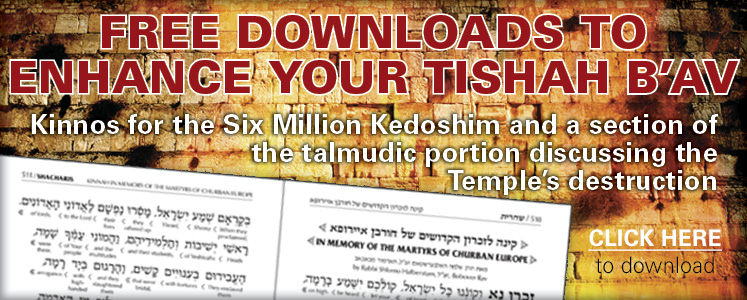
With Tishah B’Av approaching, we want to help our readers prepare to have a meaningful fast. This week we are sharing two free downloads that will make your Tishah B’Av more meaningful.

Kinnos for the Six Million Kedoshim

The destruction of the Six Million is our own generation’s stark connection to the eternal Tishah B’Av. Two great and inspiring spiritual leaders of our time, The Bobover Rebbe and Rav Shimon Schwab composed Kinnos lamenting and memorializing the unspeakable tragedy. Adopted by many congregations worldwide, these painful laments are read on Tishah B’Av.

Click here to download the excerpt from the Schottenstein Edition Interlinear Kinnos / Tishah B’Av Siddur.

A Portion of the Talmud Related to the Destruction of the Temple

On Tishah B ’Av, it is customary to study the interpersonal conflicts which led to the ruin of the Second Temple. One well-known source comes from the Schottenstein Edition…

View original post 56 more words

A Torah Insight from the Chasam Sofer on Parshas Naso

CHASAM SOFERNASO

An Elevation for All Jews

נשא את ראש בני גרשון גם הם לבית אבתם למשפחתם

Take a census of the sons of Gershon, them as well, according to their fathers’ household, according to their families (4:22).

Why does Hashem say that the sons of Gershon, “them as well,” should be counted? Would there be a reason to exclude them from the count? It is also of note that here the verse states לבית אבתם למשפחתם, according to their fathers’ household, according to their families, while in regard to the sons of Kehas (above, v. 2) and the sons of Merari (below, v. 29) it uses the opposite order: למשפחתם לבית אבתם, according to their families, according to their fathers’ household. Why is the order different for the sons of Gershon?

The names of Levi’s sons may be understood homiletically as allusions to the Jewish People, at various stages in history. The name “Kehas” connotes an ingathering or an assemblage, as in the verse ולו יקהת עמים, and his will be an assemblage of nations (Bereishis 49:10). This refers to the times when the Jews were together, serving Hashem in Eretz Yisrael. The name “Merari,” on the other hand, connotes bitterness, as in וימררו את חייהם, and they embittered their lives (Shemos 1:14). This refers to the many countries where Jews have been subject to misery and suffering. Despite this, they built communities and institutions that remained loyal to Hashem and the Torah. Both the “Kehas” and the “Merari” Jews brought glory to our forefathers, all the way back to Avraham, Yitzchak, and Yaakov.

But there were other Jews, symbolized by “Gershon,” a name that connotes expulsion, as in ויגרש את האדם, and He expelled Adam (Bereishis 3:24), but does not include a connotation of bitterness. This alludes to Jews who have been banished from their Land and dispersed throughout the nations, but have flourished in their host countries. They felt “at home” in their lands of exile, and began to blend into their surroundings, gradually assimilating and losing their Jewish identity.

            Our parashah tells us that all three categories of Jews are to be counted. Now, the term נשא, in addition to “count,” can be interpreted as “elevate.” When Israel serves Hashem loyally, that is a source of merit even for the Patriarchs, Avraham, Yitzchak, and Yaakov. The “Kehas” and “Merari” Jews are themselves elevated, and moreover, bring credit to their forebears. Thus, the Torah says, למשפחתם לבית אבתם — their elevation begins according to their families, and then brings credit according to their fathers’ household. But what of the “Gershon” Jews, the ones who have drifted away. Do they have a share in elevation?

            The Torah tells us that not only are the “Gershon” Jews to be counted, they can be elevated. How is this possible? In response to this, the Torah says לבית אבתם, according to their fathers’ household, which refers to the Patriarchs. Indeed, these Jews are unable to provide merit to their forebears, and they even lack the merit for their own elevation, but nevertheless, they are able to be elevated through זכות אבות, the merit of our forefathers. A person’s forebears can be a source of benefit to him, and allow him to gain merit despite his own limitations. Thus, our verse says, Elevate the sons of Gershon, them as well — no less than the virtuous “sons of Kehas” and “sons of Merari.” How are the “sons of Gershon” elevated? It is according to their fathers’ household, by virtue of their previous generations, which will bring merit even למשפחותם, to their [own] households. Although these Jews have little merit of their own, they will be elevated “as well,” through the merits of their forefathers (Toras Moshe HaShalem, p. 25, ד”ה נשא).

In Memory of
R’ Yakov ben R’ Shmuel Yosef
and R’ Shimon ben R’ Moshe ע”ה
© Copyright 2019 by MESORAH PUBLICATIONS, Ltd.

To download a printable copy, click here: Chasam Sofer – Naso

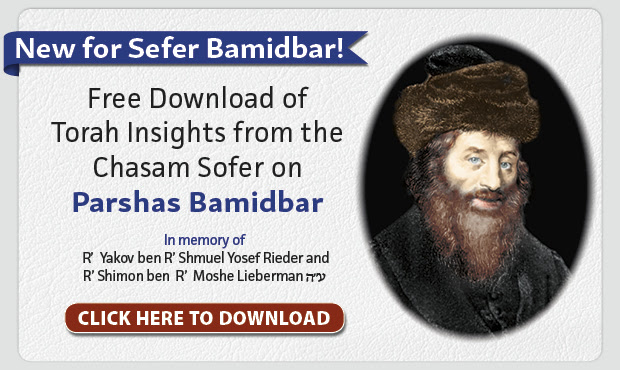
Torah Insights from the Chasam Sofer on Parshas Bamidbar

CHASAM SOFERBAMIDBAR

1. One Census, Two Meanings

שְׂאוּ אֶת ראש כל עדת בני ישראל

Count the heads of the entire assembly of the Children of Israel (1:2)

The term used for “count the heads” is שְׂאוּ אֶת ראש, which literally means raise the head. This indicates that the census served to elevate the Jewish people and ascribe greatness to them. However, the Midrash (Bamidbar Rabbah 1:11; cited by Ramban to v. 3) notes that שאו את ראש can also mean, remove the head, as in the verse (Bereishis 40:19), יִשא פרעה את מעליך ותלה אותך על העץ, Pharaoh will remove your head from you and hang you on a tree. According to this interpretation, our verse alludes to the fact that the men counted in this census were destined to die in the Wilderness, as punishment for the sin of the Spies. Ramban asks, however: Since the simple meaning of the phrase שאו את ראש follows its positive connotation of “raise the head,” why does the Midrash interpret it in a negative manner?

We may resolve this by noting that when the Torah excludes the Leviim from the count, it states (1:49): אך את מטה לוי לא תפקד ואת ראשם לא תשא, which seems to mean, But the tribe of Levi you shall not count “and their head you shall not raise.” Now, if שאו את ראש denotes “elevation,” why would the Torah exclude the Leviim from being counted and gaining this blessing? The Midrash therefore reasons that שאו את ראש must also carry the negative connotation of “remove the head.” Because the Leviim were dedicated to Hashem’s service, Hashem said, ואת ראשם לא תשא, which according to the Midrash means, and their head you shall not remove. They were excluded from the decree of death that would ultimately be imposed on all those counted in this census (Toras Moshe HaShalem, p. 1, ד”ה שאו את ראש כל עדת בני ישראל).

2. Seeing the Good

             As mentioned, the phrase שאו את ראש can be interpreted “remove the head.” While this interpretation seems negative, it actually contains a positive message as well, and complements the message of elevation and grandeur conveyed by “raise the head.”

What was the reason for the census? The apparent reason was that Moshe and the Nesiim needed to determine the number of people in each tribe so that Eretz Yisrael could be divided fairly among the tribes. The time of this census was appropriate for that purpose, because at this point the Jewish people had not yet committed the sin of the Spies, and they were ready to travel to Eretz Yisrael.

However, Hashem knew in advance that the Jews would eventually commit the sin of the Spies and that this generation would therefore die in the Wilderness. Thus, the people counted in this census would not not enter Eretz Yisrael and would not divide the Land. Obviously, then, the division of the Land cannot have been Hashem’s reason for commanding Moshe to take the census. What, though was His reason? It is, as Rashi explains, that Hashem wanted to count the Jews simply to demonstrate His love for them.

This idea is alluded to in the double meaning of the phrase, שאו את ראש. The literal meaning is raise the head, but according to the Midrash it means remove the head. The latter interpretation is negative only on a superficial level. In truth, though, it contains the basis of the positive interpretation. The expression remove the head alludes that Hashem knew that those counted in this census would die in the Wilderness. But if they would not live to divide the Land, why did Hashem want them to be counted? It must be because He loves them. In this sense, the census is an elevation for the Jews and serves to raise their head! It is thus the negative meaning that makes us realize the message contained in the positive meaning: Hashem counts the Jews because He loves each and every one of them (Toras Moshe HaShalem, p. 1, ד”ה שאו את ראש א).

In Memory of
R’ Yakov ben R’ Shmuel Yosef
and R’ Shimon ben R’ Moshe ע”ה
© Copyright 2019 by MESORAH PUBLICATIONS, Ltd.

To download a printable copy click here: Chasam Sofer – Bamidbar

Free Download to Enhance Your Tishah B’av

The Official ArtScroll Blog

With Tishah B’Av approaching, we want to help our readers prepare to have a meaningful fast. This week we are sharing two free downloads that will make your Tishah B’Av more meaningful.

Kinnos for the Six Million Kedoshim

The destruction of the Six Million is our own generation’s stark connection to the eternal Tishah B’Av. Two great and inspiring spiritual leaders of our time, The Bobover Rebbe and Rav Shimon Schwab composed Kinnos lamenting and memorializing the unspeakable tragedy. Adopted by many congregations worldwide, these painful laments are read on Tishah B’Av.

Click here to download the excerpt from the Schottenstein Edition Interlinear Kinnos / Tishah B’Av Siddur.

A Portion of the Talmud Related to the Destruction of the Temple

On Tishah B ’Av, it is customary to study the interpersonal conflicts which led to the ruin of the Second Temple. One well-known source comes from the Schottenstein Edition…

View original post 56 more words