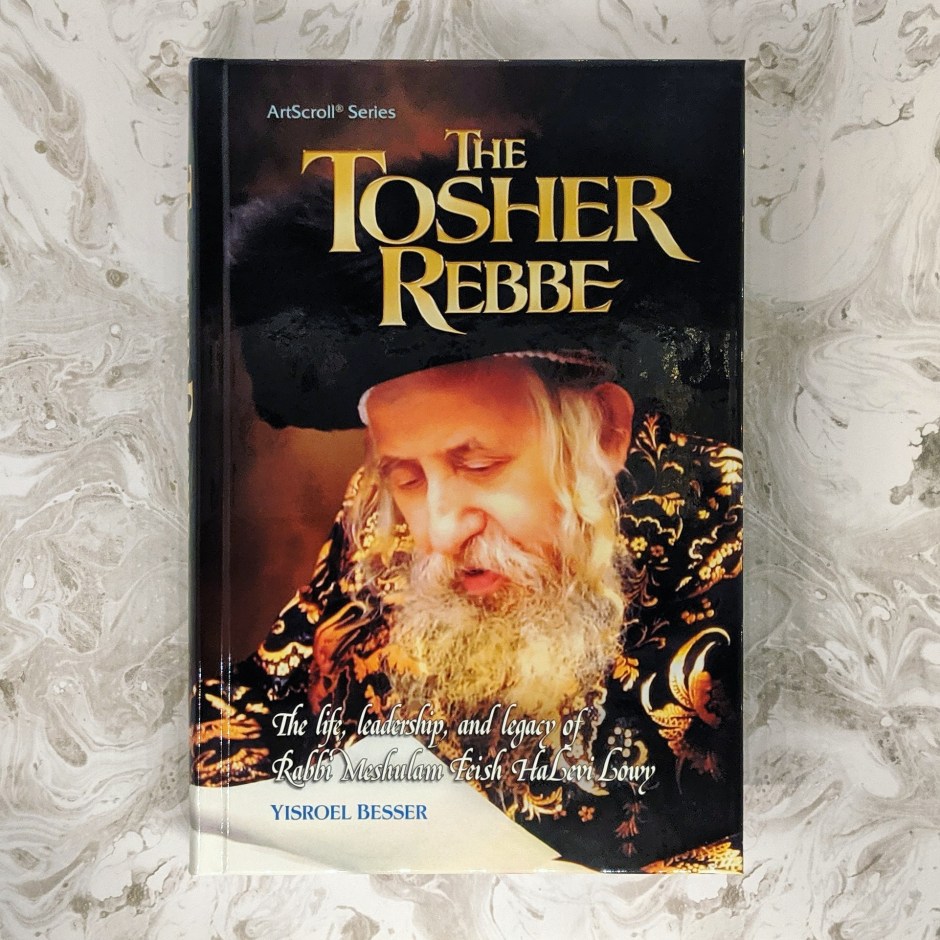
A Conversation with Rabbi Yisroel Besser, Author of The Tosher Rebbe: The life, leadership and legacy of Rabbi Meshulam Feish HaLevi Lowy

AS: You’ve captured so many facets of the Tosher Rebbe’s greatness. What went into writing this biography?

RYB: I live in Montreal, so I was able to go into the heart of Tosh, and the people close to the Rebbe opened up to me. Much of the historical material was documented, but the stories, the warmth, the heart of the book came from those close to him.

AS: The Rebbe was so saintly, yet he understood people’s everyday fears and challenges. How was he able to do that?

RYB: The Baal Shem Tov said that a neshamah comes down to this world for 70 or 80 years, just to do a tovah for another Yid. Because the Tosher Rebbe was such a chassid, all the taharah, Torah, tikun middos, perishus — they all led to helping others. He took a very pragmatic approach to shalom bayis. He was a big advocate of women having more cleaning help. He understood people’s needs davka because he was so holy, not despite being holy.

AS: There are so many stories in the book, about his chesed, his tzedakah, his vision, his berachos. Can you share one that made a strong impression on you?

RYB: Many wealthy people came and gave money to the Rebbe, because they were grateful to him for his help. But the money never stayed with him — he gave it to anyone who needed it. Once, a Yid came who was a maggid shiur; he was making a chasunah, and he didn’t have enough money. The Rebbe asked him what masechta he was learning. “Beiah.” The Rebbe asked him a question and they started speaking in learning. The gabbaim were surprised; the Rebbe didn’t usually do this. Then the Rebbe asked him about a Tosafos in Berachos that contradicted what they were discussing. As the man got up to leave, the Rebbe said, “Check the Tosafos in Berachos as soon as possible. Don’t wait, do it now. You’ll see I’m right.” There was a Shas in the waiting room. The man opened it, went to the Tosafos — and found a fat envelope full of cash! The Rebbe understood that his gabbaim wouldn’t want him give such a large amount to one person, so he found a way to use his learning and send the man the money. There are so many tzaddikim, and so many talmidei chachamim – the Rebbe merged both. 

Get your copy of this extraordinary book today at artscroll.com!

Discovering More Treasures of the Or HaChaim: The Yaakov and Ilana Melohn Edition Or HaChaim – Sefer Devarim Volume 1: Parashas Devarim – Shoftim

Wonderful news for the many thousands who have already enriched their understanding of Chumash Shemos with the Yaakov and Ilana Melohn Edition Or HaChaim. They have enjoyed the breathtaking depth, clarity, and insight of this classic Torah commentary and its masterful elucidation – and now they can continue this journey of discovery with Sefer Devarim Volume 1: Parashas Devarim – Shoftim, just in time for the Torah reading.

And if you are not yet familiar with the brilliance of Rav Chaim ben Moshe ibn Attar, the 18th century Torah sage whose commentary on the Torah is learned and loved by so many segments of Klal Yisrael, prepare to discover the treasures of one of the foremost commentaries on Chumash, the Or HaChaim HaKadosh.

Great though the commentary is, it is not simple. The Or HaChaim points out countless nuances in the Chumash text, and he blends the pshat of the Chumash with the interpretations of Chazal as well as his original comments.  R’ Chaim weaves many Kabbalistic concepts into the commentary, and also explains many of the fundamental principles of our faith.

Using the famed format of the Schottenstein Edition Talmud, the elucidated translation helps us gain a clear understanding of the Or HaChaim’s text, and the notes provide explanations, sources, and deeper insights into his words. Every volume includes the Or HaChaim commentary, the text of the Chumash, Targum, and Rashi. Or HaChaim and Rashi are both fully vowelized.

So many insights, so many fascinating ideas. How do Moshe’s words in Sefer Devarim differ from all the other words in the Torah? What are the four conditions necessary for our tefillos to be accepted, and how do we learn them from Moshe Rabbeinu’s words? Why do the Jewish People seem to suffer more than any other?

All these and so many more. Or HaChaim explains the Chumash on multiple levels, often with breathtaking originality and with lessons for life that are as relevant today as they were three centuries ago.

Get your copy today at artscroll.com!

The Groundbreaking Series Continues: The Czuker Edition Mikra’os Gedolos on Daniel / Ezra / Nechemiah

Close to 500 years ago, the revolutionary idea of Mikra’os Gedolos was introduced, in which Torah commentaries were printed on the same page as the text they discussed.  

The Czuker Edition Mikra’os Gedolos on Chumash and on Nevi’im took that concept to an entirely new level. And now that new level of excellence includes the Kesuvim, as ArtScroll announces the publication of the Czuker Edition Mikra’os Gedolos on Daniel / Ezra /Nechemiah.

Like the others in the series, the text of every commentary was intensively researched. Scholars used the most accepted edition available as their “base text” and then compared it with other editions, ensuring an unprecedented level of textual accuracy.

This volume includes the classic Mikra’os Gedolos commentaries: Targum Yonasan ben Uziel, Rashi, Radak, Rid, Ralbag, Minchas Shai, Biur HaGra, Mezudas David, Mezudas Tzion, and Malbim. In addition, it includes mefarshim that don’t usually appear on the Mikra’os Gedolos page: Mahari Kara, Maharal, Minchah Ketanah, Rishon LeTzion, Chomas Anach, Yesod VeShoresh HaAvodah. Finally, the volume also includes new, original additions: Likkutei Shas U’Medrashei HaTannaim, an original comprehensive compilation, citing relevant texts from Talmud Bavli, Yerushalmi, and major Midrashim where a verse is discussed; an original collection of comments by Baal HaTurim on Chumash explaining verses in Nevi’im and Kesuvim, and Sifsei Zekainim , an anthology of classic commentaries explaining Rashi’s commentary.

Every commentary is menukad (vowelized). All abbreviations are “opened up” and the text is punctuated. When a commentary quotes another sefer, the source citation is noted.

State-of-the-art typography ensures a wonderful learning experience. The binding is side sewn, library quality and the paper is acid-free and specially milled, to ensure the volumes will last for generations.

The Kesuvim are part of our mesorah. With this new volume, we can study and understand them on a whole new level.

Get your copy today at artscroll.com!
Faith Amid the Flames: The Story of Reb Yosef Friedenson

ArtScroll spoke with Rabbi Yosef Chaim Golding, who compiled and edited the autobiography of his father-in-law, Reb Yossel Friedenson.

AS: Faith Amid the Flames is a stunning autobiographical portrait of Reb Yossel Friedenson z”l. We get to know him through his writings and speeches, and through interviews conducted with him over the years. How did you go about compiling all these different sources into one work?

RYCG: I viewed about 100 hours of video interviews, editing, compiling, and editing some more … plus I worked from 6 hours of transcribed cassette tape discussions between us. And, of course, I had his extensive writings to draw upon.

AS: Where did Reb Yossel’s incredible moral courage and emunah have its roots?

RYCG: Unquestionably, they were from his father, Rav Eliezer Gershon Friedenson Hy’d, who accomplished so much for Klal Yisrael, all before he was incarcerated in the Warsaw Ghetto at the age of 39.

AS:  There is so much suffering in these pages, yet this book is uplifting and, yes, even optimistic. How did you (and Reb Yossel) make that happen?

RYCG: It wasn’t me; it was all him. He always spoke about the positive things that he witnessed; he let the secular historians dwell on the pain and suffering.

AS: Reb Yossel was the unofficial spokesman of the entire generation of survivors. What was the overriding message that Reb Yossel left for the generations that followed?

RYCG:  In his own words:

“The first thing I learned is that there is a Hashgachah Elyonah on every one of us, at all times. If I personally survived, it is because there is an Ayin roeh, a watchful Eye, Who kept me alive in spite of the reshaim who wanted to kill me.

“Secondly, I saw how Jews differ from the other nations. We are an am hanivchar. We are rachmanim and gomlei chassadim. Even those who, chalilah, go astray still have in them some of these elevated middos tovos.

“The third, and by far the most important, lesson that I internalized was that Klal Yisrael is truly eternal, indestructible, and will always outlive their oppressors and those who wish to destroy them. The same is true for our eternal Torah.

“The secular world lauds the Jews who physically resisted the Germans. But much greater was the spiritual resistance of those whose faith in Hashem never wavered, even under the most torturous conditions.”

Get your copy of this phenomenal book today at artscroll.com

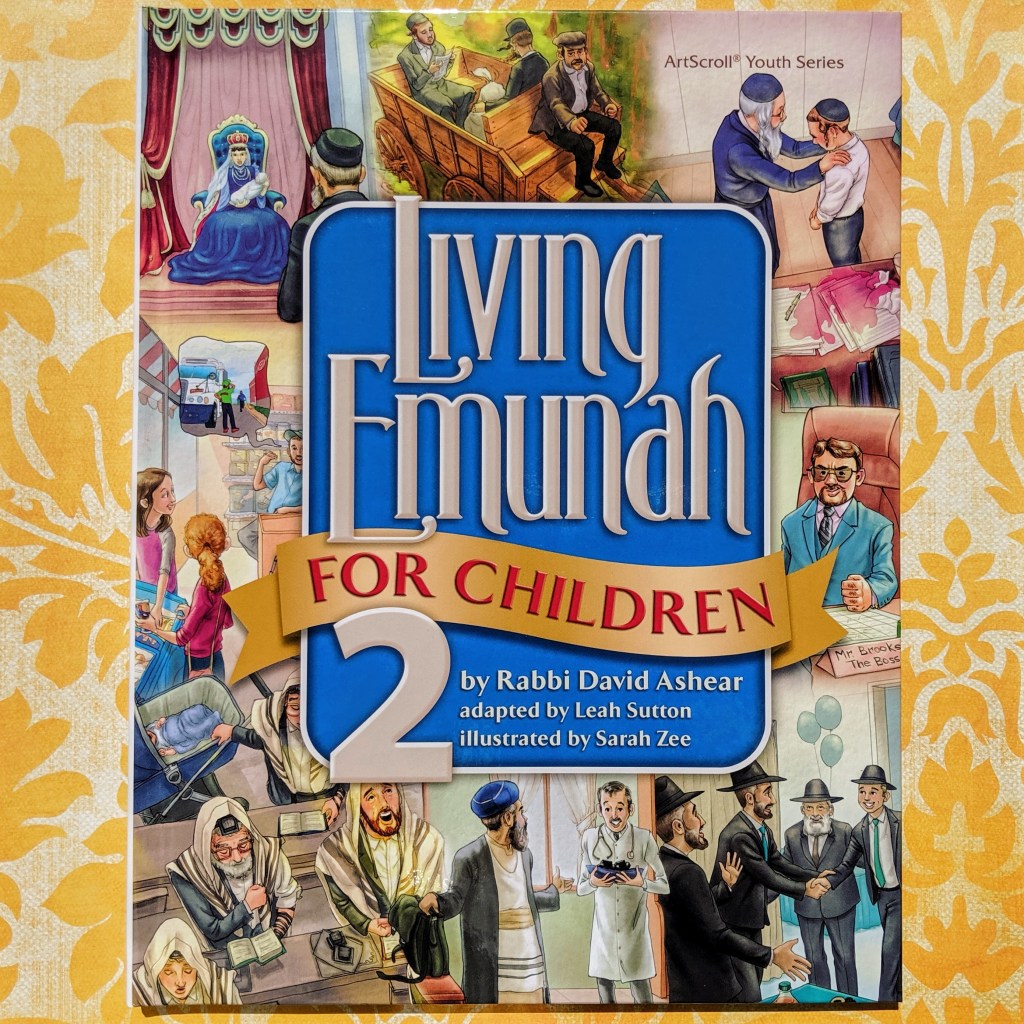
A Conversation with Leah Sutton Author of Living Emunah for Children 2

It’s never too early to show our children how much Hashem loves them and to begin instilling within them the incredible power of emunah. Following the very successful first volume of Living Emunah for Children, ArtScroll is proud to present Living Emunah for Children 2, a brand-new collection of fun and kid-friendly stories, carefully chosen and adapted from the Living Emunah series by Leah Sutton for youngsters ages 4 – 8, with delightful, full-color pictures by Sarah Zee.

We spoke with Mrs. Sutton about children, emunah, and her new book:

AS: How did you go about choosing stories from among the hundreds in the Living Emunah series?

LS: I reread some of the books that I’d loved when I was young, including many of ArtScroll’s children’s books. I thought about my childhood favorites, the books I still remember today, and I analyzed what made me love them so. Then I read through all of Rabbi Ashear’s Living Emunah books, looking for stories that could work for young people. A story with a child at its center, a story with one focus, not with many complicated details, a story with an exciting turn of events. And, of course, I got input from Rabbi Ashear.

AS: How can we inculcate even young children with emunah?

LS: Children have a certain simplicity and acceptance that makes emunah very special to them. When they hear these stories, they see themselves in them. Children often see themselves as the heroes, and in these stories the heroes are ba’alei emunah. And the heroes of these stories are often simple, everyday people, so children feel it could have been them.

AS: What is your personal favorite from among the many stories?

LS:  I love the story called “The Cry of the Baby.” Such simple hashgachah, the very day a person needed to hear a baby cry, Hashem sent that baby. Also, the story “Friendly Competition,” about a famous ice-cream manufacturer coming to the rescue of his competitor. The story was such a kiddush Hashem, it made me proud, and children love ice cream, so it was so appropriate.

AS: What was the feedback you received on the first volume of Living Emunah for Children?

LS: It was really amazing. The number of books that were sold kept going up. People who’d gotten so much out of Rabbi Ashear’s Living Emunah books had been waiting for something like this for their children.

Get your copy today at artscroll.com!

As Incredible As…. Incredible! Incredible 2! From Corporate LA to Arachim Seminars: More of the amazing true story of Rabbi Yossi Wallis by Rabbi Nachman Seltzer

Three years ago, Incredible! From the Bronx to Bnei Brak: The amazing true story of Rabbi Yossi Wallis by Rabbi Nachman Seltzer burst upon the Jewish literary scene. Tens of thousands of readers were amazed by Rabbi Yossi Wallis’s fascinating (incredible!) story of his metamorphosis from Bronx gang member to head of one of the world’s largest kiruv organizations. Readers were also astonished by the mesiras nefesh of Yossi’s family:  his grandfather, who chose death over betraying his deepest convictions; his father, who defied the Nazis with his tefilin wrapped proudly on his head as he awaited to be executed on the gallows; and – five hundred years earlier – his ancestor, who was burned in the Inquisition’s auto-da-fe.

Yes, Incredible, with more than 30,000 copies in print, left readers inspired, engaged, fascinated – and clamoring for more.

And now here it is – Rabbi Seltzer’s incredible sequel, Incredible 2! From Corporate LA to Arachim Seminars : More of the amazing true story of Rabbi Yossi Wallis.

In Incredible 2 we will join Yossi on his journey from successful weapons dealer to totally committed Torah Jew. We’ll be astonished by the hashgachah that he experiences as he decides to pay back anything that he’d taken in a manner that was against halachah. We’ll meet the people who helped him on the way: an old man who vanishes as mysteriously as he’d appeared; an even more mysterious laughing rabbi; great men such as Rav Shach zt’l and Rav Chaim Greineman zt’l, who had to restrain their eager student in his quest for greatness in Torah, until he was ready for it.

When it comes to Yossi Wallis, we know to expect the unexpected, and that’s just  as true when he’s CEO of Arachim as it was when he was a young man trying to cut his ties to the Mafia. We will see him boldly take on the “fake news” of the Israeli media when they libel the Torah community. We’ll be with him as Rav Chaim Greineman instructs him to refuse a $400,000 donation (and we’ll be astounded by the wisdom of our gedolim as we read the startling reason why). In Rabbi Wallis’s world, everything turns into a kiruv opportunity – even an FBI investigation!

Incredible 2. It’s as incredible… as Incredible!

Get your copy today at artscroll.com!

Pictures of Greatness: Great Jewish Photographs by Rabbi Moshe Bamberger

A picture is worth a thousand words, they say. As we look into ArtScroll’s newly-released Great Jewish Photographs, we can clearly see how effective images can be in enhancing the reading experience. Photos touch the heart and mind in an incomparably direct and powerful way. 

In Great Jewish Photographs, Rabbi Moshe Bamberger has collected 100 black and white and color photographs of Torah luminaries, learning, praying, laughing, crying, giving blessings and encouragement, and, of course, sharing their immense Torah knowledge. Some photos are iconic, others have been rarely seen. Some tell a story, others capture vital moments in recent history – and all of them touch our hearts and souls.

A remarkable picture of Rav Hutner learning, while he is being held hostage by terrorists on an aircraft, teaches us the power of Torah study in a way that, yes, a thousand words cannot. Gaze at the picture of the Chafetz Chaim davening in tallis and tefilin; your own prayers will be different, deeper. The  Kanievsky’s  were on the way to a  bris when their car got a flat tire; the photo of them standing at the side of the road, Rav Chaim staring into his sefer and Rebbetzin Batsheva into her Tehilim,  is both a delight and a mussar lesson!

The vignettes and biographical information that accompany each photograph add still another dimension to Great Jewish Photographs. You’ll smile at the adorable picture of Rav Shimon Schwab and his brothers, taken when he was a youngster. But then you will read how Rav Schwab took the lesson he learned at the age of four from that photo shoot and cherished it all his life, and you’ll have learned something of great value. Rav Avigdor Miller’s smile, Rav Chaim Shmulevitz’s tears, Rav Shach’s laughter: so many emotions that touch us — and teach us.

Great Jewish Photographs is a compact size, full-color paperback volume. It includes Birchas Hamazon and the berachos of bris and shevah berachos and has room for imprinting on the back, making it an ideal gift for personal simchahs and institutional events.

Get your copy today at artscroll.com!

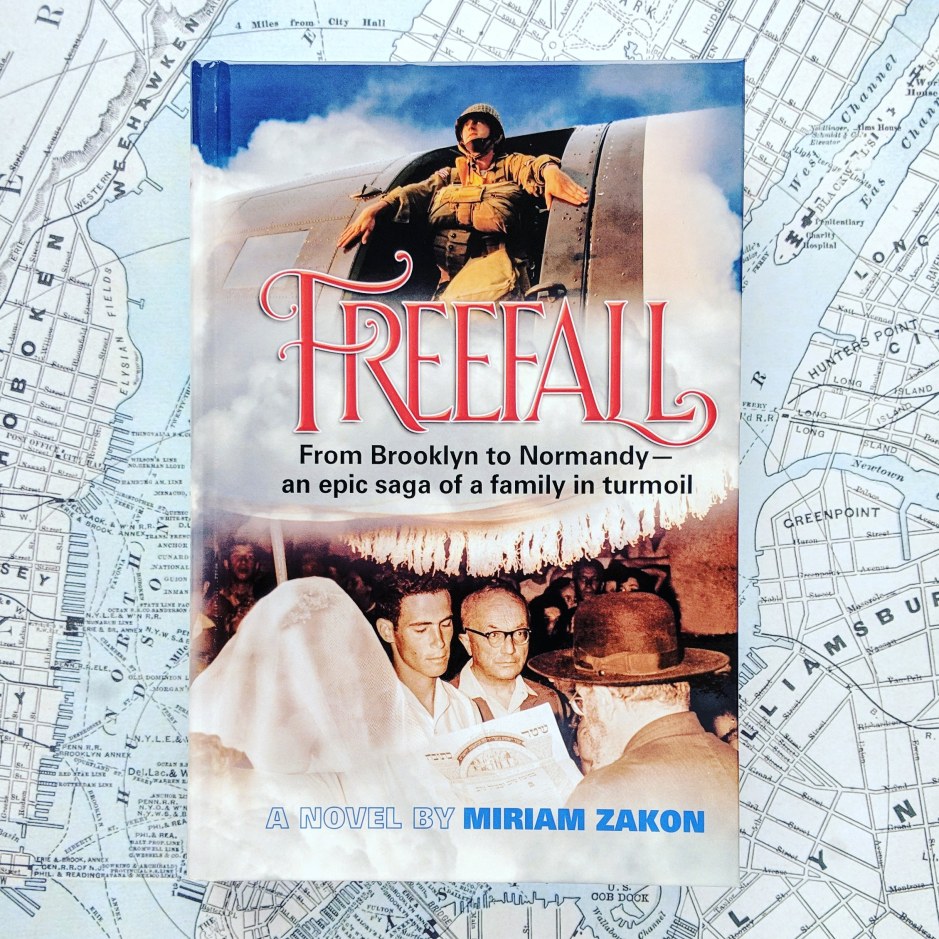
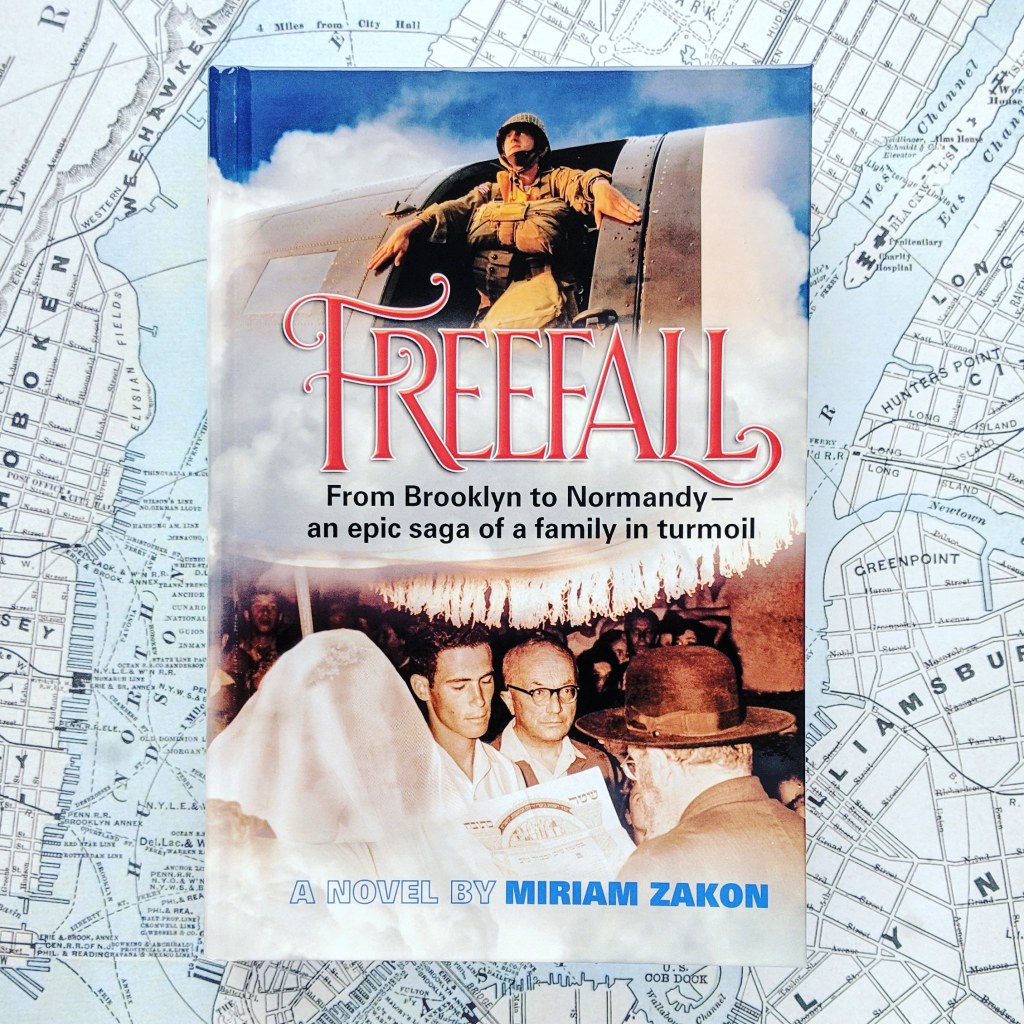
When art imitates life: Freefall by Miriam Zakon – ArtScroll Mesorah

A review by R. Deutsch (originally printed in the Jewish Tribune, June 12th 2019)

Miriam Zakon is a familiar name in the world of Jewish literature, both fiction and non-fiction alike; she has been writing articles, stories and books for decades.
Reading her latest novel, Freefall, was a fascinating journey into the life of an American soldier and his family as he joins World War 2 raging on the other side of the Atlantic. Readers of Mishpacha magazine will recognize the beloved characters of the serial with the same name which ran last year in the magazine; reading it now in book form adds an extra dimension as the reader can follow along the story line without having to wait each week for the next installment!
New readers will enjoy getting to know the truly lifelike characters, with strongly principled Pappa, lovable old-world Bubbe – who has a surprisingly young side to her – and flighty Aunt Cele weaving their way around the main younger characters, Abe, Annie and Moe. Staunchly patriotic, but still insistent on hanging on to his Yiddishkeit, however difficult that would be, Moe joins the Army determined to do his part to fight against the accursed Germans. Meanwhile, back home in Coney Island, his sister Annie faces challenges of her own as she attempts to carve a new life for herself with her unlikely shidduch, separate from the Freed Boarding House where she grew up, and where Papa still needs her help.
“I was fortunate in picking my setting and era,” says Mrs Zakon. “While the Second World War has been the setting of many frum novels, there weren’t many that focused on the American home front and American GIs. It was recent enough that I could even speak to people who lived through the era, but far enough that it had an exotic feel.” Mrs Zakon says her editor at Artscroll was very useful in making sure the historical details were correct – she lived through the war in America and remembers it well enough to be able to ascertain whether things really were as they had initially been written. For example, the author had depicted Moe insisting on eating only glatt kosher meat, only to be told that glatt was not an option in the USA in the 1940’s at all. It didn’t yet exist in the country! Neither did men wear a kittel at their chuppah in those days, Mrs Zakon was told – after she had him appearing at his own nuptials wearing one.
As an avid history buff, Mrs Zakon is always extremely particular that all her historical details are accurate. Will the reader always know the difference? No, she says, but it all adds up to the painting of an authentic picture, which is paramount to creating a level of trust with your readers, she posits.“I did a lot of reading, both about the American home front and the battles in Europe,” says Mrs Zakon.“While the history books were useful, I got a lot more out of memoirs of the GIs. They had the little details that brought the era to life. While reading them I kept an eye out for the slang of the time, and incorporated the terms into dialogue. (“He’s morphed to the gills”, “It’s the latest shout in hats.”) I also watched a lot of videos of the time. If you’re writing about any time from the First World War on, you can find incredible documentary footage. Even if you write about earlier times, you can get a sense of your setting from videos. When I wrote about a Piper Cub plane crash, I found a video of an actual crash and saw that it gave off white smoke, not the black smoke I’d envisioned. I also checked every date against a calendar from that time, to make sure the action fell on the right day of the week, and if relevant on the right day of the Jewish calendar as well.”
Mrs Zakon estimates that she used either a book, a website, or a video on roughly one out of every three or four paragraphs she wrote, just to get the details correct. With research like that, the reader can be guaranteed that he or she is really getting so much more than just fiction.
With almost 400 pages, Freefall kept me captivated from beginning to end. It was a fascinating read and one that is sure to become a firm favorite on any bookshelf.

Get your copy today at artscroll.com

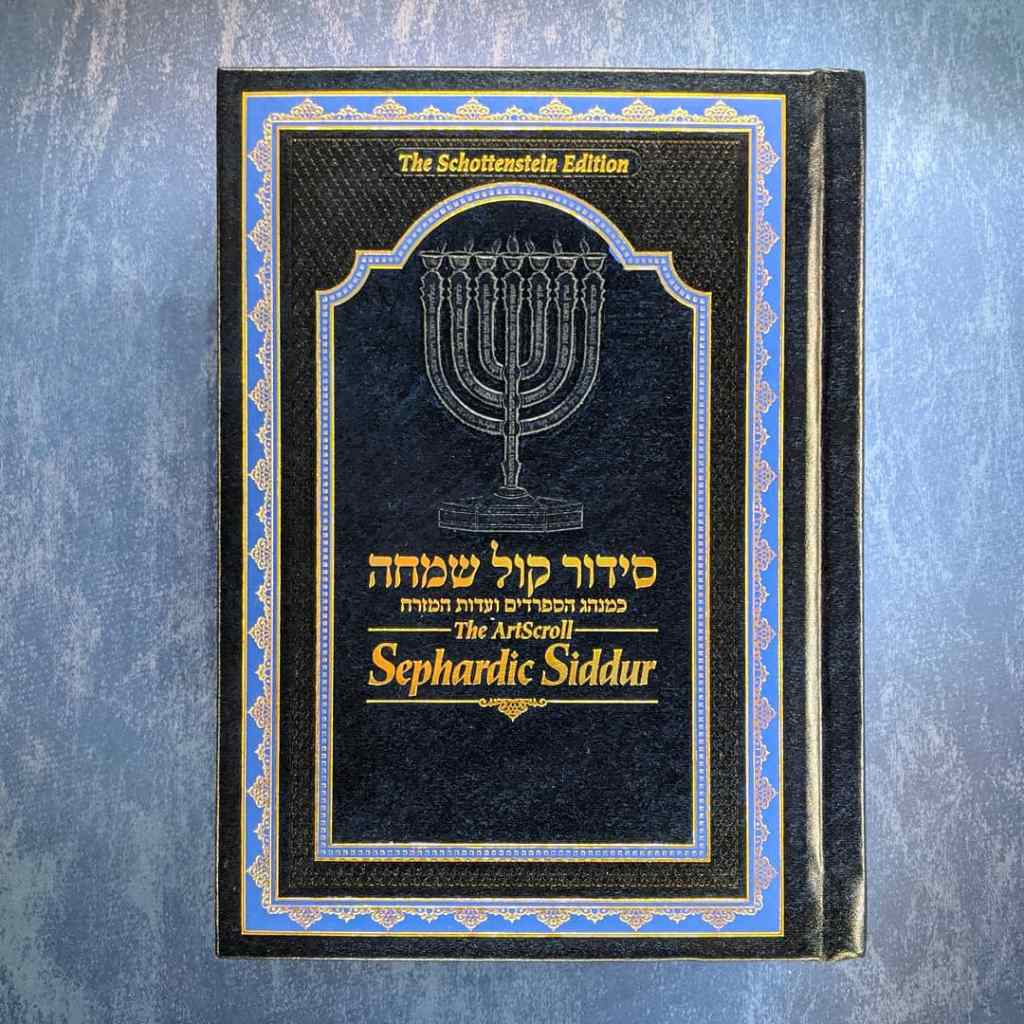
The Journey of the ArtScroll Sephardic Siddur Schottenstein Edition

“Why don’t you produce an ArtScroll Siddur for the Sephardic community?”

We heard it over the years from countless people in Brooklyn, in Deal, in L.A. and beyond, indeed, wherever Sephardic Jews live. While ArtScroll’s other sefarim and books speak to Jews of every stripe and background, there was no ArtScroll’s siddur in the nusach of Sephardim and Edot Hamizrah. Why not?!

It was a valid question. There are well over a million copies of ArtScroll siddurim in print, making them the most widely-used siddurim in history. They are hailed the world over for their magnificent translation and wide-ranging, inspiring commentary, their crystal clear instructions and halachahs, and their state-of-the-art typography. “Why isn’t there a Siddur of such outstanding quality for Sephardic Jews?”

Mr. Jay Schottenstein, patron of the ArtScroll Talmud and many other ArtScroll projects, was visiting Rav David Abuchatzeira shlita, a year and a half ago. The Hacham had that same question: “You have dedicated so many works of Torah and Tefillah. Why don’t you sponsor an ArtScroll Sephardic Siddur?” Together they called Rabbi Gedaliah Zlotowitz, President of ArtScroll and put the question to him.

Rav Gedaliah didn’t flinch, and in a moment the exciting decision was made: The time had come for an ArtScroll Sephardic Siddur!   And so the work began immediately on Siddur Kol Simcha.

There was much to do. The Hebrew text and English translation had to follow Sephardic traditions. Transliterations would reflect Sephardic pronunciation, and laws and customs would follow Sephardic poskim and minhagim.

Dozens of pizmonim and piyyutim for Shabbat and other occasions would be accurately translated and sourced. Shem Hashem would appear according to Sephardic tradition, and there would be taamim for selections from the Tanach. There would be a commentary and introduction that would explain and inspire.

There were other innovative features as well. When a person is praying, he or she wants to see the relevant laws conveniently appear next to the prayers, so in this new Siddur, the halachot are right where they are needed – and there is also a comprehensive halachot section in the back of the Siddur. Special typography and graphics indicate when there are differences in text between various communities, so everyone can pray according to his or her own custom without confusion.

Artscroll is proud to add this magnificent state-of-the-art Sephardic Siddur to its repertoire. A new gem in the treasure house of ArtScroll.

Get your copy today at artscroll.com!

ArtScroll Speaks With C.B. Weinfeld Author of A Canopy of Stars

AS: Amazing! Your 5th collection of stories, and yet they are still so fresh, so vibrant and varied. What’s your secret to finding such intensely interesting stories?

CBW: There’s really no secret to finding interesting stories. All you need is a willingness to ask and the capacity to listen—to really listen. I find that the most rewarding stories come when I close my mouth and just absorb what the other person is saying! Sometimes, during a conversation or interview, I think the story is over, but if I stay quiet for another minute or two, I’ll find the story has only just begun.

AS: One of the sections of the book is called Faith and Courage. What’s the connection between the two?

CBW: One is often an outgrowth of the other. Being whacked by a ‘double whammy’ of challenges can either make one shrivel and give up in defeat, or it can bring out the most potent parts of our neshamah. In “Dance of Life,” for instance, a man facing the loss of a long-awaited kidney draws on his faith and finds the courage to dance, to celebrate the fact that it wasn’t meant to be. In “Guided by an Angel,” the protagonist draws on his faith and finds the courage to travel alone to meet his brothers, whom he had never met before.

AS: When writing these stories, many of them poignant, did any of them actually bring you to tears? Which one, and why?

CBW: The story “Judge and Jury,” about a woman whose husband is experiencing an emotional breakdown, had a powerful impact on me.  I know many people who are living like this, acting as if they had perfect lives, in a desire to preserve their dignity and protect their families. In reality they are dealing with unfathomable challenges and intense pain—and the judgment of their own family members, which is sometimes hardest of all to bear.

AS: And here’s the toughest question of all: Which of the stories are your favorites?

CBW: Asking me to name a favorite would be like asking me to name a favorite grandchild—I love them all so intensely, and each has a special place in my heart.

Get your copy today at artscroll.com!