A Torah Insight from the Chasam Sofer on Parshas Beha’aloscha

CHASAM SOFER – BEHAALOSCHA

The Light of Torah

 דַּבֵּר אֶל־אַהֲרֹן וְאָמַרְתָּ אֵלָיו בְּהַעֲלֹתְךָ אֶת־הַנֵּרֹת אֶל־מוּל פְּנֵי הַמְּנוֹרָה יָאִירוּ שִׁבְעַת הַנֵּרוֹת

Speak to Aharon and say to him: When you kindle the lamps, toward the face of the Menorah shall the seven lamps cast light (8:2).

The verse teaches that the flames of the six outer lamps must be directed toward the center of the Menorah. What does this arrangement of the flames symbolize? It can be understood based on the following introduction.

Hashem showers us with blessing in accordance with our performance of mitzvos. Every mitzvah that we perform, so to speak, “unlocks” Hashem’s blessing by making us worthy of receiving that blessing. And each individual mitzvah is the key to a specific aspect of His blessing; when we do a particular mitzvah, we merit to unlock the blessing associated with that mitzvah.

Now, the light of the Menorah represents the Light of Torah (see Bava Basra 25b with Rabbeinu Gershom ד”ה ומנורה, and Shemos Rabbah 36:2-3). One might thus think that the purpose of lighting the Menorah in the Beis HaMikdash is to make us worthy of receiving Hashem’s ultimate blessing — the gift of Torah knowledge. But it is not so. Unlike other aspects of Hashem’s blessing, which might be activated by a person’s physical performance of a mitzvah, Torah knowledge is so spiritually sublime that it cannot possibly be acquired as a result of man’s physical actions. Rather, Hashem grants the gift of Torah knowledge to one who toils diligently to understand the Torah and plumb its depths. When a person invests the required effort to uncover the secrets of the Torah, he is awarded those secrets directly from Hashem. But no physical action on man’s part – not even a mitzvah action – can possibly make him worthy of unlocking the channel of Torah knowledge and drawing down this exalted blessing upon himself.

The arrangement of the Menorah’s lights, with the six outer lamps directed toward the middle one, is meant to teach this lesson. While the outer lamps of the Menorah symbolize the Light of the Torah, the center lamp represents Hashem, the Source of this Light. By directing the outer lamps towards the middle one, we indicate that the Light of the Torah can be kindled by Hashem alone. Our physical kindling of the lamps does not cause their light to shine outward toward us; rather, it causes them to turn inward toward the Light of Hashem, which is what enlightens us and illuminates our lives.

***

With this understanding of the verse, we may explain a statement of the Gemara in Shabbos (22b). The Gemara remarks: “Does Hashem need the light of the Menorah? Why, during the forty years that the Jews were in the Wilderness they traveled by the Light of Hashem Himself! Rather, the light of the Menorah testifies to the entire world that the Shechinah dwells among the Jewish People.”

How does the light of the Menorah provide this testimony?

Based on the above, we may explain that the Gemara’s question, “Does Hashem need the light of the Menorah,” means the following: Can it be that we light the Menorah in order to make ourselves worthy and thus “enable” Hashem to grant us the blessing of Torah knowledge? Why, this cannot be the purpose of the mitzvah, since the Jewish People traveled in the Wilderness for forty years by Hashem’s Light! During those forty years, they experienced the illuminating Light of Torah Knowledge directly from Hashem, Who spoke to them “Face to face” at Sinai (Devarim 5:4). Surely, no physical mitzvah act can gain us access to that Light, nor is it needed to bring us that Light!

The Gemara answers that indeed, the mitzvah of lighting the Menorah is not meantto unlock the blessing of Torah knowledge. Rather, since the Menorah’s light is in fact totally unnecessary — as seen from the fact that the six outer lamps face the middle one — the Menorah serves to remind us that when we toil in Torah we receive knowledge directly from Hashem, as the Jewish People did in the Wilderness. This testifies that the Shechinah rests among the Jewish People (Chasam Sofer al HaTorah, p. 31, ד”ה בהעלתך ב).

In Memory of
R’ Yakov ben R’ Shmuel Yosef
and R’ Shimon ben R’ Moshe ע”ה 
© Copyright 2019 by MESORAH PUBLICATIONS, Ltd.

To download a printable copy, click here: Chasam Sofer – Beha’aloscha

A Torah Insight from the Chasam Sofer on Parshas Naso

CHASAM SOFERNASO

An Elevation for All Jews

נשא את ראש בני גרשון גם הם לבית אבתם למשפחתם

Take a census of the sons of Gershon, them as well, according to their fathers’ household, according to their families (4:22).

Why does Hashem say that the sons of Gershon, “them as well,” should be counted? Would there be a reason to exclude them from the count? It is also of note that here the verse states לבית אבתם למשפחתם, according to their fathers’ household, according to their families, while in regard to the sons of Kehas (above, v. 2) and the sons of Merari (below, v. 29) it uses the opposite order: למשפחתם לבית אבתם, according to their families, according to their fathers’ household. Why is the order different for the sons of Gershon?

The names of Levi’s sons may be understood homiletically as allusions to the Jewish People, at various stages in history. The name “Kehas” connotes an ingathering or an assemblage, as in the verse ולו יקהת עמים, and his will be an assemblage of nations (Bereishis 49:10). This refers to the times when the Jews were together, serving Hashem in Eretz Yisrael. The name “Merari,” on the other hand, connotes bitterness, as in וימררו את חייהם, and they embittered their lives (Shemos 1:14). This refers to the many countries where Jews have been subject to misery and suffering. Despite this, they built communities and institutions that remained loyal to Hashem and the Torah. Both the “Kehas” and the “Merari” Jews brought glory to our forefathers, all the way back to Avraham, Yitzchak, and Yaakov.

But there were other Jews, symbolized by “Gershon,” a name that connotes expulsion, as in ויגרש את האדם, and He expelled Adam (Bereishis 3:24), but does not include a connotation of bitterness. This alludes to Jews who have been banished from their Land and dispersed throughout the nations, but have flourished in their host countries. They felt “at home” in their lands of exile, and began to blend into their surroundings, gradually assimilating and losing their Jewish identity.

            Our parashah tells us that all three categories of Jews are to be counted. Now, the term נשא, in addition to “count,” can be interpreted as “elevate.” When Israel serves Hashem loyally, that is a source of merit even for the Patriarchs, Avraham, Yitzchak, and Yaakov. The “Kehas” and “Merari” Jews are themselves elevated, and moreover, bring credit to their forebears. Thus, the Torah says, למשפחתם לבית אבתם — their elevation begins according to their families, and then brings credit according to their fathers’ household. But what of the “Gershon” Jews, the ones who have drifted away. Do they have a share in elevation?

            The Torah tells us that not only are the “Gershon” Jews to be counted, they can be elevated. How is this possible? In response to this, the Torah says לבית אבתם, according to their fathers’ household, which refers to the Patriarchs. Indeed, these Jews are unable to provide merit to their forebears, and they even lack the merit for their own elevation, but nevertheless, they are able to be elevated through זכות אבות, the merit of our forefathers. A person’s forebears can be a source of benefit to him, and allow him to gain merit despite his own limitations. Thus, our verse says, Elevate the sons of Gershon, them as well — no less than the virtuous “sons of Kehas” and “sons of Merari.” How are the “sons of Gershon” elevated? It is according to their fathers’ household, by virtue of their previous generations, which will bring merit even למשפחותם, to their [own] households. Although these Jews have little merit of their own, they will be elevated “as well,” through the merits of their forefathers (Toras Moshe HaShalem, p. 25, ד”ה נשא).

In Memory of
R’ Yakov ben R’ Shmuel Yosef
and R’ Shimon ben R’ Moshe ע”ה
© Copyright 2019 by MESORAH PUBLICATIONS, Ltd.
To download a printable copy, click here: Chasam Sofer – Naso

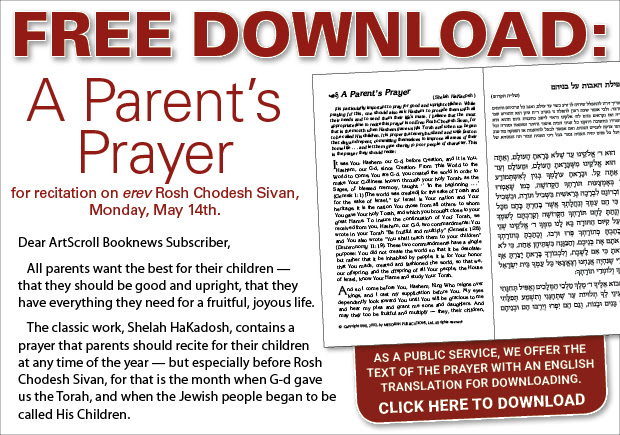
A Parent’s Prayer – for recitation on erev Rosh Chodesh Sivan, Monday, June 3rd

All parents want the best for their children – that they should be good and upright, that they have everything they need for a fruitful, joyous life.

The classic work, Shelah HaKadosh, contains a prayer that parents should recite for their children at any time of the year – but especially before Rosh Chodesh Sivan, for that is the month when G-d gave us the Torah, and when the Jewish people began to be called His Children.

Click here to view, print or download: Tefillas Hashelah – A Parent’s Prayer.

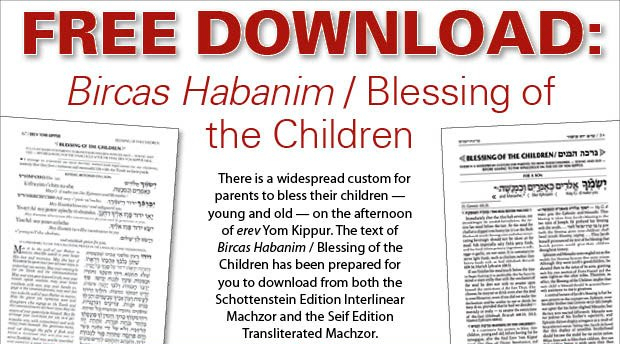
FREE DOWNLOAD: Bircas Habanim / Blessing of the Children

There is a widespread custom for parents to bless their children – young and old – on the afternoon of erev Yom Kippur. The text of Bircas Habanim / Blessing of the Children has been prepared for you to download from both the Schottenstein Edition Interlinear Machzor and the Seif Edition Transliterated Machzor.

Click here to download from the Schottenstein Edition Interlinear Machzor

Click here to download from the Seif Edition Transliterated Machzor

G’mar Chasima Tova!


unnamed

Free Download: A Parent’s Prayer {Tefillas HaShelah)

Today, May 14th, is Erev Rosh Chodesh Sivan – the day before the start of the month of Sivan, in which we received the Torah. It is a custom on that day for parent’s to recite Tefillas Hashelah – the prayer written by the Shelah Hakodosh for parents to say on behalf of their children.

Click here to view, print or download: Tefillas Hashelah – A Parent’s Prayer.

Get a FREE volume of Digital Makkos!

For a limited time, you can get a FREE digital edition of the ENTIRE Artscroll Hebrew or English Makkos!

If you already have the ArtScroll App Installed on your device:

You can get your free volume directly from the store in the ArtScroll App. 

  • Simply Open the app –   tap on Menu > Store 
  • Tap on ALL FREE Downloads  – Locate Makkos and download it to your device!

Or you can click one of these links and add it to your cart and check out for FREE – you will be emailed installation instructions:

 FREE Makkos Volume – English

 FREE Makkos Volume – Hebrew

If do not have have the ArtScroll App Installed on your device:

All you need to do is install the ArtScroll app and the FREE Makkos Volume will automatically be installed!

app-store-badge.pnggoogle-play-badge

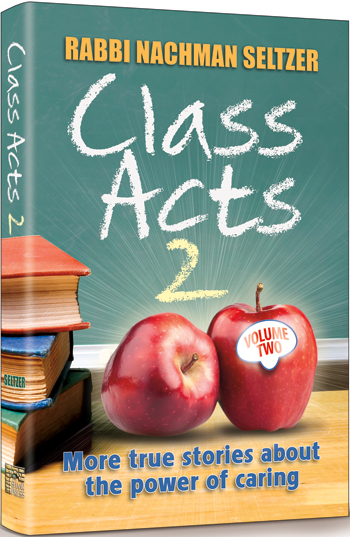
Free Download: Sample Story from Class Acts 2

cla2hIn Class Acts 2, Rabbi Nachman Seltzer shares the true story of….

….the speech that literally changed all of our lives.

….the celebrated rav who created the world’s first “junior Beis Din”

….the “Great Water Fight” in a prestigious yeshiva, and how a gadol ha’dor handled the deluge

Bestselling author Rabbi Nachman Seltzer has an unusual ability to find great stories and bring them to life. In Class Acts, one of his most popular story collections, he turned his penetrating gaze to the schoolroom, discovering remarkable stories about teachers, students, class friendships – and, most of all, about the power of caring to change lives.

Now, in Class Acts 2, we’re back in the classroom with still more jaw-dropping stories of teachers burning with a sense of mission – and a smile; of gedolei ha’dor whose understanding of the human psyche borders on the miraculous; and, of course, of students from different backgrounds, with hugely varying personalities and potential, all united by their need for understanding, compassion, and love.

These stories are thought-provoking, inspiring, and just plain interesting – because, after all, what goes on in school is not kids stuff!

Click here to view, print or download a sample story from Class Acts 2

Click here to purchase Class Acts 2

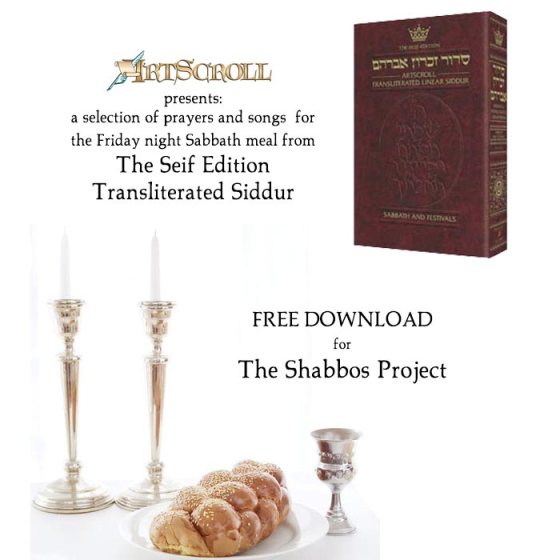
Free Download for The Shabbos Project

transliterated-update
ArtScroll is proud to participate in The Shabbos Project with a free download from the Siddur that speaks your language.

The user-friendly Seif Edition Transliterated Siddur has a phrase-by-phrase English transliteration alongside the Hebrew text with the translation directly below – so you have the best of three worlds. These selections comprise the essence of the fFriday night Sabbath meal.

Use it! Enjoy it! Have a great Shabbos!

Download these selections and print it for all of your guests – perfect for those who don’t read Hebrew.

Click here for a free download of Seif Edition Transliterated Sabbath Prayers and Songs

If you enjoyed this download, purchase a copy for yourself or your guest:

Click here to purchase the Seif Edition Transliterated Sabbath Siddur.

Click here for the entire Seif Edition Transliterated Series.

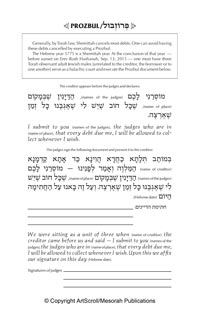
Prozbul Reminder – Free Download

Prozbul Reminder for Erev Rosh Hashanahprozbul_download3

The Torah provides that outstanding loans between two Jews are automatically nullified atthe very end of the Shemittah [Sabbatical] year (Deuteronomy 15:2). Hillel the Elder observed that the wealthy, fearing their money would not be repaid, refused to lend to the poor prior to Shemittah. This not only caused a hardship for the poor, but was also a direct transgression of the Torah’s exhortation not to refrain from lending (ibid. 15:9-10).
To remedy this situation, Hillel enacted the prozbul, a legal document by means of which a creditor transfers his loans to a court. [Three knowledgeable laymen may constitute a court for this purpose.] Once the debts have been transferred to the court for collection, they are not nullified by Shemittah (Sheviis 10:2), as implied by Scripture.
Since Shemittah nullifies loans at the end of the year, it is advisable to delay writing the prozbul until Erev Rosh Hashanah, so that it will cover all loans made up to Rosh Hashanah. A prozbul should be made before Rosh Hashanah this year.

Click here to download.

Free Download: Wisdom For Living

New Release: Wisdom for Living:  Rav Noach Weinberg Zt”l on the Parashah

The Gross Family Edition

Rav Noach Weinberg, a pioneer in Jewish outreach and the legendary founder and Rosh Yeshiva of Aish HaTorah, was a man whose very essence was love – love for Hashem, His Torah, and His people. Rav Noach’s entire being radiated wisdom and joy, and no wonder: he was profoundly and deeply connected to the Torah, the source of all wisdom and true happiness.

And how he loved to give over that wisdom. His Thursday night Torah lectures were legendary. The newest arrival to Aish HaTorah and seasoned kollel students — everyone wanted to hear what Rav Noach had to say about the weekly parashah, and how we could take Toras Chaim, the Torah’s wisdom for living, into our own lives and challenges.

In Wisdom for Living, Rav Noach speaks to us with all the brilliance, passion, and fervor that he brought to those unforgettable Thursday night sessions. His devoted students, Rabbis Nechemia and Yitzchak Coopersmith, have adapted those lessons for print, scrupulously maintaining Rav Noach’s unique and beloved voice. In every parashah Rav Noach uncovered a piercing insight for our lives. Sometimes he discovered a truth to help us break down our barriers to greatness, other times he shared an unexpected insight into the workings of the cosmos – or our own daily lives. This remarkable book shares some of Rav Noach’s revolutionary approaches to understanding the wisdom of the Torah in today’s world.

Click here to download the chapter on Parashas Bamidbar from Wisdom for Living

Click here to purchase Wisdom for Living

Also from Rav Noach Weinberg: What the Angel Taught You