PESACH: Stealing the Show

Adapted from: Haggadah with Stories by Rabbi Nachman Seltzer

The minhag of children “stealing” the afikoman is one of the best-known traditions of Klal Yisrael. The Gemara in Pesachim (109a) writes, “We snatch the matzos on the night of Passover in order to keep the children awake.”

This line from Pesachim indicates the possibility that the practice of “stealing the afikoman,” may have already been around in the time of the Gemara. It seems possible that even back then, the head of the household would break the middle matzah, put one part back in its place, then put the other one down so that the children could find it. (In some households the leader of the Seder hides it away, and the children have to find it. Slightly different method, but same idea: keep the kids engaged an interested — and awake!)

We all know the drill. It’s a lot of fun — but what’s the point of the minhag? Why the whole setup to enable the children to hide away the afikoman when their father isn’t looking?

Throughout the Seder, we do all kinds of things to prompt our children to ask questions. And the more the child asks, the better. Basically, allowing the children to “grab” the afikoman and hide it away is a play to ensure that they stay awake and focused on everything happening at the Seder table.

But everything we do at the Seder also has a deeper significance. There must be something else going on here. Rav Avigdor Miller quotes the Dubner Maggid and explains what we are actually accomplishing here.

The Dubner Maggid says that the custom of breaking the middle matzah, and putting away the larger half to eat later as the afikoman, represents the efforts we should be making in this world to put away as much reward as we can for Olam HaBa. This is actually what the word tzafun implies — that what we put away is “concealed” for the World to Come.

Says the Dubner Maggid: “The head of the household works so hard to provide his family with everything they need. And after making sure that everyone has what they need for Pesach (and the rest of the year), he should find himself thinking, What about me? I need to put away something for myself for the next world…”

In essence, the many demands of this world try to “grab” the matzah that the leader of the Seder is putting away for the World to Come.

Rav Avigdor Miller adds that one of the reasons that the children are taught to “grab” the afikoman at the Seder is to remind us of what happens over the course of the year — how we are enslaved by the society in which we live, a society that keeps us focused on our material needs and wants and distracts us from spiritual pursuits. The “stealing” of the afikoman reminds us that we need to “grab” time for ourselves, to devote our time to spiritual activities, putting away at least part of our resources for the Next World.

In light of this, we can offer yet another understanding of this minhag.

Maybe the reason we tell our children to “grab” the afikoman is not just to keep them awake, but for ourselves as well. The more the children are involved in the Seder, the more we become absorbed in our role of passing the tradition on to the next generation. By virtue of the fact that the children are engaged in what’s happening at the Seder, they are helping us remain focused on our role.

There are times in life when we do things because we want to help our children, and then, after thinking about it, we realize that we benefited ourselves as well. True, they are the ones who are supposed to ask the questions, but at the end of the day, it’s the questions that they ask and that we answer that helps us understand the story of the Haggadah on a much deeper level. 

PESACH: Hold onto Your Roots

Adapted from: A Most Meaningful Seder by Rabbi Yechiel Spero

Maggid isn’t just another part of the Seder. It’s THE part. 

Listen carefully, because tonight, your father, or whoever is the head of the household, has a story to tell. And it’s not just their story. It’s your story: your family, your roots, and the foundation that keeps us all standing strong through the winds and storms of history.

Story: The Tree-Lined Boulevard

In the early 1920s, Winston Churchill, the future prime minister of England, visited Eretz Yisrael. As part of his trip, he came to see the young city of Tel Aviv, a small, dusty town just beginning to grow. The leaders of the city wished to make a strong impression. They wanted Mr. Churchill to see that their city was modern and beautiful.

The main street, Rothschild Boulevard, was supposed to be the pride of the city. But there was a big problem. It didn’t have any trees. A boulevard without trees? The thought was embarrassing! How could they call it a “boulevard” and welcome such an important guest without any greenery to provide shade or beauty?

Meir Dizengoff, the first mayor of Tel Aviv, came up with a bold plan. He ordered workers to bring in fully grown trees and “plant” them along the street overnight. The next morning, the once-empty boulevard looked grand, with tall, leafy trees lining the path Mr. Churchill would take.

When Mr. Churchill arrived, the city was buzzing with excitement. People waved flags, cheered, and gathered to see the famous British leader. Mayor Dizengoff proudly led Mr. Churchill down the tree-lined boulevard, beaming with pride.

But then, disaster struck.

A group of local kids was curious about the new trees and eager to catch a closer look at Mr. Churchill. So, they began climbing them. The trees, however, were still unrooted in the sandy ground. They couldn’t hold the children’s weight. One by one, the trees began to fall. First one tree toppled, then another, and then another.

The city leaders were horrified. Their grand plan to impress Mr. Churchill had come crashing down — literally.

However, instead of becoming upset, Mr. Churchill simply smiled. He patted Mayor Dizengoff on the back and said something simple yet memorable. “Roots. Without roots, the trees will never stand.”

Mr. Churchill’s statement wasn’t just about trees. It holds a deep message for us, too. Without roots, nothing can survive. Not trees, not people, and, most importantly, not Yiddishkeit.

As Yidden, our roots are our Torah, our mitzvos, and the mesorah passed down from generation to generation. These roots give us strength to stand tall, no matter how fierce the winds or how tough the storms of life may be. Without them, we’d topple, like those unrooted trees. But with them, we flourish and grow. 

Every year at the Seder, we connect to those roots. We remind ourselves of where we come from, of the sacrifices our ancestors made to pass the flame of Yiddishkeit from generation to generation. We remind ourselves that the strength of our future depends on the strength of our connection to the past.

Tonight, at the Seder…

As you begin Maggid, think about your roots. Where do you come from, and how can you grow stronger? Without roots, we cannot stand. But with them, we can weather any storm and grow taller than we ever imagined. 

CHODESH NISSAN: Going the Extra Mile

Adapted from: A Most Meaningful Seder by Rabbi Yechiel Spero

Pesach is like no other Yom Tov. From the moment Purim ends (and in some homes, even before that), there’s a hum in the air, a sense that something big is coming. There are so many details: vacuuming floors, washing down surfaces, checking cabinets, scrubbing refrigerators and ovens and stoves… There’s something about Pesach that makes us want to go further, to be extra careful, to add an extra layer of protection. Even little kids pick up on it. 

Sometimes, though, you may want to know why everyone seems to be working so hard and going the extra mile. These thoughts may cross your mind when you’re told for the tenth time not to bring snacks into the room that’s already Pesachdik. Why are we so, so careful?

To answer, let me tell you a story.

It was a cold, rainy afternoon many years ago in Pittsburgh, Pennsylvania. Inside a large department store, people moved quickly from aisle to aisle, checking out the displays, but among the crowd was one elderly woman who stood out — not because anyone noticed her, but because no one did.

She wasn’t there to shop. She was simply wandering through the aisles. Her steps were slow, her face tired. To most of the salespeople, she was invisible. They gave her a glance and turned away, instead paying attention to the customers who looked like they were ready to buy something.

She continued walking, counter after counter, unnoticed. Until she reached the far end of the store. There, a young salesclerk stood, arranging items on the display. Unlike the others, he didn’t look past her or pretend to be busy. He stepped forward, his face bright with a smile, and asked, “May I help you, ma’am?”

She shook her head. “No, I’m just waiting for the rain to stop.”

The young man could have nodded and walked away. But he didn’t. Instead, he offered, “Would you like a chair?”

Before she could respond, he disappeared and came back carrying a chair. He placed it next to the counter and motioned for her to sit. The woman smiled — a real smile, one that lit up her tired face. “Thank you,” she said gratefully as she sat down.

When the rain finally stopped, the young man didn’t just say goodbye. He walked her to the door, watching her carefully, making sure she didn’t slip on the wet sidewalk. “Take care, ma’am,” he said with a nod.

The woman turned to him before she left. “What is your name?” she asked. He told her, and she asked for his card. He handed it to her, not thinking much of it. It was just another rainy day, and soon he forgot about the encounter.

Months passed. Life in the store went on as usual. One day, the store owner received a letter from Scotland. It was a request to send the young clerk to take an order for furnishing a home. The owner was puzzled. The young man didn’t work in the furniture department. He worked in sales. The owner suggested sending someone more experienced for the job.

The response came back quickly: No one but this young man will do.

It turned out that the elderly woman wasn’t just any customer. She was Andrew Carnegie’s mother. Carnegie, one of the richest men in the world, had asked her to go to the store and quietly observe how she was treated. She had noticed everyone who ignored her. And she had noticed the one young man who treated her with respect, offering her kindness when he had nothing to gain.

The young man was sent to Scotland, where he arranged for an order worth thousands of dollars. But that wasn’t all. He earned a partnership in the store. Over time, that partnership grew into half-ownership of the very business where he had once been just another clerk.

That simple act of kindness — a chair, a smile — changed his life.

Maybe that’s the lesson of Pesach. When Hashem chose the Jewish people, we weren’t the strongest nation. We weren’t the most powerful or impressive. We were slaves, broken and tired. But Hashem knew we were different. 

We did the small things, the extra things. We followed Him into the Midbar with nothing but emunah. And because of that, we are His beloved nation.

Like the young man in the store, we earned more than we could have hoped for. Hashem didn’t just take us out of Mitzrayim. He became our Partner. He gave us His Torah, His mitzvos, and nonstop berachos. And every Pesach, we remind Him why He chose us.

That’s what chumros (being extra careful and strict when it comes to halachah) are all about. They’re our way of going the extra mile, of saying, “Hashem, we’re still Your nation. We’re still the people who do more, who care about the details, who show You we’re different.” 

PARASHAS HACHODESH: From Now On

Adapted from: Around the Year with Reb Meilech by Yisroel Besser

This Shabbos marks the celebration of a beginning, which is itself a beginning: It is the start of the first month of the year, Rosh Chodesh to the rosh hachadashim, the first of the months.

Tzaddikim revealed the power of this Shabbos and its special koach to enable a person to begin again.

Reb Meilech lowers his head, and his shoulders sag. “Who am I? How will I ever climb up out of my current situation?” He asks this in a dejected, discouraged voice. “That is what ‘he’ wants us to believe, but this Shabbos tells us differently. Listen to the words of the Beis Avraham.”

The very first mitzvah we received was that of kiddush hachodesh, and where did we receive it? In Mitzrayim! While we were still there. This was to show us that a Yid who wants to get close to Hashem should not wait until he rids himself of his yetzer hara or until he feels like he is completely pure. Rather, while he is still in the pit, still in his personal meitzarim, he should find the strength to start serving Hashem.

Rav Gamliel Rabinowitz relates the story of a Rav who is on the way from Yerushalayim to Bnei Brak, where he is to be mesader kiddushin at a wedding.

On the way, the car he is in gets a flat tire, and it looks like he might be late for the chuppah, keeping everyone waiting.

Rav Gamliel Rabinowitz

Imagine the Rav would stop the trip then to analyze what caused the puncture — was it a nail on the road? A sharp rock? Was the tire itself faulty? — and refuse to continue until they determined the reason for the flat.

“Not only wouldn’t he make it for the chuppah,” Reb Meilech laughs, “but he wouldn’t even make it for the mitzvah tantz!”

They change the tire as quickly as possible and drive on. He has a chasunah to get to. Later, after the chasunah, he can do his investigation as to what happened.

We need to repair our holes, but not stand there and analyze, wonder, speculate, and consider, because then we’re stuck in place.

That’s the koach of chiddush, a koach given to us while we were still in Mitzrayim. Move on, move forward, and continue on your way; later, you can think about how to make sure you don’t fall again.

Chazal state (Berachos 4b) that one who recites Tehillah LeDovid three times each day is destined for the World to Come. This refers to the tefillah of Ashrei, and Rav Zalman Brizel would explain what makes this perek unique.

When a Yid finishes saying Ashrei, he concludes by calling out, va’anachnu nivareich kah mei’atah v’ad olam, halelukah, But we will bless God from now until forever (Tehillim 115:18).

“A person who proclaims three times each day that he is serving Hashem Mei’atah, from now,” said Reb Zalman, “is guaranteed Olam Haba. Fuhn yetzt bin ich a nai’eh Zalman, from now, I am a new Zalman,” he would say, “ready to try higher.”

Reb Meilech smiles. “Even if your name is not Zalman, the vort is true. Starting Mei’atah, from now, again and again and again, is how a person becomes great.” 

TORAH: Honoring Torah

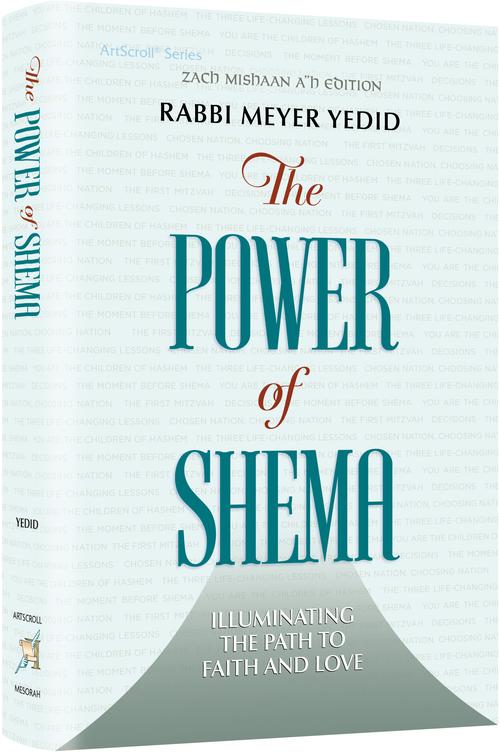
Adapted from: The Power of Shema by Rabbi Meyer Yedid

Torah brings so many benefits and Torah itself is so beautiful, so enjoyable, so great to be around as much as we can. But, like everything else in life, if you don’t give it the proper kavod, respect, you will not realize that potential.

We see this principle with regard to David HaMelech: When he was older, he no longer derived warmth from his clothing. Chazal tell us that this was because, on one occasion, David did not show respect to clothing the way he should have, at his level. On that occasion, he cut off a piece of Shaul HaMelech’s robe. He did it for a good reason. But again, Chazal saw in that a bit of disrespect for clothing. As a result, clothing was no longer able to benefit him.

And we learn a rule from that. The rule is that if you give honor to something, it will give you something back, and if you disrespect something, it will give you little, if anything, back. Whatever you respect in life will reciprocate. If we expect to have the Torah light up our life and light up our insides and outsides and light up our relationships and light up our middot, we first have to show it kavod. We have to respect it.

How do you respect Torah study? I saw a beautiful story about R’ Moshe Shmuel Shapiro. Somebody invited him to be the sandak at a bris taking place in a city nearby in Eretz Yisrael and he declined. One of the people who were close to him questioned why he declined. R’ Shapiro explained, “It’s true that when you go to a brit milah you meet Eliyahu HaNavi, but when I go to the Gemara, I meet the Ribbono Shel Olam! How can I leave the Ribbono Shel Olam in the Gemara in order to meet Eliyahu HaNavi?”

R’ Shapiro’s attitude was: When I’m learning, I’m learning with Hashem.

Is that the attitude we have when we open a Gemara, when we open a Chumash? Do we say to ourselves: We’re with Hashem? Do we give kavod to the Torah in that way?

That’s what we need to do.

R’ Moshe Shmuel Shapiro

We need to understand where the Torah comes from and Who we’re with when we learn it.

A person who loves the Torah makes sure he has time to learn it, whatever he’s capable of doing. Some people are capable of learning only twenty minutes a day. That’s it. They’re only capable of twenty minutes. But if they make sure to use those twenty minutes for learning, they’re giving kavod to the Torah. And some people can learn an hour and some people can learn two hours and some can learn ten hours. Whatever a person can do. The point is not how much; the point is to be mechabed the Torah, to honor it and recognize its value.

When you are mechabed the Torah, the Torah is mechabed you. It gives you all the benefits that you need.

How else are you mechabed the Torah? When you clarify things, when you try to understand things, when you do chazarah (review). Recently, I saw someone sit down and write notes on something he had just learned. That’s called kavod haTorah. When you see someone writing notes as he reviews, that’s called honoring the Torah: I didn’t come here just to show my face. I didn’t come here to check in and check out. I’m doing chazarah because it’s actually important to me. I want to understand it. I don’t want to forget it. That’s called kavod haTorah.

When you are mechabed the talmidei chachamim, when you are mechabed those who learn the Torah, that’s also called kavod haTorah. When you buy beautiful sefarim, when you don’t throw them around, when you have your own Gemara that you take with you — do you know how precious it is when someone brings his own Gemara from home and proceeds to learn with it? There’s nothing wrong with finding a Gemara on a shelf and using that, but when you bring your own, that’s kavod haTorah!

The more kavod haTorah we have, the more we will be able to learn and enjoy the Torah. 


PARASHAH: Round Trip Greatness

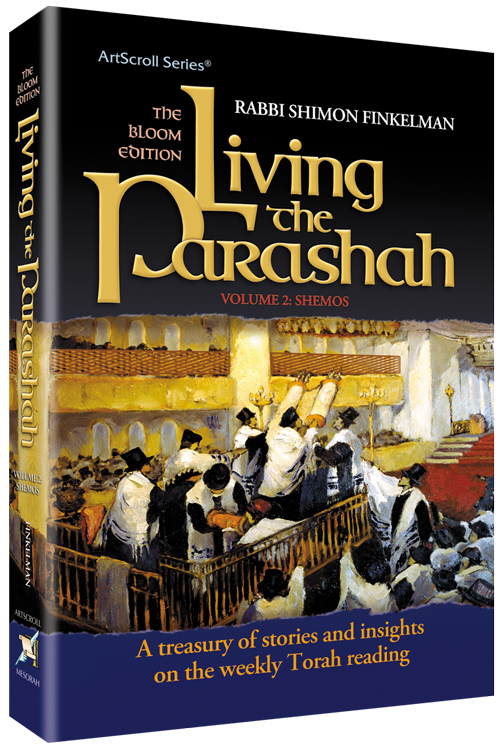
Adapted from: Living the Parashah — Shemos by Rabbi Shimon Finkelman

וַיֹּאמְרוּ אֶל מֹשֶה לֵאמֹר מַרְבִּים הָעָם לְהָבִיא … וַיְצַו מֹשֶׁה … אִישׁ וְאִשָּׁה אַל יַעֲשֹוּ עוֹד מְלָאכָה לִתְרוּמַת הַקֹּדֶשׁ

They said to Moshe as follows: “The people are bringing more than enough … [Therefore] Moshe commanded … “Man and woman shall not do more work toward the gift for the Sanctuary” (Shemos 36:5-6).

The builders and artisans informed Moshe that there were more than enough materials for the construction of the Mishkan, its vessels and the making of the Kohanim’s vestments. Moshe therefore issued a call which brought the preparation of materials to an end.

Why did Moshe say, “Man and woman shall not do more work”? Why didn’t he say, “Man and woman shall not bring any more materials”? Sefer Kli Chemdah suggests the following:

Picture a person who had prepared materials for the Mishkan, was getting ready to transport them to where the construction was taking place, and then heard the announcement that nothing more was needed. Surely, he would be hurt to see that his efforts were for naught. Moshe Rabbeinu did not want this to happen. Therefore, he announced that no more “work,” meaning preparation of materials, was needed. However, if someone had already prepared the materials, he was asked to bring them. They could be used for future repairs or to make additional vessels.

It is upsetting and frustrating for a person to see that his efforts were fruitless. Great people are careful to recognize the efforts of others on their behalf and to make them feel appreciated.

For Yonason Goldberg, it was a moment for which he had been waiting for a long time. He had traveled from Queens to Monsey to seek advice on an important matter from one of the generation’s luminaries, Rabbi Yaakov Kamenetsky.

Rabbi Yaakov Kamenetsky

The discussion did not last as long as Yonason had expected. With his keen insight and unparalleled wisdom, R’ Yaakov quickly cut through to the heart of the matter, resolving it clearly and succinctly. With the discussion apparently over, the sage asked his visitor, “Are you returning from here to Queens?”

Yonason nodded in the affirmative.

“Well, then,” R’ Yaakov went on, “I have a favor to ask of you. Our grandchild has been staying with us and needs to go to the airport in Queens. We already arranged for a neighbor of ours to undertake this mitzvah. But for whatever reason, he is not comfortable driving alone. My rebbetzin and I had said that we would accompany him on the round trip. However, if you can take our grandchild, there will be no need for us to go along.”

Yonason was only too happy to save R’ Yaakov and his rebbetzin from having to make such a trip. However, he was not ready to leave just yet. He had waited so long for this opportunity; there were other questions, none of them terribly urgent or important, that he wanted to ask R’ Yaakov. He proceeded to ask his questions, one by one. As soon as R’ Yaakov answered a question, Yonason had something else to ask. Only later did he realize that R’ Yaakov had been trying, in his very polite and friendly way, to draw the visit to a close.

Then the doorbell rang. It was R’ Yaakov’s neighbor, who had come to make the trip to the airport. R’ Yaakov had been unable to reach him at home and cell phones did not yet exist. “We’ll be with you shortly,” R’ Yaakov told his neighbor with a smile.

Then he said quietly to Yonason, “We will have to go with my neighbor. Had you left before he came, I would have explained to him that we found a ride that made it unnecessary for my rebbetzin and me to come along — and he certainly would have understood. But now that my grandchild is still here and the neighbor is ready and eager to make the trip, I think that he will feel bad if we tell him that we have found a different ride.”

And so, to avoid hurting the feelings of their neighbor, R’ Yaakov and his rebbetzin made the trip to Queens and back. 

CHESSED: A Ray of Light

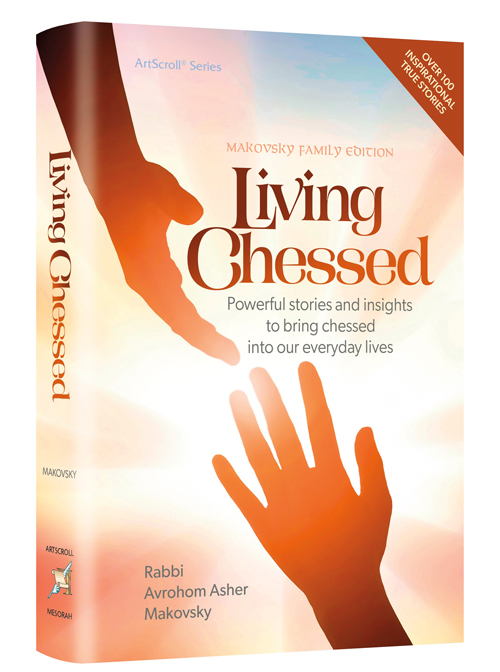
Adapted from: Living Chessed by Rabbi Avrohom Asher Makovsky

Moshe Walkin, a 21-year-old bachur from Lakewood, was learning at Yeshivas Mir in Yerushalayim. A few days before Lag B’Omer, his close friend ran to him bursting with excitement. “You’re not going to believe it!” he said. “I got a few VIP passes to pour the oil for lighting the Toldos Aharon bonfire in Meron!”

Moshe and his friends would be up-front and close to the center of the action. They would be able to pour the oil that the Toldos Aharon Rebbe would light!

The boys reserved an apartment in Meron and thought about little else but their thrilling upcoming adventure. However, Moshe got a call from his father, Rabbi Aharon Walkin, that would change the plan. Reb Aharon had been putting in a concerted effort to obtain all the permits needed during those times of Covid-restricted travel to come to Yerushalayim and pay a long overdue visit to his elderly father. He would be arriving right before Lag B’Omer and he wanted his son to come with him to visit his zeidy.

Moshe was disappointed. Instead of spending the night with his friends in Meron, he would be spending it with his father and Zeidy in Yerushalayim. However, Moshe knew what his priorities had to be. He told his father about his arrangements for Meron, adding, “But of course I’ll stay with you, Totty.”

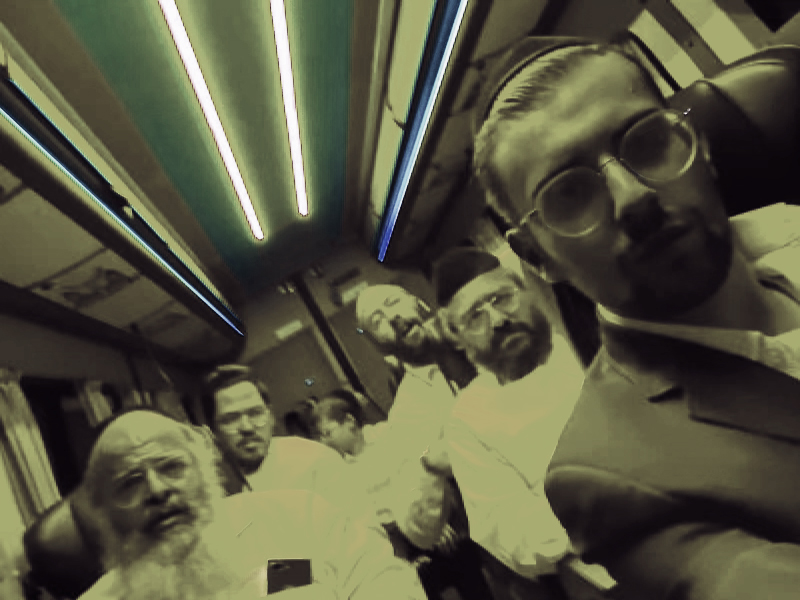
Reb Ahron and Moshe Walkin on the way to Meron

On Erev Lag B’Omer, at 5 p.m., Reb Aharon arrived at Ben Gurion airport. He took a cab directly to his father’s apartment in Yerushalayim, where he and Moshe spent several hours. At about 10 p.m., Reb Aharon told Moshe that he would drive with him to Meron to catch the remainder of the celebration.

However, by the time they arrived in Meron, several hours later, the police were stationed along the road turning everyone back. “No one is allowed into the area,” they were told. The Walkins had no choice but to return to Yerushalayim. They awoke the next morning to the shocking news. The combination of overcrowding and limited exits had resulted in causing the people to lose their balance, fall upon and crush each other. The epicenter of the tragedy was the Toldos Aharon bonfire, and the two friends with whom Moshe was supposed to share the experience — Dovi Steinmetz and Yossi Kohn— had perished in the crush.

The Torah gives us two ways to merit arichus yamim. One is the mitzvah of kibbud av v’eim. As Reb Aharon so eloquently stated, it took two hefty doses of this mitzvah to save Moshe’s life. “For me, leaving Lakewood to go visit my father in Eretz Yisrael was very hard to arrange. For my son, he had to give up this once-in-a-lifetime opportunity. It was with magnificent mesiras nefesh that he did kibbud av v’eim for me. With these two zechusim, he merited to be saved.”

No matter what happens, we have to look for the ray of light Hashem will always show us. In our present times, we often see it against the darkness, but we will soon arrive at the time when Hashem’s light will forever drive the darkness away. 

GREATNESS: Bedtime Stories

Adapted from: One for the Books by Rabbi Yechiel Spero

Little Leah was growing up in a Chassidishe mishpachah. Like most five-year-olds, she had her little routines, and when she woke up in the middle of the night, she always knew where to go—to the comforting embrace of her parents’ bedroom. That’s where the world felt safe, where she could drift back to sleep, enveloped by their presence.

One cold, dark night, Leah woke up and ran to her parents’ room, only to find it… empty. The beds were untouched, the lights were off, and there wasn’t a trace of her beloved father and mother. The house felt eerily quiet. She called out, “Mommy! Tatty!” but was answered with silence. A wave of fear gripped her. Where could they be?

She began wandering through the house, her small feet padding against the cold floor, her sobs growing louder as she searched each room. Yet her parents weren’t anywhere to be found. The house that had always been her haven now felt unfamiliar and vast. Tears streamed down her cheeks as she whispered to herself, “I just need someone… someone to help me fall asleep.”

What Leah didn’t know was that her parents had stepped out to a wedding, deciding to quickly run and say mazel tov. They had arranged for a neighbor to check in on Leah, but at this late hour, the neighbor wasn’t there. Leah was alone.

Then her eyes caught sight of a small piece of paper stuck to the fridge. On it was written a phone number. Leah had heard her parents talk about this number once. It was a number they said was only for the direst of emergencies. The kind of number you call when there’s no one else to turn to.

With trembling hands, Leah picked up the phone and dialed.

The phone rang. And rang. And rang. Each ring felt endless to the frightened little girl. Finally, just as she was about to hang up, someone picked up. A warm, calm voice came through the receiver. “Who is this?” the voice asked gently.

Leah took a shaky breath. “It’s Leah. I’m home alone, and I’m scared. My parents aren’t here.”

There was a pause on the other end. Then the voice spoke again, full of reassurance. “Don’t worry, Leah. Your parents will be home soon. You’ll be okay.”

“But I’m scared,” Leah countered. “And when I’m scared, my parents usually tell me stories. That’s what helps me fall asleep.”

The man on the other end of the line, with much sensitivity and warmth, didn’t hesitate. “Then I’ll tell you a story.”

And he did. He told her a beautiful story, weaving a world of comfort and imagination for the little girl. Her tears slowed; her breathing calmed. And then, as he began the second story, the line grew quiet. Leah was finally falling asleep, clutching the phone, her fears fading into the night. Now relaxed, she hung up the phone and went to back to bed.

The next morning, Leah ran to her parents, her face alight. “Mommy, Tatty,” she exclaimed, “I was scared, but I called the number on the fridge, and the man told me stories until I fell asleep.”

Her parents exchanged puzzled glances. “What number?” 

Leah pointed to the refrigerator, and when they saw the number, their faces went pale. That number served as a direct line to one person: their Rebbe, the Pnei Menachem, the Admor of Ger.

The Pnei Menachem

They asked Leah to repeat what happened, hoping it was a child’s dream. But Leah’s details were too vivid, too real. Their little daughter, in her moment of need, had called the Rebbe himself.

Overcome with a mix of awe and embarrassment, they rushed to the Rebbe’s house to apologize. How could they have allowed such a thing to happen? The Rebbe simply smiled, his face radiating joy. “There’s no need to apologize,” he said. “Baruch Hashem, the stories worked. That’s what matters.”

The Pnei Menachem taught them what it means to truly care for another Yid. Even a little girl in the middle of the night. Even when she calls unexpectedly. Because to him, every Yid mattered, no matter how small.

And Leah? She would carry that night in her heart forever, the night a tzaddik made her feel safe, simply by telling her a story.

PURIM: A Dance for the Ages

Adapted from: Living Higher by Rabbi Binyomin Pruzansky

While learning in Yeshivas Mir Yerushalayim, I witnessed firsthand how the rosh yeshivah, Rav Nosson Tzvi Finkel, who was stricken with Parkinson’s disease, would struggle to deliver his shiur as his entire body shook uncontrollably. However, although he may have been weak and in pain, he was tamid be’simchah, always happy. You heard the joy in his voice, and you felt it in his presence. The Torah he learned and taught gave him so much happiness and koach, enabling him to push above and beyond the norm.

“Ki heim chayeinu ve’orech yameinu.” When Torah is your life, it empowers your days, giving you strength and vitality.

The Ponevezher Rav, Rav Yosef Kahaneman, known as a prince of Torah, was focused on achieving his mission of building Yeshivas Ponevezh in Bnei Brak. Indeed, he merited to build one of the greatest edifices of Torah in the world. In order to accomplish his dream of rebuilding Torah after the war, he frequently traveled to America to raise funds, yet he never appeared burnt out.

Rav Yosef Kahaneman

On one such trip abroad, he returned to the home of his host, tired and worn out. His host brought him a hot cup of coffee. “Here, this will give you some strength.”

Rav Kahaneman gratefully took the coffee, but replied, “If you really want to give me strength, please give me the number of a wealthy person who can help support my yeshivah; that would be the best thing you could do for me right now.”

The host couldn’t get over it. “How do you keep going? Where did you get this fiery passion? Where did you develop this love of Torah?”

“It all started when I was a little boy of eleven years old,” Rav Kahaneman shared:

It was Purim morning. My mother was in the kitchen baking a cake, and she exclaimed, “I am so excited to bake a cake for the rav of our town. What a zechus to give honor to a tzaddik!” My mother’s excitement affected my father, who said, “I, too, have something for the rav. A peddler recently came through the town selling Gemaros, and I bought a Maseches Bava Basra from him. I know that the rav doesn’t have a full set of Shas in his home, and he is missing a Bava Basra. Now he will have it; how happy he will be.”

My older brother and I went to the rav of the town to deliver the mishloach manos and the gift. My brother held my mother’s cake and I held the Bava Basra. I handed the rav the Bava Basra and his eyes lit up. He kissed it and called out in joy, “How lucky I am, what a treasure, a whole masechta Bava Basra!” Then he danced around the table holding the Gemara, as if it were Simchas Torah and he was dancing with the Sefer Torah.

As the Ponevezher Rav told his host the story, he danced around the table, to demonstrate how the rav had danced. Then he continued.

The rav asked his wife, “Do you also want to give me mishloach manos?”

“Yes, of course,” she answered.

“Great! Yesterday we decided that we would begin our Purim seudah at 5:00 p.m. But if you would be kind enough to push it off until 6:00 p.m., then I can learn from my new Gemara from 5:00 to 6:00, for an uninterrupted hour. That would be the greatest mishloach manos gift in the world.”

The wife agreed and the rav danced around the table again.

“I was only eleven years old when this took place. But at that moment, I was so inspired that I made up my mind to dedicate my life to Torah and put everything I have into it. That is where I derive the inner strength, determination, and drive to build Torah in Eretz Yisrael.”

Sometimes, a seemingly insignificant action can lead to big results. The rav’s simchah and dancing inspired Rav Kahaneman to dedicate his life to building Torah, and thus Yeshivas Ponevezh was born. He became a partner in Rav Kahaneman’s work of building Torah in Eretz Yisrael.

When our homes are infused with true simchah, the simchah of the Torah, it can influence not only our children, but all of Klal Yisrael. 

PURIM: The Best Mishloach Manos

Adapted from: What if on Yamim Tovim 2 Adapted by Rabbi Moshe Sherrow from the works of Rabbi Yitzchok Zilberstein

Q: One Purim, around one hundred years ago, many Yidden who were residents of the city of Saana in Yemen brought mishloach manos to Rabbi Shlomo Alkara, their beloved rav. One poor Jew also wanted to bring mishloach manos to the rav, but he had nothing in his home to offer. The only food he found was a rotten radish. He wrapped it in a pretty napkin, put it on a plate, and waited on line to give it to the rav.

When he presented his offering to the rav, the rav’s face lit up and he blessed the man warmly. When the next man in line gave the rav his mishloach manos, the rav blessed him and in return gave him as mishloach manos the package he had received from the poor man. When the man unwrapped the napkin to examine its contents, he discovered the rotten radish.

The rav spoke immediately. “Do you think that the man wanted to insult me? Chalilah v’Chas. This was the offering of a poor man who had nothing else to give. Such an offering is exceptionally precious. On this the pasuk states, v’nefesh ki sakriv korban minchah la’Hashem, When a man among you brings an offering to Hashem; he brings his nefesh (soul) with the offering. And now, if you are zealous for my honor, fill this man’s house with bounty so he will have the means to give an honorable mishloach manos.”

Everyone sent the poor man mishloach manos as per the rav’s instruction, until he was inundated with food. In this way, the townsmen fulfilled the mitzvah of mishloach manos as well as the mitzvah of matanos l’evyonim.

Could the poor man have fulfilled the mitzvah by proffering a rotten radish, had there been another food accompanying it, or, since a rotten radish is inedible, was it eligible to use for the mitzvah?

A: The Chasam Sofer explains that there are two reasons given for the mitzvah of mishloach manos. The Terumas HaDeshen maintains that it is in order to ensure that people will have the wherewithal with which to make a seudas Purim. Even if the recipient has more than enough food for his Purim feast, one has nevertheless fulfilled the mitzvah. In that way, even those who do not have enough will not be embarrassed to accept for themselves, since all Jews send each other gifts of food without discrimination. The Manos HaLevi taught that the rationale behind the mitzvah of mishloach manos is to create peace and love between Jews. This is to contradict Haman’s accusation that the Jews are dispersed and separated by machlokes (strife). Thus, we have a mitzvah to effect the exact opposite.

It would seem that a rotten radish could not be used for the seudas Purim, nor would it engender peace and friendship, so according to both reasons, it could not satisfy the requirement of mishloach manos. It must be that the radish was not completely rotten, and although a more discriminating diner might not have eaten it, most people would.

The poor man recognized the rav’s great stature, including the fact that the rav sufficed with simple fare, as the mishnah teaches us in Pirkei Avos, kach hi darkah shel Torah; pas b’melach tocheil… This is the way of Torah: Eat bread with salt ….” The rav would certainly have been satisfied to accept such a radish; hence, the man would have fulfilled the mitzvah of mishloach manos had he given another food item with it.