


Free Download: Tefillah for Tu B’Shvat!

Adapted from: The Power of Shema by Rabbi Meyer Yedid
We want to succeed at everything we do in our lives. If we thought that we couldn’t succeed at something, then we probably wouldn’t do it.
If so, how does a person guarantee that he will be successful? Is there some formula we can use to know that we are on our way to success?
And not only success, but pleasure too?
Let me pause to make myself perfectly clear: To the American mind, “success and pleasure” describes easy street, a life of leisure with nothing to do. That’s not what I’m talking about. I am not saying that life will be easy. Life wasn’t meant to be easy. But even if it is not easy, you can still live a successful and enjoyable life.
So, again, is there a way to make sure that, when I get involved with something, I am going to succeed and I am going to enjoy it?
I’m going to give you a rule. The rule is:
If you do it lishmah, then you will succeed and you will love it.
When I say lishmah, I mean doing it for the right reason. Whatever you involve yourself with in life, if you do it for the right reason, then you will succeed. And you will love it.
Let me state the rule the other way around: Whatever you’re involved with, if you do it for the pleasure, then (A) you will probably not succeed, and (B) you will probably not enjoy it.
I’ll give you an example.
Let’s talk about going to school. When you go to class lishmah, it’s a different class. It’s a different school experience. But you might ask: What does that mean? How would I go to school lishmah?

Lishmah in school means that I’m going to school because I realize I need to learn. I need wisdom to succeed in life. I realize that, in order to become successful, I have to know many things in many areas. So I am going to school to get that.
Imagine a seventh- or eighth-grader, or a high school student, whether a boy or a girl, going to school lishmah. Do you have any idea what going to school lishmah would be like as opposed to shelo lishmah? When you go to school lishmah, you become a great student, you succeed. No matter what level you’re on, you succeed and you love it. You love going to school.
If you do it shelo lishmah — you’re going to school because your parents told you to go, or because you have no choice — then your rate of success will plummet and you won’t enjoy it either. You won’t like it because you’re not lishmah.
I once told a group of students that they would enjoy their school experience much more if they were lishmah.
And they said, “But we don’t see the value in school. How can we be lishmah?”
So, before I continued, I asked for their forgiveness in advance. And then I said, “I’m going to argue with you. I can prove to you that you see the value in school.”

I then asked them, “Do you plan to get married and have children one day?”
“Yes.”
“When you have children, will you send them to school?”
“Yes.”
“That’s not nice,” I said. “If you are suffering by going to school, why would you make your kids suffer?” I asked them, “Would you send them to, like, a camp type of school, or a real school with real work?”
“No, no; the best school.”
“Would you want your children to do well in school?”
“Of course.”
“But you said you see no value in school. It’s not true. Of course, you see value in school!”

A great man told me something years ago that he said changed his life. In many ways, it changed my life too. He said that, at a young age, someone told him that when you have to make a decision in life, especially an important one, make believe you’re making this decision for your children. Don’t decide for yourself. When you decide for your children, you will realize, all of a sudden, how much clarity you really have. When it comes to yourself — because you’re lazy, because you have certain things that block or bias you — you don’t see straight.
Think about your children. That’s how you should make decisions. The option which is truly lishmah will then be clear and no longer clouded by your personal limitations and biases, and your chances to succeed and enjoy the journey will be so much greater.


Adapted from: Beis Halevi on Bitachon by Rabbi David Sutton
One is obligated by the Torah to give charity, but what is not well known is that the Torah also tells us how one should give charity.
Rabbeinu Yonah (Shaarei Teshuvah 3:35) explains that to achieve generosity, it is not enough to just try to give more money; rather, one must work on developing a generous heart.
Giving charity both generously and with happy feelings is not just an advisable idea; it is part of the Torah obligation!

But how does one achieve this, as it is very hard to part with hard-earned money?
The answer, as Beis HaLevi teaches, is through bitachon. One who has bitachon knows that his money is all a gift from Hashem. It is not a result of his hard work, but rather of Hashem’s kindness, and is therefore truly His. Such a person does not find it difficult to part from his money; he gives generously and happily, trusting Hashem to keep His word, and repay him for his deed.
And there is another important aspect to giving charity.
The Gemara (Bava Basra 10a) states that on Rosh Hashanah, Hashem determines the amount a person is going to earn, as well as the amount he is going to lose. If one merits, the money he is destined to lose will go for charitable causes; if he does not merit, the money will end up in the hands of unworthy people.
Thus, the amount of money one is destined to lose is already decreed in the beginning of the year. However, it is up to the person to decide how he will part from the money.

The Gemara proves this from a story. R’ Yochanan ben Zakkai once dreamt that his nephews were going to lose 700 dinar — a very large sum of money — during the coming year. R’ Yochanan implored them to donate significant sums to charity. They heeded his advice, and they donated a total of 683 dinar.
On Erev Yom Kippur, government officials came to collect 17 dinar in tax money from R’ Yochanan’s nephews. They were very frightened, afraid that the government would then be demanding more.
R’ Yochanan assured them that they had nothing to fear. He informed them of his dream, and explained that by donating 683 dinar to charity, they reduced the decree to just 17 dinar, and so this was all they were going to have to pay.
The Chofetz Chaim asks: Why is it necessary to have two different decrees — how much one will gain and how much one will lose? Why doesn’t Hashem simply decree how much one will earn in total? Instead of decreeing, for example, that a person will earn $200,000 and lose $20,000, why doesn’t Hashem simply decree that he will earn $180,000?

The Chofetz Chaim explains that as a result of one’s sins, one is deserving of punishment. Hashem therefore issues two separate decrees for our benefit, so we can earn atonement without enduring severe calamity. Through these two separate decrees, one can “redeem” his punishment through financial losses. If he simply made less money, the decrease would not count as a “redemption” because he would not feel the pain of actually losing it. By first decreeing that the person should earn a certain amount and arranging that he lose some of it, the loss can serve as his punishment for his sins, in lieu of something more severe.
The Chofetz Chaim adds that, as stated in the Gemara, not only does the loss of money serve as a protection from more severe punishment, giving to charity has the same effect. Thus, charity offers a double benefit; it has the effect of reducing the amount of money one is destined to lose and, secondly, it is a precious mitzvah, for which we will be richly rewarded.
Internalizing this concept makes the mitzvah of giving charity not only a great mitzvah, but a positive experience as well.


Adapted from: The Power of Shema by Rabbi Meyer Yedid
In the Va’eira issue of At The ArtScroll Shabbos Table, we mentioned that one of the definitions of the word shema is “to gather.” Ultimately, it’s all about caring for your brothers and sisters, seeking the best for each one of them in his or her uniqueness, and for Am Yisrael as a whole. There’s an interesting allusion to this in Tehillim (136:13): Le’gozer Yam Suf l’gizarim ki l’olam chasdo. When Hashem split the Yam Suf, He didn’t just split it in two; He split it so that there were twelve parallel paths, each surrounded by walls of water, standing in place. It must have been a beautiful sight, but what was the message? Why couldn’t they all go on the same path? Why did there have to be walls of water in between?
I once heard a beautiful explanation. You know that every person in life has his path, and every shevet, every tribe, has their path. And you may have noticed also, if you ever saw a drop of water sit as a blob upon a printed word, that the water acts as a magnifying glass. The letters you see through that drop of water look larger than the letters outside it. I once heard this explanation: When the Jewish people were crossing the Yam Suf, each one was walking in his own path. Each one had his own mission and his own goal that he needed to reach. But, if you’re part of Am Yisrael, you cannot just walk in your own path and be oblivious to everything else. Aren’t you worried about the guy next to you? So you have to look on the other side to make sure that he too is proceeding, and succeeding, in his path. You look and you see his needs, and how you can help. And to do that properly, you need a magnifying glass. The walls of water functioned as a magnifying glass.
Kol Yisrael areivem zeh bazeh, All Jews are responsible for one another. That’s why if an unexpected guest arrives late to a Friday night meal, and the host has already made Kiddush, nevertheless, the host can make it again for the guest. If the host doesn’t need it for himself, why make it for someone else? Let the guest make Kiddush! The answer is, Kol Yisrael areivem zeh bazeh. As long as someone else didn’t make Kiddush, I also have not made Kiddush yet. My responsibility is: One is for me, and one is for you. And as long as you didn’t do it, I’m still responsible.
This is what the fourth meaning of Shema is all about. We turn to each other at the beginning of the Shema and we say, “Let’s go! Let’s do this! But let’s do this together, both as interconnected individuals and as an indivisible nation.”

Shema Yisrael says to us: When you accept Hashem as your guide, don’t forget, you are part of a much bigger group. You are not by yourself. You are part of a great nation, and we have to be responsible for that nation. All of us together. And that’s how we live together in this nation. We live, each one doing his own thing. Each one on his or her path. Each one crossing the Yam Suf. But every once in a while, we look through the magnifying glass to make sure all the other people are also walking through themselves. And whatever it is that we can do to help, we make sure to do it. That’s what we do. That’s what Shema Yisrael is.


Adapted from: A Heart for Another by Rabbi Yaakov Bender
My rebbi, Rav Shmuel Berenbaum, wasn’t a featured speaker at assemblies or conferences, and his students knew that if they wanted him to be mesader kiddushin at their weddings, then they had to wait until after second seder for the chuppah to begin.
Many of our weddings took place in Aperion Manor, simply because it was close to the yeshivah. Someone else would fill in the kesubah, and the chassan and kallah would make all their preparations; the chuppah waited for the Mirrer Rosh Yeshivah to arrive just after 8:00!
He davened in yeshivah and learned mussar seder and kept sedarim like a young Torah student on the first day of the zman (semester). Physically and geographically, his footprint was very small. He lived his life within a relatively small space, traveling between yeshivah and his home.
But from his corner, he left such a huge impression. Seventy-five thousand people showed up to his levayah, each of them feeling a profound sense of mourning. They understood that with his diligence in Torah, he was creating a current of berachah and protection that flowed well beyond Ocean Parkway; his Torah elevated all of them.
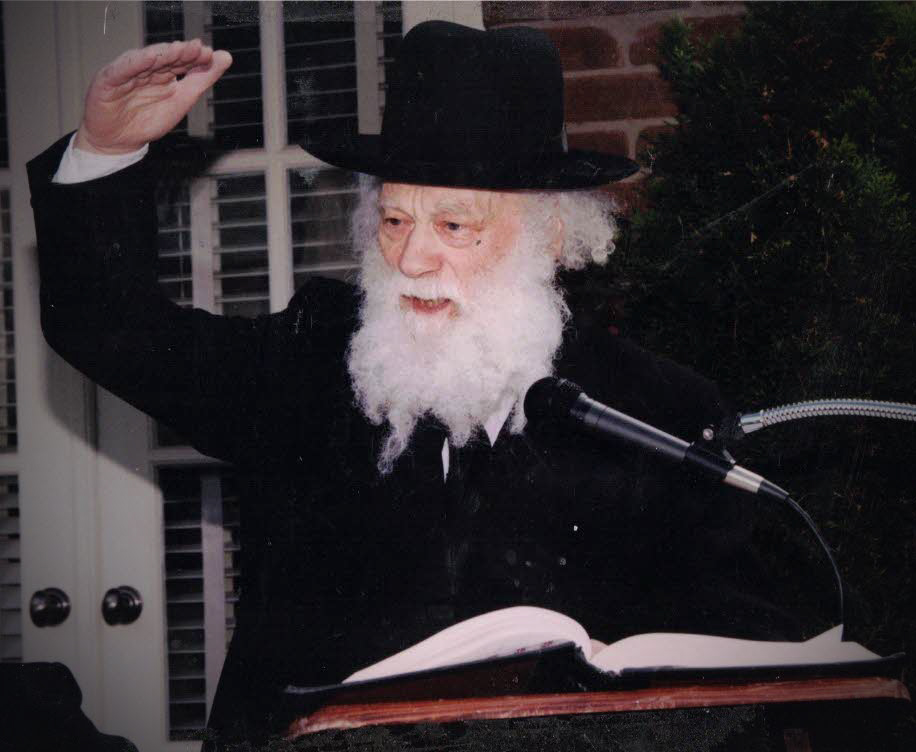
He was not one for lengthy meetings and activism, but somehow, with just a few conversations, he launched an international chessed organization — a fund that is active and thriving until today — benefiting young Torah scholars who, like him, make such a profound impact on the world without moving from their shtenders.
And because he lived this way, able to shake heaven and earth from his little corner, he wanted us to realize that we had that same potential.
My mother would go to the country during the summers, taking my younger siblings to the bungalow colony, but I stayed back in Brooklyn so as not to miss yeshivah.
There were no options of finding a ride upstate on Friday afternoons, so I did what most bachurim did, and left on Thursday night. On Sunday, Reb Shmuel asked where I had been Erev Shabbos, and I explained why I had left early.
He didn’t like the explanation. “This week, you will stay on Erev Shabbos too and I will pay for your car service up to the mountains,” said the Rosh Yeshivah, as if it was the most obvious solution in the world.

The Rosh Yeshivah, who did not have an extra dollar, made it clear that whatever it would cost, it was a small price to pay. He wanted me to know this secret, about the impression left by an ordinary yeshivah bachur sitting in his seat for a few hours on a summer Friday.
This Gadol, who took such splendor, such beauty, and such glory with him when he passed away, wanted all of us to realize that not only did we each have that power, but that we each bore that responsibility.
If a person can leave an imprint, they must. Now, in a media-driven world, we confuse relevance with prominence. We live in a world that is impressed by publicity, and if someone is famous or popular, their opinions are assumed to be worthwhile.
There is a Rashi — one of the most famous Rashis in the Torah — that tells us differently. And Yaakov left from Be’er Sheva and he went to Charan (Bereishis 28:10). If he went to Charan, isn’t it obvious that he left Be’er Sheva?
Rashi explains that it is obvious that he left Be’er Sheva, but the pasuk is teaching us that his leaving itself made an impact, because when a tzaddik leaves a place, its glory, splendor, and beauty depart along with him.

Yaakov did not merely go to Charan — he left Be’er Sheva, and this made a difference!
The Kli Yakar asks a question. If the impression was made by the fact that Yaakov Avinu was a tzaddik, then why did his leaving the city make such an impact: Weren’t Yitzchak and Rivkah tzaddikim? They were still there, so in their merit, that glory, splendor, and beauty should have remained!
Clearly, what we see here is that every single person has the ability to leave their own imprint, their mark of splendor and beauty, and a tzaddik epitomizes this! Yitzchak and Rivkah certainly had an effect on their surroundings, but none of them could create the unique impression that Yaakov was meant to leave.
In America, they say that no one is indispensable. They say, cynically, that the cemetery is filled with people who were considered irreplaceable.
This Rashi says differently. It says everyone is indispensable, and that people who live their lives aligned with Hashem’s Will have a unique mark that they are meant to leave on creation.

Dear Friends,
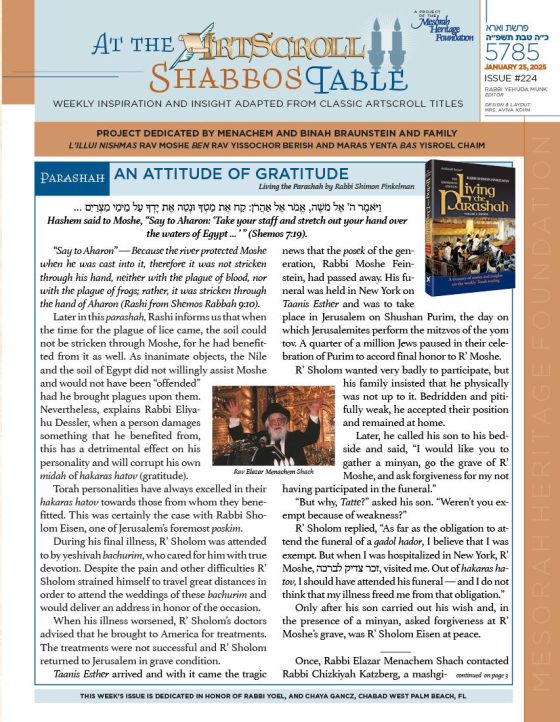
Below please find the latest edition of At The ArtScroll Shabbos Table, containing inspiration and insight from classic ArtScroll titles.
This weekly publication will contain a rich collection of stories, divrei Torah and insights that are suitable for the Shabbos table – or for anytime. We hope you enjoy and look forward to future issues, as we tap into the unparalleled treasure trove that is the ArtScroll Library, sharing the depth and beauty of our Judaic and Torah literature with you.
Read it. Be uplifted. And share the inspiration.
Have a good Shabbos.
Click HERE to view, download At The ArtScroll Shabbos Table – Bo




Adapted from: Rav Pam on Chumash by Rabbi Sholom Smith
הַחֹדֶשׁ הַזֶּה לָכֶם רֹאשׁ חֳדָשִׁים
This month shall be for you the beginning of the months (Shemos 12:2).
The mitzvah of Kiddush HaChodesh, the sanctification of the new moon, was the first commandment given to the Jewish people as they were about to become a nation. Kiddush HaChodesh is the manner by which Jews measure the passage of time and is the basis for the yearly cycle of Yamim Tovim.
Sforno comments on this mitzvah, ‘‘From now on, the months will be yours to do with them as you wish.’’ There is a deep significance in Kiddush HaChodesh as the first mitzvah presented to a nation of freed slaves. A slave has no time to call his own. His days and nights are controlled by his master. Freedom means the ability to use time as one wishes and not be dependent on the needs or desires of one’s master. Only when a person is in control of his time can he be a mitzuvah v’oseh to perform the mitzvos of the Torah. Therefore, as a prelude to their new obligations to uphold the Torah, Klal Yisrael was given this special mitzvah which is the key to all the other mitzvos.
It is the Beis Din’s task to sanctify the cycle of months. It is the task of every Jew to sanctify the gift of life he has been given by proper utilization of time.
When a person has a sizable amount of money to invest, he doesn’t simply accept the first offer that comes his way. He will seek the advice of expert investment bankers to guide him because his financial future is at stake.
Yet while most people understand that investing money requires careful forethought, very few people realize that even more forethought, advice and planning is required in investing time — a commodity infinitely more valuable than money.
Every human being is allotted a specific amount of time on this earth and a person’s task is to make the optimum use of this priceless gift. In what should a person invest his time to yield the greatest ‘‘returns’’ in this world and the World to Come? Someday a careful reckoning of every moment of life will be made by the Heavenly Court to ascertain if this gift of time was used properly.

The Chofetz Chaim would often repeat the following aphorism to his students: ‘‘Ihr meint az men darf zine frum? Men darf zine klug!’’ (‘‘Do you think you have to be frum? You have to be smart!’’) His intention in this remark can be explained with a statement from the Gemara (Chagigah 4a) which teaches that a shoteh is defined as someone who loses whatever is given to him. Thus, a person who is given the gift of time and life and thoughtlessly wastes it with nonsense is in the category of a fool.
Yet in America there are multi-billion-dollar industries devoted to helping people ‘‘kill time’ which, given its immense value, is essentially first-degree murder.
Let us not fall victim to their tactics by discarding our valuable time — essentially our lives — and utilize the gift of time and thereby earn the full blessings of Hashem to live our life to the very fullest.


Adapted from: A Heart for Another by Rabbi Yaakov Bender
It is hard to describe what it means to be an adam gadol or, for that matter, an ishah gedolah.
The secular world wrongly assumes that our leaders hold that position because they are the greatest teachers, most capable of imparting knowledge. While it is certainly true that our Gedolim generally teach Torah, what makes them great — and what inspires us when we are around them — is that they are elevated people.
Yeshiva Darchei Torah owes its existence to a baalebos who was one of the pioneering bnei Torah in Far Rockaway. A talmid of Rav Chatzkel Levenstein, Reb Yisroel Bloom burned with zeal to do, to build Torah and chessed.
His son shared a childhood recollection of how his father would bring small change to shul each morning, twenty-six cents for the pushka — one quarter and one penny.
The child wondered why his father specifically gave that amount each morning.
“Dovid,” Reb Yisroel answered his son, “it is because a Yid must give what he can — and then he should push himself to give a bit more… Twenty-five cents is the normal amount, so that extra penny represents the push to do more…”
Yiddishe tenuos. Yiddishe hergeishim. Innately Jewish feelings and gestures. There is no halachah that says anything about giving a penny above what is considered normal, but those who had the opportunity to be around great people picked up this approach of constantly striving for more.
Greatness is in the small details, and to me, it is a special zechus for our yeshivah that its founder was a Yid who lived this way, always pushing himself to do a bit more.

When I had my first opportunity to visit Eretz Yisrael as a newlywed, I was eager to encounter the Gedolei Yisrael whose names and lessons had inspired me since I was a child. I davened a tefillah in the Ponevezher Yeshivah, using the opportunity to observe the conduct of the sainted Mashgiach, Rav Chatzkel Levenstein.
Every part of his tefillah was sublime, the yiras Shamayim radiating from him, but what is especially memorable is what happened when davening was over. He went to straighten the shelf of siddurim, arranging them into order and ensuring that they were given the proper kavod.
Is that the halachah? I do not know. But it is pure Yiddishe hergesh and it’s part of becoming great!
I still remember a habit of my sister, Rebbetzin Esther Epstein, and it always moved me. She lived in Boro Park, in the same house as my mother, so I was often there visiting. I noticed that whenever an ambulance passed by the house, sirens blaring, my sister would stop what she was doing and say a kappitel Tehillim.
She did not give a shmuess explaining the minhag, because she did not have to. If we are all family, then when an ambulance is heard in the neighborhood, there should be worry and concern, so this reaction is only appropriate.
The tenuos of Yiddishkeit…
I remember a Yid at whose side I merited davening Shacharis every morning. Reb Mordechai Aryeh Yosef Weinberger was a simple, ehrliche Yid from Ungvar — but there was nothing simple in the way he davened.
He slowly, lovingly unwrapped his tefillin, tefillin that had miraculously accompanied him through Auschwitz, tefillin that he had donned at some of the darkest moments of Jewish history; and in Far Rockaway of a half-century later, he wore them with pride.
This image, an older man in a windbreaker holding tefillin as if they were the greatest treasure imaginable, seared itself onto my mind. I know that there are people who have tefillin that were written with more hiddurim, but I don’t know too many people who put on their tefillin with such humility and gratitude. When he replaced them in their bag, it was with the seriousness of a person replacing a diamond in its setting.
His tefillin might have had a special history, but every pair of tefillin is just as precious. We have to remain sensitive to that, and not let ourselves be distracted and pulled away by a world that comes so fast, relentless in its push to deprive us of those feelings.
Sometimes, it is the smallest actions that tell of a person’s greatness.

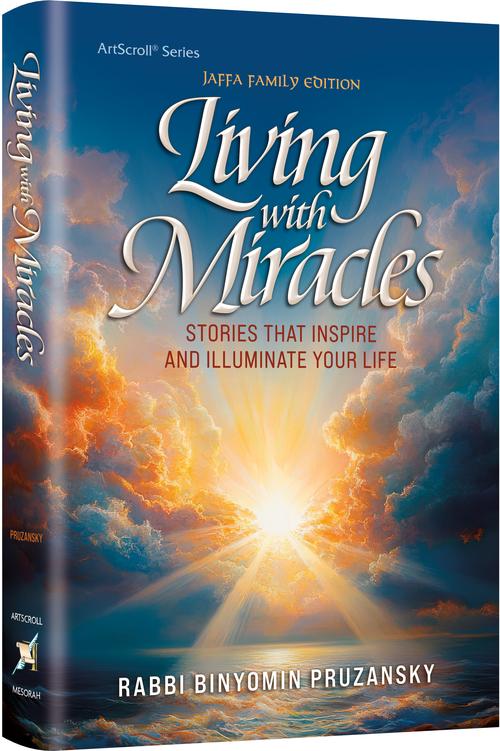
Adapted from: Living with Miracles by Rabbi Binyomin Pruzansky
The Spring Hill Times is a relatively new publication that has inspired many Jews around the world. Most newspapers carry all types of news, from happy and inspiring to sad or even tragic. Rabbi Yitzchok Kaufman of Chestnut Ridge, New York, decided that Klal Yisrael needed a publication that carried only positive, uplifting news. He fills his publication with stories and articles that inspire emunah and bitachon. It provides perfect reading for Shabbos, as it imbues readers with joy and pride in being a Jew.
On Monday morning, Parashas Behar, 2024, Rabbi Kaufman sat looking at the $3,650 bill that sat on his desk awaiting payment. If he wanted to keep the Spring Hill Times running, he had to come up with the money. He decided that as a merit for his father’s neshamah, he would dip into his own savings to cover the bill; certainly, in some way, Hashem would repay him.
That Thursday night, on arriving home, he took in the mail. One envelope was from New York State. On opening it, he found a check. The accompanying letter explained that the money was a bonus the state had granted to playgroups like the one his wife ran. It was worth more than double the amount he had paid out for the newspaper! Rabbi Kaufman knew Hashem would repay him, but so much, so fast? He could hardly believe his eyes.
On Friday, he woke up to find a message on his phone from his brother who lives in Kiryat Sefer:
“I have amazing news to share with you. I just bought a desk for my son, and he wanted to put a picture of a gadol on it. As you know, I have a lot of things in storage that you left behind when you left Eretz Yisrael, and in one of the boxes I knew there was a picture of Rav Malkiel Kotler (rosh yeshivah of Beis Medrash Govoha).

“The only problem was that the frame was the kind that hangs on the wall. My son wanted the kind he could stand on his desk. So, I figured I would get him a new frame. I opened up the frame with Rav Malkiel and you’ll never guess what I found between the picture and the backing. An envelope containing $6,000 in cash! The envelope had your old Israeli phone number written on it. It’s yours!”
After hearing this message, Rabbi Kaufman began to recall what had happened fifteen years ago, before he left Eretz Yisrael. His father had sent him $6,000, and fearing that someone would steal the money, he had hidden the envelope in the picture frame. He gradually forgot all about the hidden envelope and packed the picture away with a variety of items he had left behind in his brother’s storage room. In fact, his brother once came close to giving the picture away.
Now, fifteen years later, the true purpose of the hidden envelope emerged. Hashem knew back then that there would come a time in the future when Rabbi Kaufman would launch a newspaper called the Spring Hill Times. Further, Hashem knew that on the Monday of Parashas Behar, 2024, Rabbi Kaufman would take $3,650 from his own pocket to keep the Spring Hill Times in print, spreading love for Hashem and trust in His goodness. Therefore, Hashem inspired Rabbi Kaufman’s father to send him $6,000. He wiped the memory of the money from Rabbi Kaufman’s mind, ensuring that it would remain untouched. It would lie in a storage box until it was found on Erev Shabbos of that week, repaying Rabbi Kaufman for the sacrifice he had made in his father’s merit.
Within five days of laying out the money, Rabbi Kaufman had received back more than four times what he had spent. Could there have been a clearer message that Hashem was pleased with his avodas hakodesh, and that his father was pleased with his son?
When Rabbi Kaufman was laying out the money to support his publication, he had no idea how he would be repaid. He only knew that when we do something l’sheim Shamayim, Hashem takes care of us. Within days, he saw his amazing reward. In our own lives, we too should remember that when we do our utmost for the sake of Shamayim, we can only benefit.

Dear Friends,
Below please find the latest edition of At The ArtScroll Shabbos Table, containing inspiration and insight from classic ArtScroll titles.
This weekly publication will contain a rich collection of stories, divrei Torah and insights that are suitable for the Shabbos table – or for anytime. We hope you enjoy and look forward to future issues, as we tap into the unparalleled treasure trove that is the ArtScroll Library, sharing the depth and beauty of our Judaic and Torah literature with you.
Read it. Be uplifted. And share the inspiration.
Have a good Shabbos.
Click HERE to view, download At The ArtScroll Shabbos Table – Vaeira



 The Official ArtScroll Blog