TEFILLAH INSPIRATION: One for All!

Adapted from: The Power of Shema by Rabbi Meyer Yedid

One of the definitions of the word shema is “to gather.” How does that fit into Shema Yisrael? What kavanah am I supposed to have when I say Shema Yisrael with regards to gathering? What exactly am I gathering?

Before we answer that, let’s consider another question, an oddity that many of us may have never noticed, even though it pops up in pesukim throughout the Torah. Let’s take, for example, a pasuk from Parashat Kedoshim (Vayikra 19:9): וּבְקֻצְרְכֶם אֶת קְצִיר אַרְצְכֶם לֹא תְכַלֶּה פְּאַת שָׂדְךָ לִקְצֹר.

This pasuk is talking about the mitzvah of pe’ah, the obligation to leave an end of the field unharvested for the poor to eat. The first words, וּבְקֻצְרְכֶם אֶת קְצִיר אַרְצְכֶם, When you reap the harvest of your land, are in the plural. The כֶם of קֻצְרְכֶם and the כֶם of אַרְצְכֶם both signify the plural form. But, surprisingly, the next words — in the very same pasuk — are in the singular: לֹא תְכַלֶּה פְּאַת שָׂדְךָ לִקְצֹר, You shall not complete your reaping to the end of your field. Here, both the word תְכַלֶּה and the word שָׂדְךָ indicate the singular.

What’s going on here? And there are many other examples of the Torah switching back and forth between singular and plural when addressing the Jewish people. Which way should it be? 

The Tzeror HaMor (Vayikra 19:19) from R’ Avraham Saba offers a beautiful explanation. He says that even when there are millions of Jews, they are considered one person, one neshamah. There is a neshamah called Am Yisrael, and every single Jew is a part of that one big neshamah.

The Gemara (Shevuot 39a) teaches: Kol Yisrael Areivim Zeh Bazeh. Simply, that means that all Jews are responsible for one another, but the word Areivim is related to the root Areiv, to mix. Accordingly, the Tomer Devorah teaches that Kol Yisrael Areivim Zeh Bazeh means that all Jews are intermingled. Inside of every Jew is a sliver of every other Jew. We are all areivim, responsible for one another, because we are all me’uravim, mixed together. We are one! “Love your neighbor as yourself” (Vayikra 19:18), because he is literally a part of yourself.

We are all fully invested in the success of every Jew, similar to the partners of a corporation. If one salesperson closes a huge deal, then not only does he make money, but every partner makes money. If he causes a loss, then not only does he lose money, but all the partners lose money. So, Am Yisrael is like one company; when someone does something great and lifts up his neshamah, then all of us benefit spiritually from that. And if, Heaven forbid, it’s the other way around, all of us go down because of that.

And that’s why, the Tzeror HaMor says, the Torah always talks to us in two ways: It talks to us as individuals, because we have to be responsible for ourselves. But it also talks to us as one entity, because we have to know that we are not only responsible for ourselves, but we are also responsible for every other person in our nation, represented by every other part of our neshamah.

What does Shema have to do with gathering? What is the kavanah we are supposed to have? The answer is, when someone says Shema Yisrael, he turns to the rest of the Jewish nation and says, Let’s do this together. Let’s commit together. A piece of every one of you is in me and a piece of me is in every one of you. I feel for you as I feel for myself and I am responsible for you as I am responsible for myself.

You cannot turn to Hashem as a lone individual and expect to be successful. When a Jew says the Shema, it’s not enough that he is thinking about himself. You can’t just say, Shema, Hashem, me and You. You have to think about the rest of the Jewish nation, and you have to feel a togetherness with them, and you have to feel responsible for all of them. Shema Yisrael means “Together, Yisrael!” We, the Bnei Yisrael, declare together and commit together that we serve the One and Only G-d.   

DOWNLOAD + PRINT At The ArtScroll Shabbos Table – Parashas Shemos!

Dear Friends,

Below please find the latest edition of At The ArtScroll Shabbos Table, containing inspiration and insight from classic ArtScroll titles.

This weekly publication will contain a rich collection of stories, divrei Torah and insights that are suitable for the Shabbos table – or for anytime. We hope you enjoy and look forward to future issues, as we tap into the unparalleled treasure trove that is the ArtScroll Library, sharing the depth and beauty of our Judaic and Torah literature with you.

Read it. Be uplifted. And share the inspiration.

Have a good Shabbos.

Click HERE to view, download At The ArtScroll Shabbos Table – Shemos

PARASHAH INSPIRATION: Insights into Rashi

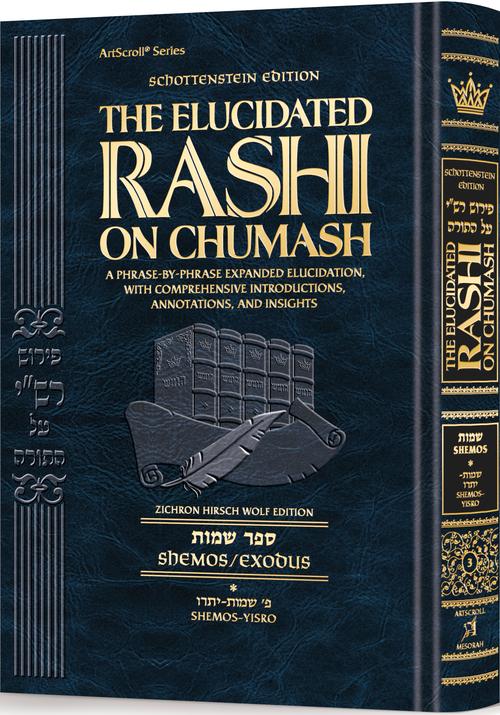
Culled from the Insight section of the recently released Elucidated Rashi on Chumash, Shemos-Yisro 

Rashi to Pasuk 3:12  ד״ה וַיֹּאמֶר כִּי אֶהְיֶה עִמָּךְ — 

And He Said, “For I Shall Be With You…”

Rashi explains that Hashem ensured Moshe that the Jewish people deserved to be taken out of Egypt because they would later accept the Torah on Mount Sinai.

INSIGHT: Future Merit 

In his commentary to Bereishis (21:17), Rashi explains that Hashem only judges a person based on his current behavior— not his future actions. Therefore, Hashem provided water for Yishmael in the desert, without considering the sins that he or his offspring would commit in the future. Similarly, the Midrash (Shemos Rabbah 3:2) teaches that Hashem redeemed the Jewish people from Egypt, despite the Sin of the Golden Calf, which He knew they would later commit, for He sees iniquity but does not consider it (Iyov 11:11), instead limiting His judgment to the present moment. However, Rashi’s comment to our verse indicates that Hashem does account for the future in judgement, for He credited the Jewish people with the merit of accepting the Torah before they had done so!

To resolve this contradiction, Parashas Derachim suggests that although Hashem does not account for our future transgressions, He does account for our future merits, for His system of justice is tempered by His great mercy and kindness. Indeed, while those very people who would later accept the Torah would also participate in the Sin of the Golden Calf, Hashem redeemed them for their future merit while simultaneously ignoring their future iniquity (Parashas Derachim §4; see Zohar, Vol. 1, 121b).

Rav Chaim Kanievsky

Rashi to Pasuk 5:20  ד״ה וַיִּפְגְּעוּ — 

They Encountered.

Rashi explains in his second approach that the “the officers of the Children of Israel” who spoke harshly to Moshe and Aharon were the wicked Dassan and Aviram (Nedarim 64b; Shemos Rabbah 5:20).

INSIGHT: Dassan and Aviram’s Conflicting Traits

While Dassan and Aviram are noted throughout the Torah for their wickedness (see Rashi above, 2:13, 15, 4:19; below, 16:20; Bamidbar 16:1, 12-14, 27), according to this approach of Rashi, they possessed an element of great virtue: They were among the officers of the Children of Israel who let themselves be beaten rather than enforce Pharaoh’s unfair work quota on their brethren! Now, Rashi explained in v. 14 that the officers who took such beatings merited to become members of the Sanhedrin and attained prophecy. This does not mean that all the officers achieved that status. There were thousands of officers (one for every ten Jewish laborers; Shemos Rabbah 1:28), and only seventy of them — the most worthy ones from each tribe — were appointed to the Sanhedrin. Dassan and Aviram surely were not on the Sanhedrin. However, the merit of taking beatings for their brethren benefited them in another way. Rashi writes below (10:22) that there were wicked Jews who did not want to leave Egypt and they died during the Plague of Darkness. Dassan and Aviram were in that evil group, but they survived, and in fact remained in Egypt when Moshe led the Jews out at the time of the Exodus (Targum Yonasan to 14:3 below). At some later time, they joined the Jews in the Wilderness and resumed their wicked behavior. Why did they not die during the Plague of Darkness? R’ Yehoshua Leib Diskin explains that it was in the merit of the beatings that they took on behalf of their brethren. Despite their evil desire to remain in Egypt, they were spared from death. But while they gave of themselves for their brethren, their behavior toward Hashem remained evil, and when the Jews left Egypt they chose to remain behind. After the Splitting of the Sea, when all the Egyptians drowned and it was evident that Egypt had no future, Dassan and Aviram joined the other Jews in the Wilderness. There they carried on their wicked ways, acting as thorns in Moshe’s side until they were swallowed up by the earth together with Korach (Maharil Diskin al HaTorah).

R’ Chaim Kanievsky would often point out a lesson to be learned from this incident. One who suffers on behalf of his fellow Jews gains enormous merit which may save him from death even if he has grave sins — but there is a limit to this merit. Once the person gets involved in dispute, as Dassan and Aviram did when they joined Korach’s rebellion, even the great merit of taking blows for other Jews will not save him (Minchas Todah [Honigsberg], p. 443). 

LEADERSHIP INSPIRATION: DON’T STOP THE MUSIC!

Adapted from: A Heart for Another by Rabbi Yaakov Bender

I remember the levayah of Rav Aharon Kotler, and how we accompanied the aron to the airport, from where it was to be flown to Eretz Yisrael for kevurah. In an unprecedented move, TWA Airlines had agreed not just to transport the aron to Eretz Yisrael in regular passage, removing several seats from the aircraft to allow for the space, but they had also consented to place a curtain around the aron and allow a group of talmidim to sit around it, continuing their shemirah until the kevurah.

It was a rare display of true kavod HaTorah for the America of those years, and the send-off from the airport was equally respectful, as befitting a levayah for a giant, a Rosh Yeshivah, a manhig, and a father to so many.

Just after the levayah, his son and successor, Reb Shneur, was sitting in the airport and accepting nechamah from people, a line forming in front of him despite the din and commotion all around.

Somehow, Reb Shneur, the bereaved son, managed to pick up a heated discussion between some of the bachurim, though they were not in front of him. He called one of them over and asked what they were talking about.

The talmid explained that there was a chasunah that night for one of their friends, but none of them felt it appropriate to go dance. They were simply too heartbroken.

Reb Shneur Kotler

Reb Shneur looked at him in surprise. “It is not even a shailah,” he said, “that just as you had a tafkid to mourn your rebbi, you now have a tafkid to be mesameiach a chassan and kallah. Why should the couple lose out on the simchah that is rightfully theirs because of what happened?”

Interestingly, I think that this might have been the first psak that Reb Shneur gave after assuming his father’s position, and it reflects his leadership. He had the unique ability to balance what sometimes appeared to be contradictory demands, to know how to fuse genuine yiras Shamayim with genuine simchah, to protect and safeguard the olam hayeshivos while radiating ahavas Yisrael and respect for each Yid.

Not long after the Second World War, Rav Michoel Ber Weissmandel met with the Satmar Rebbe.

Later, he told his talmidim, “I have never seen a Yid whose heart is as broken as that of the Satmar Rebbe… he just covers it over with his smile.”

The Satmar Rebbe carried the pain of the klal and of the yachid. He lived, as the Chovos HaLevavos tells us about tzaddikim who are constantly doing teshuvah, with “aveilo b’libo, his mourning in his heart, v’tzahalaso al panav, his joy on his face.”

That balance made him such a great leader.

During this last period of war in Eretz Yisrael, when we heard bad news day after day, I received a call from the parents of a bar mitzvah boy. They wondered if they should cancel the music they had planned for their son’s bar mitzvah as a way of commiserating with those suffering in Eretz Yisrael.

I told them that they absolutely should not cancel the music. Why should the boy lose out on something his friends had, and feel badly about it? And why should they absolve themselves with a mere external act of empathy?

Rather, I suggested, they keep the music. But instead, they should give their hearts. They should undertake to daven more and reflect more on the reality of people living under the threat of constant danger, of children whose schools are closed, parents who cannot work, fathers and brothers called away from home.

When they feel the pain and distress, they should say a perek of Tehillim, and then go dance at the bar mitzvah.

Both are possible, and that is what it means to be a Yid.  

EMUNAH INSPIRATION: A Talmid Remembers…

Adapted from: Miracle Baby by Rabbi Yehoshua Frankenhuis

It is the night of Rosh Hashanah 5780 at Yeshivas Heichal HaTorah, Har Nof, Yerushalayim. The final notes of Adon Olam hover in the air as the bachurim surround the rosh yeshivah, Rav Zvi Kushelevsky. They accompany him as he slowly makes his way through the throngs of people, out of the beis midrash, and up the stairs to his apartment located on the top floor of the yeshivah. Suddenly, joyous singing and dancing break out in the procession. This is no Rosh Hashanah tune, nor a poignant song of dveikus. It is a heartfelt rendition of “Zara zara zara zara chaya v’kayama…”

This annual minhag is five years old. Ever since Rav Zvi remarried following the petirah of his first wife, he requests a berachah to have children from everyone he meets — from gedolim such as Rav Moshe Sternbuch to bachurim not even a quarter of his age. He seeks berachos from everyone, because who knows which person’s berachah will break through the Gates of Heaven and bring down the yeshuah?

Rav Zvi Kushelevsky

And so, on the night of Rosh Hashanah, the bachurim took it upon themselves once more to bless their rosh yeshivah with the berachah “Zara di lo yifsok…”

A thought passes through some of our minds: Perhaps after more than five years of marriage, and at the Rosh Yeshivah’s advanced age, the time has come to stop falsely inspiring hope in him. Maybe the Rosh Yeshivah should move on, rather than dwell on the crushed hopes and the anguish! To focus on the gifts he has, rather than be reminded once more of the precious gift that he so deeply yearns for…

But no. Rav Zvi encourages all of us bachurim and passionately joins in the singing. He radiates the steadfast belief that through our tefillos and berachos, his yeshuah will come. That he too will merit “zara di lo yifsok v’di lo yivtol mipisgamei Oraisa.”

Rav Zvi enters his apartment, the singing quiets down, and the bachurim drift away to their various seudos, while I head home to my family. The beis midrash and the yeshivah corridors fall silent once more. Yet the clear realization that Hashem doesn’t run the world based on statistical probabilities continues to ring loudly in my mind.

Yes, Hashem is truly all-powerful. Even when the chances seem very slim, we ought to place our bitachon in Him and daven to Him, because He can bring a yeshuah under any circumstance. I already knew this in theory, but on that special night I deeply experienced and internalized how a true maamin, a true believer, relates to unbounded yeshuas Hashem as a tangible reality. 

DOWNLOAD + PRINT At The ArtScroll Shabbos Table – Parashas Vayechi!

Dear Friends,

Below please find the latest edition of At The ArtScroll Shabbos Table, containing inspiration and insight from classic ArtScroll titles.

Click HERE to view, download At The ArtScroll Shabbos Table – Vayechi

This weekly publication will contain a rich collection of stories, divrei Torah and insights that are suitable for the Shabbos table – or for anytime. We hope you enjoy and look forward to future issues, as we tap into the unparalleled treasure trove that is the ArtScroll Library, sharing the depth and beauty of our Judaic and Torah literature with you.

Read it. Be uplifted. And share the inspiration.

Have a good Shabbos.

CHIZUK INSPIRATION: Mammeh!

Adapted from: A Heart for Another by Rabbi Yaakov Bender

There are moments in a person’s life that live on, single encounters or conversations that replay, again and again, for years. One such moment can shape an entire life.

My mother, Rebbetzin Basya Bender, was a chiddush, a novelty — an immigrant to this country and a young almanah. The lone survivor in her family, she rose above pain to not only raise us on her own, but to inspire and guide hundreds of bnos Yisrael as a beloved and effective teacher.

She was a woman of resilience and faith, but if I had to identify the moment when her strength and spirit shone most brightly, it was early on a Shabbos morning.

It was not just any Shabbos morning: It was that week, in the autumn of 1965, when we were sitting shivah for my father zatzal, who had been niftar so suddenly and unexpectedly.

Every one of us was lost without him. That Leil Shabbos, she worked to keep our mood upbeat during the seudah, to show us that we would be able to carry on as a family, that Shabbos was still Shabbos.

It could not have been easy.

Rabbi Yaakov Bender

That night, we all slept. It had been an exhausting week, emotionally and physically, and we must have slept very deeply. When we started to come down on Shabbos morning, we rubbed our eyes in disbelief.

The house was in complete and total disarray, furniture toppled over, sefarim thrown all over the floor, and the cabinets empty. The house had been ransacked, thieves obviously coming in during the night and robbing whatever valuables they could find.

It was too much. The house was a mess. We had been in financial distress before this, and there was certainly no money to replace whatever had been taken.

But especially painful was the fact that they had taken away that which was most precious to us — the small reminders of our father that had remained.It shook us up. Whatever sense of calm we might have had was shattered. It was just too much. It seemed so unfair, the blow that would make all the challenges with which we had been confronted that week unbearable.

Then we heard our mother’s footsteps and we froze. How would she handle it?

She came down the stairs and saw what happened. She — a woman in a strange country, her parents gone, having suddenly lost her husband a few days earlier and faced with the burden of feeding and clothing us on her own when money was tight — looked around at the damage, and then she looked at our faces.

“Kinderlach,” she said, “we don’t cry over things that can be replaced.”

One line, but one line that gave us such clarity. There are times to cry, when tears are appropriate. And there are times when tears have no purpose or place. Items, even with sentimental value, are replaceable, and we would not allow the loss of mere objects to pull us down.

And here is the enduring lesson of my mother and her lesson on that Shabbos morning.

If ever in my life I felt like an umlal, a despondent person, it was that week, during those terrifying, confusing days in which the foundation of our lives had been pulled out from underneath us. That blow — the invasion and robbery — had the potential to be so devastating, that extra challenge that would have made the whole situation unendurable.

But she didn’t let that happen, and in doing so, she sent us another message. The rule in Chazal is that “middah tovah merubah mimiddas puraniyos — Hashem’s measure of good is greater than His measure of punishment” (Sotah 11a). From this we can extrapolate that if a harsh word to an umlal can be devastating, then a kind word to an umlal has the potential to build, reassure, and restore.

At that moment, our mother gave us the gift of a perspective and attitude that can carry a person through so many difficulties — we don’t cry over that which can be replaced. And instead of sinking deeper into pain, it gave us a way forward.

Our loss was significant, but we still had each other, and everyone was healthy. We would find strength in one another. We would continue in our father’s way and make her proud.

If we did not become umlalim, it was because of her. She gave us our lives. 

EMUNAH INSPIRATION: When the Answer Is No

Adapted from: Miracle Baby by Rabbi Yehoshua Frankenhuis

Rav Zvi has become an example of emunah, hope, inspiration, and encouragement to thousands all over the world. Although perhaps what garnered the most attention was when, at the age of 88, his ben bechor was born, the greatest chizuk and source of inspiration are his sixty-five years of waiting, of davening, of disappointments, of not seeing the answer to his tefillos yet not letting it interfere with his avodas Hashem. 

There are many who struggle with infertility, with shidduchim for themselves or their children, with illness or earning a parnasah. They beg Hashem for a yeshuah and sometimes feel great disappointment when their tefillos are not answered. They do not understand what has happened to their prayers, or why they deserve their plight.

Let us go to the very beginning of the Torah, which will shed light on this subject.

Rav Zvi Kushelevsky

The Torah begins by describing the creation of the world in great detail. Why is this the most important thing with which to begin the Torah? The Torah is not written chronologically. Why then does it begin with creation rather than discussing mankind, the Avos, or Mattan Torah?

We are all familiar with the story of the cruel executions of the Asarah Harugei Malchus, recited on Yom Kippur and Tishah B’Av. Following baseless accusations, these ten tzaddikim were taken to be killed by the Roman emperor in the cruelest ways imaginable. Upon seeing the horrific events, the malachim cried out to Hashem, “Zu Torah v’zu secharah? Is this Torah and is this its reward?” But Hashem’s response was, “Shtok — Quiet! If I hear this question being asked again, I will destroy the world and return it to tohu vavohu.”

Why did Klal Yisrael experience such terrible hester? Why did the greatest tzaddikim deserve such a fate? Why did Hashem shut down the seemingly reasonable question of the malachim and threaten to destroy the world?

A parable provides insight:

Meshulam, a trusted tailor for the king, created magnificent garments for the royal family. For the king’s jubilee, he was commissioned to craft a spectacular robe using the finest material. After weeks of meticulous work, Meshulam delivered a masterpiece, exceeding the king’s expectations and the king paid him handsomely.

However, a jealous bishop slandered Meshulam, claiming he stole and sold some of the royal material. The king, initially dismissive, decided to investigate. When the material’s measurements were compared with the completed cloak, there was a discrepancy. Meshulam was arrested for treason and sentenced to death.

On the day of his execution, Meshulam requested his final wish: to have the cloak and a pair of scissors. 

Granted his request, he began cutting the garment. “Stop!” the king shouted. 

Meshulam calmly explained, “Every inch of material you gave me is in this robe. The only way to show you is by undoing the seams and stitches, returning the fabric to its original state. Then, all will be clear.”

With this we can explain the episode of the Asarah Harugei Malchus. Hashem’s message to the malachim was: “You were not there during maasei Bereishis, when I created the world. If you continue to ask this question, I will need to explain it to you, and the only way for you to understand is if I undo every last seam and every last stitch of the world — return it to tohu vavohu. Then, in its original state, there will be no questions.”

This, explains the Vilna Gaon, was Hashem’s response to the malachim. “Indeed, from your perspective, from your vantage point, you pose a great question. Why is all this pain, suffering, and carnage inflicted upon the greatest tzaddikim? I do not have an answer that you can understand. You weren’t there when I created the world. You did not see the masterplan of thousands of years. You do not understand every pleat of fabric, every seam and stitch.”

DOWNLOAD + PRINT At The ArtScroll Shabbos Table – Parashas Vayigash!

Dear Friends,

Below please find the latest edition of At The ArtScroll Shabbos Table, containing inspiration and insight from classic ArtScroll titles.

Click HERE to view, download At The ArtScroll Shabbos Table – Vayigash

This weekly publication will contain a rich collection of stories, divrei Torah and insights that are suitable for the Shabbos table – or for anytime. We hope you enjoy and look forward to future issues, as we tap into the unparalleled treasure trove that is the ArtScroll Library, sharing the depth and beauty of our Judaic and Torah literature with you.

Read it. Be uplifted. And share the inspiration.

Have a good Shabbos.

SIMCHAH INSPIRATION: A Real Millionaire

Adapted from: Living with Miracles by Rabbi Binyomin Pruzansky

Everyone knows that money can’t buy happiness, but sometimes we can’t stop ourselves from feeling that it can. We live in a physical world where money is a vital necessity, but true happiness is an internal feeling of contentment. We need inner strength to realize that, as Pirkei Avos tells us, the rich person is one who is happy with his lot. The following story related by Rabbi Eytan Feiner portrays this strength.

Rabbi Lipa Yisraelson, a grandson of Rav Yosef Shalom Elyashiv, lived in Bnei Brak, in the same apartment building as Rav Aharon Leib Shteinman, the gadol hador. One day, Reb Lipa met Rav Aharon Leib in the hallway, and Rav Aharon Leib asked him to come into his apartment. When they entered, Rav Aharon Leib led him into his small kitchen.

“Look, I’m so fortunate,” said Rav Aharon Leib. “I have a refrigerator.” Opening the refrigerator door, he said, “Look at all this food. I’m not hungry. I have all the food I need, even for tomorrow. I’m so lucky. Look, I have a fork and a spoon and a knife and a cup and a plate. I have everything I need to eat.”

Then he led Reb Lipa into his study. Pointing to his sefarim shrank he said, “I have so many sefarim to learn from. More than I could ever imagine owning.”

Reb Lipa didn’t know what Rav Aharon Leib was trying to tell him. Why, he wondered, was the rosh yeshivah proudly showing him around his modest home?

The tour continued. Rav Aharon Leib led Reb Lipa into his bedroom and told him, “Look at these comfortable beds.” In reality, they were the beds he had acquired sixty years earlier when he got married. They were old and rickety, covered with thin mattresses that could hardly have been described as comfortable.

Next, Rav Aharon Leib showed Reb Lipa the chair on which he sat when he learned Torah. It had no upholstery and no back, but Rav Aharon Leib praised his comfortable chair and the table on which he learned. “I have it all!” he proclaimed with a bright smile.

At last, Rav Aharon Leib disclosed his reason for sharing all his “treasures” with Reb Lipa. “I called you in because I know you are going to America soon,” he explained. “I’m sure you’re going to meet many wealthy people there. I want you to look at the wealthy people around you, and if you find someone who is happier than me, then come to me afterward and I will give you $1 million. It’s no risk for me, because I truly believe I am the happiest person in the world.”

When Reb Lipa returned to Eretz Yisrael after his stay in America, he came to Rav Aharon Leib and told him, “The Rosh Yeshivah was right. I met many wealthy people, but I didn’t find anyone happier than the Rosh Yeshivah.”

Sometime later, Reb Lipa met Rabbi Uri Zohar and related the story. “What do you mean?” Rabbi Zohar countered. “I’m happier than Rav Shteinman.”

Rabbi Zohar lived in a simple apartment that was far from the luxurious surroundings he had enjoyed when he was a popular Israeli entertainer. He had given up everything from his past life to learn and teach Torah in utter simplicity.

“Please tell the rosh yeshivah that he owes you $1 million because I am happier than he is. I am also living in a tiny apartment with peeling paint and very little furniture, but I’m the happiest person in the world because I have everything I need. And I have one up on Rav Aharon Leib because I am a baal teshuvah, and Chazal say that a baal teshuvah is on a higher madreigah than a talmid chacham.”

But then Rabbi Zohar rethought the statement. “I take it back,” he said. “The rosh yeshivah doesn’t owe you $1 million because he has something much greater than I have. He has all of Torah in his mind and that is the greatest madreigah a person can reach. So, he must be happier than I am.”

Regardless of who won the “happiness contest,” Reb Lipa acquired a priceless life lesson: A person can have next to nothing in material belongings, and yet, he can feel like the richest man in the world.

When we recognize and value all the gifts Hashem has given us, we discover that we are all millionaires.