PARASHAH: A “Good Name” for Kiruv

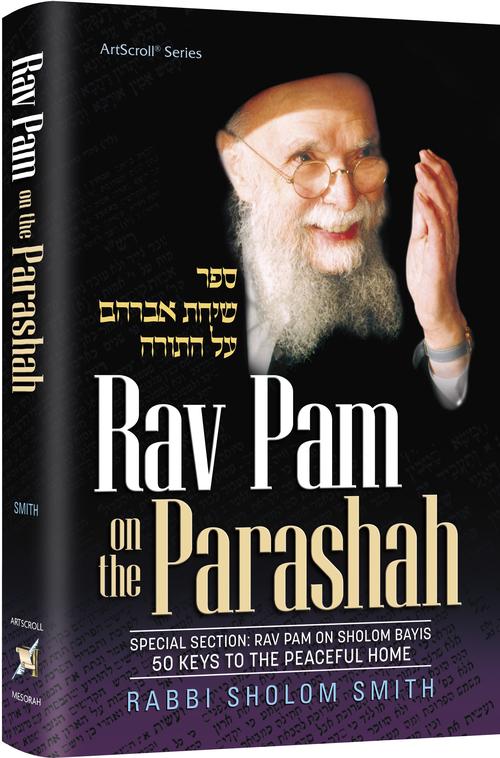
Adapted from: Rav Pam on the Parashah by Rabbi Sholom Smith

וְאֶעֶשְׂךָ לְגוֹי גָּדוֹל וַאֲבָרֶכְךָ וַאֲגַדְּלָה שְׁמֶךָ וֶהְיֵ’ בְּרָכָה. — I will make of you a great nation; I will bless you, and make your name great, and you shall be a blessing (Bereishis 2:2).

Rashi notes that when Hashem commanded Avraham to leave his country, his birthplace, and his father’s house, He gave him three blessings to counteract three detrimental effects of long-distance travel: The diminishment of the possibility of having children, the loss of wealth, and the loss of fame. Hashem blessed him that he would become the father of a great nation, would be blessed with enormous wealth and would gain world-wide renown.

The first two berachos are easy to understand. Avraham longed for a son who would continue his life’s work of publicizing the existence of a Creator, and who would in turn produce a great nation of believers in Hashem.

Avraham needed wealth as the means of continuing his remarkable chesed activities, his hachnasas orchim and tzedakah. All these things required large sums of money to uphold and expand. But why did Avraham need to have a great name? Can it be that Avraham was hungry for publicity and renown, things that seem to be the very antithesis of all that he stood for?

It must be that until the time when Avraham left his birthplace, his name commanded little respect in the eyes of the populace. If anything, he was considered a radical and revolutionary who wished to overthrow the system of pagan belief that most people held. He had destroyed the idols of his father and had defied the mighty King Nimrod (see Rashi 11:28) who had thrown him alive into the fiery furnace of Ur Kasdim. He was Avram the Ivri (14:13); the Midrash (Bereishis Rabbah 42:8) says that he was called this because the whole world was on one side, while Avraham alone was on the other side. He refused to practice idolatry like everyone else, instead espousing belief in one G-d. Thus, his name was certainly not mentioned with honor or reverence.

However, now that he was moving to a new land and was beginning a new phase of his life, he needed the blessing of a good name to attract followers and bring them under the wings of the Shechinah. No more do we find Avraham destroying idols or boldly defying people like Nimrod. Now, as the Torah recounts in the following parshiyos, Avraham became a N’si Elokim, prince of G-d (23:6) in the eyes of the neighboring people and was treated with great respect and reverence by many of them.

The Chofetz Chaim comments on a Mishnah in Pirkei Avos (4:17) that teaches that the crown of a good name surpasses even the crowns of Torah, Kehunah, and malchus. The crown of a good name was Avraham’s most effective tool in his efforts to bring people to a recognition of their Creator. With Avraham’s exceptional trait of chesed, his goodness of heart, and his concern for his fellow human beings, coupled with his warm, pleasant, caring personality, he was able to attract many thousands of people to a belief in One G-d.

In our time the same holds true. In order to be effective in kiruv rechokim (outreach efforts), one must have exemplary middos and true ahavas Yisrael. These traits serve as a magnet to attract people to Yiddishkeit, because the seekers see in him what Torah observance makes a person into, and they wish to be close to him and to emulate his lifestyle. This is the value of a “good name” with which Hashem blessed Avraham and which is a necessity in our times to bring fellow Jews back to their roots. 

GREATNESS: IMPERATIVES OF SIMCHAH AND MIDDOS

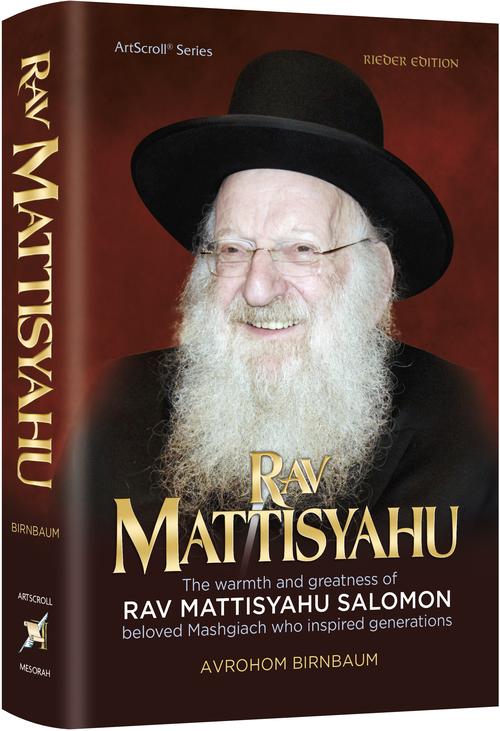
Adapted from: Rav Mattisyahu by Avrohom Birnbaum

The Simchah Imperative

It was Erev Shabbos, only hours before licht bentchen.

The phone rang in the home of R’ Nosson Zev Nussbaum.

It was the Mashgiach. After greeting him warmly, the Mashgiach asked, “Perhaps it is possible to find a dentist who will still treat me before Shabbos. I really need a dentist today.”

“Oy!” R’ Nosson Zev commiserated, “if the Mashgiach is calling now, he must be in tremendous pain. Otherwise, he would wait until after Shabbos.”

“No,” Rav Mattisyahu replied, “I can manage with the pain. The reason for the urgency is that the dental issue that I have is preventing me from smiling a full smile. Tonight, the entire yeshivah will file past me to wish me a ‘Gut Shabbos,’ expecting me to give them a full smile. Some people wait for this smile all week. If I don’t go to the dentist and have the problem fixed, I won’t be able to give them a full smile!”

It was an imperative that the Mashgiach constantly stressed. It was imperative that an oveid Hashem should be b’simchah, happy and full of joy and good cheer. When he came to Lakewood, one of the first things that he spoke about and demanded was just that, simchah. When people would file past to wish him a “Gut Shabbos” on Friday night, he would ask them, “Where is your smile? You are learning Torah! You have the zechus to serve Hashem! Why is that simchah not visible on your face?!”

He once told a person close to him that he knows of a Yid who would wake up in the morning and dance for five minutes, singing, “Shelo asani goy.” 

“My feeling,” that person commented, “is that he was talking about himself!”

Another common refrain of the Mashgiach’s was, “When a ben Torah gets up from his seat after learning a proper mussar seder, he should have a smile on his face.”

The Middos Imperative

When a chassan asked him which sefer to learn in preparation for his wedding, the Mashgiach replied that he should learn the sefer Tomer Devorah, because it is a sefer that speaks about the middos of savlanus (patience), vittur (forgoing, giving in), and chessed, the primary components essential in a successful marriage.

Rav Shraga Feivel Zimmerman, the former Rav of Gateshead, once took his son, a chassan, to Reb Mattisyahu for a berachah.

When the chassan asked for advice on how to be a good husband. Reb Mattisyahu asked him, “Do you get along with your friends?”

He replied affirmatively.

Rav Mattisyahu prodded, “Do you have a good relationship with your siblings and your parents?”

Again, the chassan answered, “Yes.”

Turning his focus to the father, Reb Mattisyahu then said, “A good bachur will be a good yungerman. In other words,” he explained, “marriage is not a unique experience, it is about middos tovos. If a person develops good middos, it will carry over to every relationship. If he does not have good middos, there are no shortcuts to having a successful marriage.”

In fact, when the Mashgiach’s youngest son-in-law, R’ Moshe Yehuda Halpern, was in the chassan room right before his chuppah, his father asked the Mashgiach for a berachah that his son should become a “gutte yungerman.” The Mashgiach responded, “A good bachur becomes a good yungerman.”

On another occasion, when one of his nieces was nineteen years old and embarking on shidduchim, she asked her uncle, the Mashgiach, “What should I look for in a husband?”

“The first thing,” he recommended, “is middos tovos.”

His niece asked again, convinced that he was going to say she should seek a talmid chacham, but no! While certainly he advocated seeking a talmid chacham for a husband, he still stressed that “the ikkar is middos tovos!” 

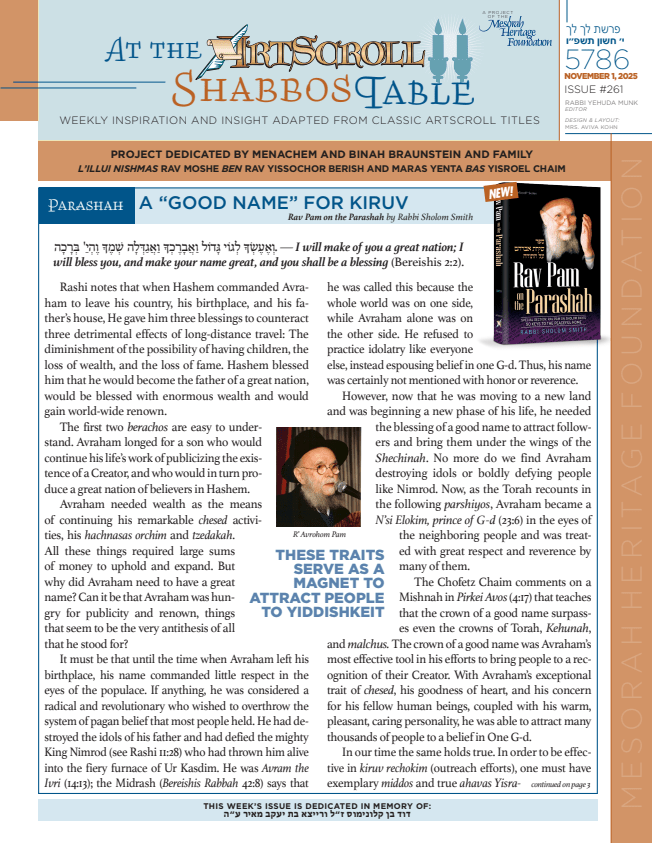
DOWNLOAD + PRINT At The ArtScroll Yom Tov Table – Sukkos!

Dear Friends,

Below please find the latest edition of At The ArtScroll Yom Tov Table, containing inspiration and insight from classic ArtScroll titles.

This weekly publication will contain a rich collection of stories, divrei Torah and insights that are suitable for the Shabbos table – or for anytime. We hope you enjoy and look forward to future issues, as we tap into the unparalleled treasure trove that is the ArtScroll Library, sharing the depth and beauty of our Judaic and Torah literature with you.

Read it. Be uplifted. And share the inspiration.

A Gut Yom Tov! Chag Sameach!

Click HERE to view, download At The ArtScroll Yom Tov Table – Sukkos

DOWNLOAD + PRINT At The ArtScroll Yom Tov Table – Yom Kippur!

Dear Friends,

Below please find the latest edition of At The ArtScroll Yom Tov Table, containing inspiration and insight from classic ArtScroll titles.

This weekly publication will contain a rich collection of stories, divrei Torah and insights that are suitable for the Shabbos table – or for anytime. We hope you enjoy and look forward to future issues, as we tap into the unparalleled treasure trove that is the ArtScroll Library, sharing the depth and beauty of our Judaic and Torah literature with you.

Read it. Be uplifted. And share the inspiration.

A Ksivah V’Chasimah Tovah.

Click HERE to view, download At The ArtScroll Yom Tov Table – Yom Kippur

YOM KIPPUR: The Thought Process

Adapted from: A Most Meaningful Viduy by Rabbi Yechiel Spero

זַדְנוּ — We have sinned intentionally.

זַדְנוּ is when we think it through, and still choose to go ahead with the aveirah. We plan it. We decide it is worth it.

And that’s what makes it so dangerous. It’s the machshavah, the thought.

Let’s say a person says, “I know I shouldn’t look, but I’m going to anyway.” Or, “I don’t feel like davening now. I’ll pretend I forgot.” Or someone plots how to get another kid in trouble, and then follows through.

These are decisions. This is what we are confessing to when we say זַדְנוּ.

But there’s another layer. Chayei Adam explains that זַדְנוּ also refers to when we let our middos take over: when our anger pushes us to yell, when our laziness lets us ignore a mitzvah, when jealousy or gaavah drives us to say hurtful things, when we give in to taavah even though we know how wrong it is.

Sometimes, we don’t even realize we’re doing something wrong, because we’ve gotten used to certain habits or reactions. We allow our middos to steer the wheel. That’s also זַדְנוּ, because we let those middos grow without working on them. And they led us to sin.

When we say זַדְנוּ, we’re not only asking forgiveness for what we did, but we’re asking for help to change the kind of person we’ve started to become. We’re saying to Hashem: “It wasn’t an accident. It didn’t come out of nowhere. I know where it started: inside me. And now I want to fix that, too.”

A Story: Someone You Are Not

It happened when Meir was just a teenager. He was already on his own, far from home, living in towns and cities he’d barely heard of, all for the sake of one thing: Torah. He had joined a yeshivah where the air itself was charged with greatness, the legendary Slabodka, under the guidance of the towering tzaddik, R’ Nosson Tzvi Finkel, whom they called the Alter.

But then came World War I. Suddenly, the peaceful world of learning was turned upside down. Towns were swallowed up by fear. The enemy army was marching, and nothing was safe anymore. Entire communities packed their bags in the middle of the night and ran. Meir, barely eighteen, was among them.

He ran with a friend, another yeshivah bachur he had met along the way. Their lives were at stake. The two of them found themselves in a town not far from the advancing front: Kremenchuk. When they heard that the enemies were getting closer, they sprinted toward the town square, where wagons were loading up the last of the people before heading out.

Suddenly, his friend turned pale. “My tefillin and my papers!” he gasped. “I left them at the inn! I can’t leave without them. What am I going to do?” He looked at Meir, hoping he would volunteer to wait. Meir agreed.

“Thank you, Meir! I’ll run there and be right back!”

One by one, the wagons pulled away until there was only one wagon left. The square was empty. And still, Meir waited. He could have gone with any of the wagons but he had given his word. He couldn’t betray his friend like that. You wait for a friend. You don’t abandon him.

The square was now completely empty. No friend. No wagons. Just Meir, standing there alone, heart racing, every part of him screaming to run. But his conscience was holding him there like a rock.

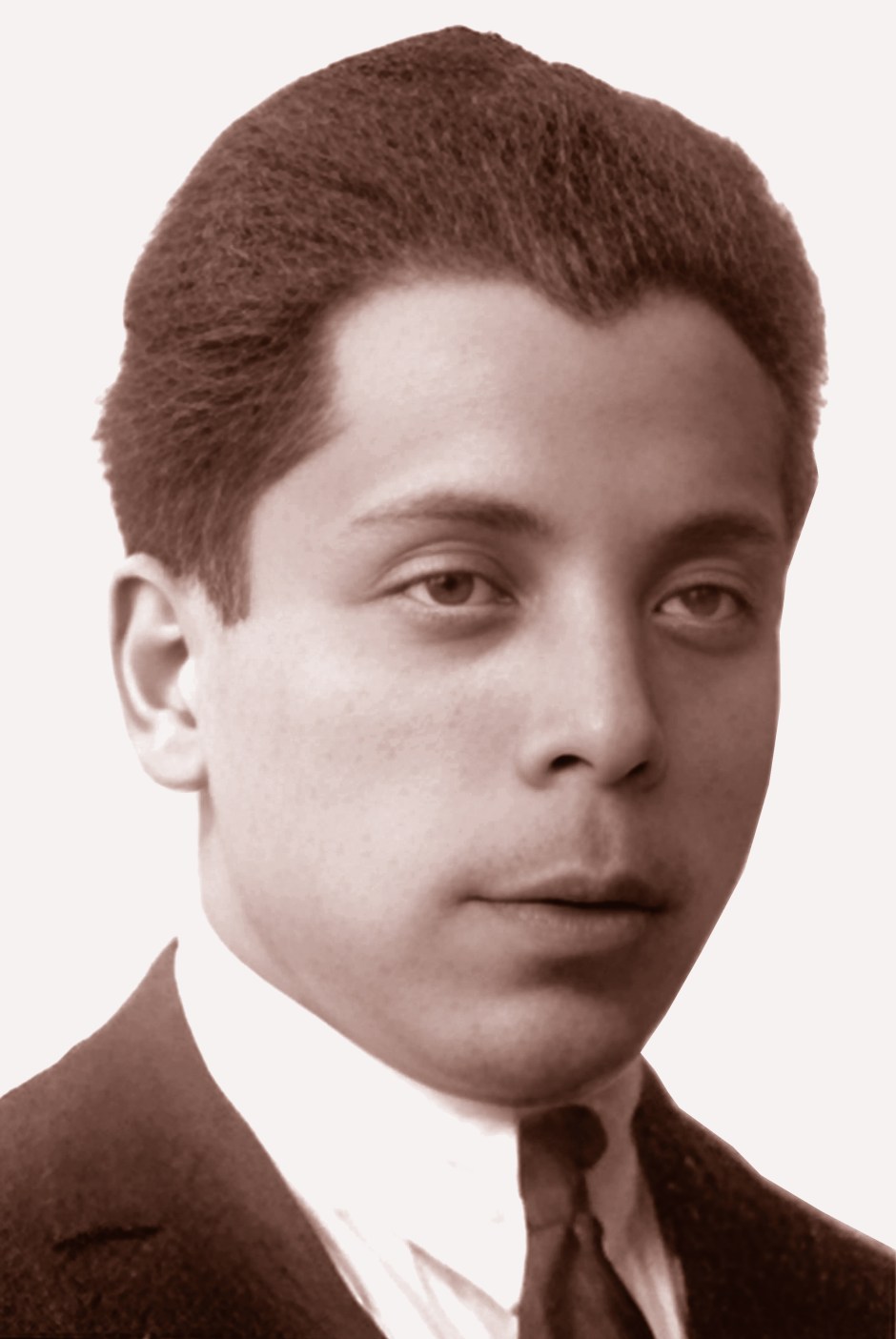
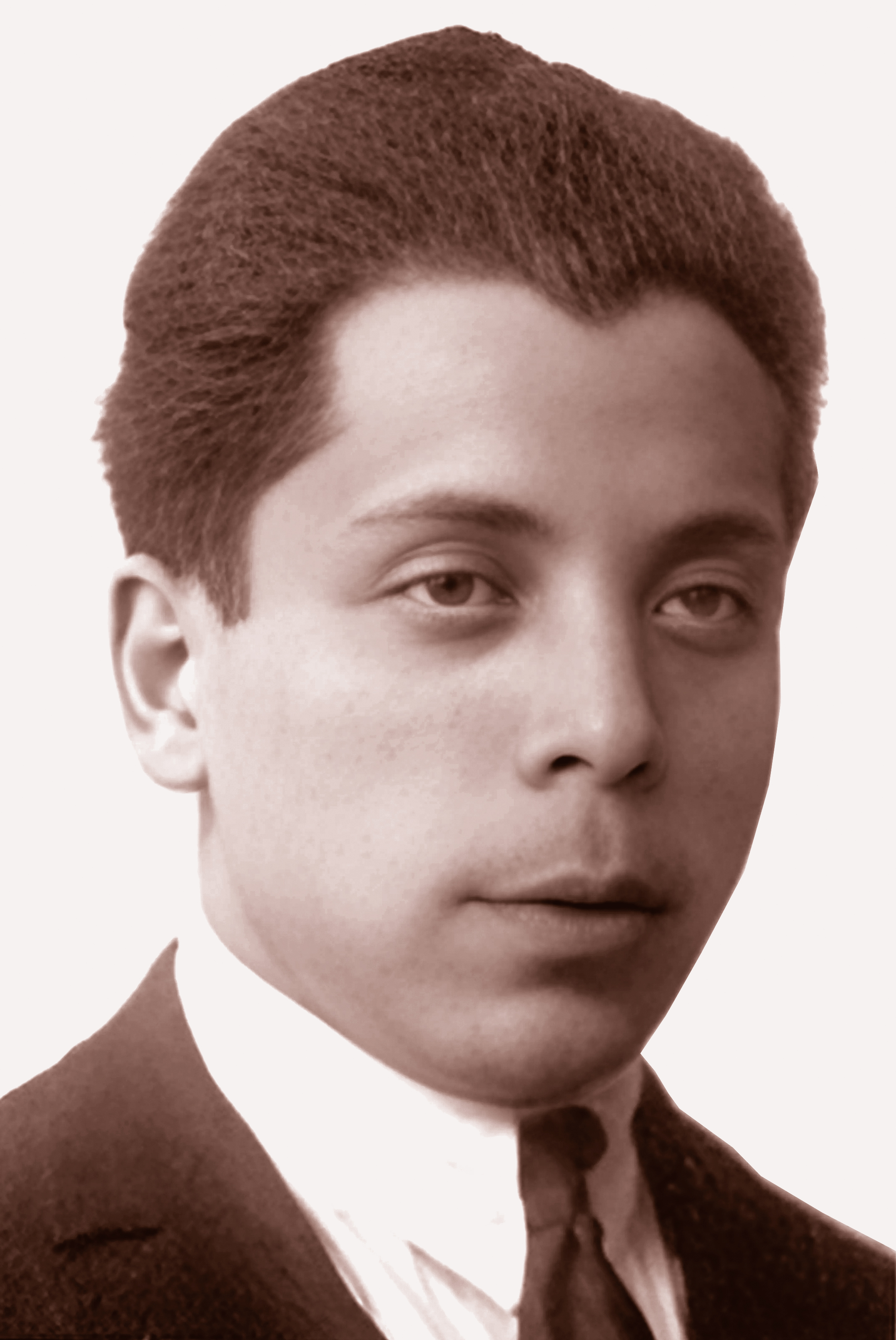
R’ Meir Chodosh as a young man

And then, he spotted a figure running toward him. It was his friend! Behind him was an old wagon pulled by horses. One final wagon had arrived! Meir’s heart soared. It was all going to be okay.

But then the most shocking thing happened. The wagon stopped. “One spot,” the driver barked. “Only one.”

Meir’s friend didn’t look at Meir. He simply climbed aboard without a word. The wagon rolled off, disappearing into the horizon.

Meir stood there. Alone. Betrayed.

The same friend he had waited for in a moment of danger had taken the one seat and left him behind without even saying thank you.

A storm erupted inside him. He was so very angry. How could someone do that? How could someone be so cold, so selfish? Right then and there, Meir made a decision. He would never again wait for anyone. Never again sacrifice himself for someone else. He’d be smarter, tougher, more shrewd. From now on, it was every man for himself.

But then, another voice began to speak inside him. “Meir, why did you wait in the first place? Because you were soft? Weak? No. You waited because you cared. Because you’re a mensch. Because you’re someone who puts values above convenience. Why would you change that because someone else didn’t live up to your standards? If you let his failure rewrite who you are, then you lose twice. It was all hashgachah. Hashem had decided that you should step forward and now is not the time to regret your actions.”

Meir stood up straight. He would not let that betrayal take him down. He would rise higher because of it. He would stay kind, loyal, strong.

That day is the day he became Meir Chodosh. The Meir who would go on to become one of the greatest mashgichim in the world. The Meir who would lift generations of bachurim with his warmth, his mussar, and his iron will.

It was the Meir who would survive the Chevron Massacre and other moments of his life when he nearly died. And when he would tell this story to his talmidim, he’d say it clearly: “It was in that moment — alone, hopeless, furious — that I chose not to let pain turn me cruel. I didn’t let disappointment turn me into someone else. That moment changed me forever. I became a new Meir. Meir Chodosh.”

Greatness is not letting hurt turn us into someone we are not. 

• AS I SAY VIDUY… •

… I will make a decision to choose different thoughts, grow different middos, become the person I am meant to be. 

I will focus on the fact that at all times, I can decide to do what is wrong, and I can also decide to what is right.

TEFILLAH: Cries That Tear the Heavens

Adapted from: Rav Mattisyahu by Avrohom Birnbaum

It was Yom Kippur. The year in Gateshead had been a difficult one, with several tragedies. Davening in the Gateshead Yeshivah on the Yamim Noraim was always an elevated experience, but that year, especially, the seriousness of the day and the understanding that the community is completely dependent on Hashem and His kapparah was very evident. 

At the front of the beis midrash, davening at the amud, fully in white, was the Mashgiach. He looked like a malach, and his voice thundered in heartfelt tefillah. Rav Mattisyahu, who served as chazzan for decades in Gateshead, davened with tremendous passion and heart, collectively sweeping up the entire yeshivah and kehillah in his enthusiasm, arousing the assembled to ever higher levels of tefillah and avodah. 

One of the most climactic moments of the davening is without a doubt the tefillah of U’Nesaneh Tokef, when we acknowledge that the books of life and death are open in front of Hashem and He decides the fate of each person… Who will live and who will die? Who by water, who by fire…? 

Rav Mattisyahu

And then there is the climax of that powerful tefillah. The emotionally charged words that teach us that we have the power to rescind a decree. “U’teshuvah, u’tefillah u’tzedakah maavirin es roah hagezeirah — with repentance, prayer, and charity we can remove the terrible decree!”

As Rav Mattisyahu, his booming voice laced with feeling, poured his heart and soul into those words, a blood vessel burst in his nose. Blood gushed all over the machzor and landed on the words “maavirin es roah hagezeirah,” literally covering over and wiping out those words. 

Incredibly, that year, not one person in the community passed away!

When there were people who wanted to make a connection between the incident and the fact that no one passed away that year, and others even experienced yeshuos, Rav Mattisyahu retorted, “I serve as a baal tefillah, not a baal mofeis!”

His message was that tefillah, davening with one’s entire heart, is accepted by Hashem and is the greatest thing. 

Rav Mattisyahu had a deep emunah in tefillah and only tefillah. He did not resort to segulos even in times of great difficulty and need, remaining ironclad in his emunah in the power of tefillah. 

◊◊◊

Rav Mattisyahu served as the ultimate role model in how one approaches davening. First, he always arrived early to yeshivah and was standing in his place with tallis and tefillin before the start of davening. 

His davening every single day was a sight to see and emulate. He davened in his powerful, beautiful voice, with tremendous passion and enthusiasm, not just on the Yamim Noraim. The way he led the yeshivah in Tehillim had the power to arouse the entire tzibbur, connecting everyone with his heartfelt tefillos. 

Gateshead talmidim fondly remember the way he said the kappitel of Tehillim that begins, Maskil L’David, before mussar seder. 

◊◊◊

At a gathering in England that centered on how to accustom children to davening, Rav Mattisyahu explained to the crowd that he had not actually received any specific guidance on this topic from his rebbeim. He shared a very telling story that took place during his years in Gateshead. It was a story that not only gives insight into how to accustom children to davening but also into the Mashgiach’s own definition of davening. 

A young boy whom we will call Eli once wanted to watch R’ Elyah Lopian daven. To achieve his goal, Eli pushed himself to the front and stood near R’ Elyah. Throughout the davening, Eli shuckeled and davened with tremendous enthusiasm.

Davening ended.

R’ Elyah, who had noticed the way Eli was davening, turned to those in the room and commented, “This boy davened very nicely. However, were we to ask him if he understands the meaning of the words, he would probably say no, as he cannot translate them. If so, what is the meaning of such a davening? Is there a meaning to davening when one does not know what one is saying?” 

Gazing around the beis midrash, R’ Elyah thundered, “Yes! Tefillah entails our knowledge and belief in the POWER of tefillah; in the fact that we can speak to Hashem and ask Him for all our needs, that He hears everyone’s davening. This is the definition of tefillah! It is entirely possible that this boy was asking for a new toy or game. It may not have been a direct translation of the words in the siddur, but it was a tefillah. The essence of tefillah is the realization that we can speak to Hashem and ask Him to grant our requests.”

Rav Mattisyahu then continued, “We have to know and believe that we can connect to Hashem. That is the first thing we must work on. We must instill in our children that we can connect to Hashem and that Hashem IS listening to us!”

In fact, on more than one occasion, Rav Mattisyahu bemoaned the fact that many people daven, but they do not REALLY believe that their tefillah has the potency to make a difference. He would quote his Rebbi, Rav Elyah, saying, “Once, when we were davening for a sick person, Rav Elyah got up and banged on the shtender, ‘When people daven for a choleh and we see them crying, often those tears are because they are already thinking about the levayah…!’”

A person must have true emunah in the power of tefillah. 

ASERES YIMEI TESHUVAH: The Throne of Mercy

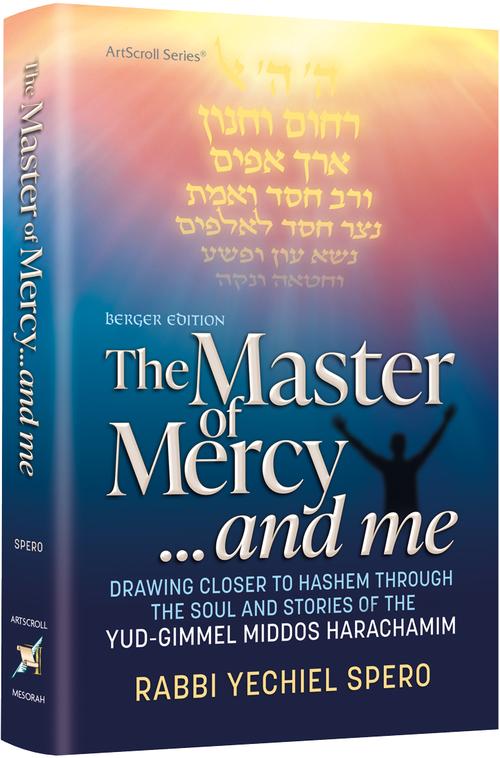
Adapted from: The Master of Mercy…and Me by Rabbi Yechiel Spero

אֵ־ל מֶלֶךְ יוֹשֵׁב עַל כִּסֵּא רַחֲמִים 

 G-d, King Who sits on the Throne of Mercy.

This introductory tefillah, which leads into the Yud Gimmel Middos, comes from the siddur of R’ Amram Gaon. Like Keil Erech Apayim, it sets the stage for everything that follows.

Keil — This Name conveys two powerful truths. First, as a Melech, Hashem is the Baal HaKoach; there is nothing beyond His power — nothing we can conceive, and even that which we can’t begin to imagine. But Keil also reflects His nature of pure Kindness. As Tomer Devorah (a most significant sefer on the Yud Gimmel Middos shel Rachamim) explains, He is a King of inexhaustible Chessed. His goodness extends to the farthest corners of the universe, touching even those who feel distant from Him.

Yosheiv — He sits. Shelah HaKadosh explains that this word tells us that Hashem is always ready. Always waiting. Always poised to hear the cries of His people. Always prepared to turn toward us the moment we turn toward Him.

Al Kisei Rachamim — He sits on the Throne of Mercy. Ready to take Din, strict Judgment, and transfer it to a place of Compassion. He doesn’t sit in Judgment with harshness. He sits with a desire to forgive, to heal, to draw close.

This is how we begin.

With a Father Who conveys power and Kindness; Who is there for us; Who is ready to forgive us when we repent.

A Story: Why Didn’t I?

Before the skies over Europe darkened with smoke and screams, there was a flicker of hope. A miracle called the Kindertransport. Ten thousand Jewish children, plucked from the jaws of Nazi Germany and Austria, were brought to safety in England. Away from danger, away from the gas that would fill the air soon after.

Years later, the BBC (British Broadcasting Corporation) invited one of those survivors — a man now in his eighties — to share his story on the radio. He was twelve at the time of the transport. And though many years had passed, there was one moment, one memory that never left him.

When the children were first brought to England, they cried, clinging to memories of home and the arms of their mothers, now thousands of miles away.

Some of them adjusted. Some even smiled again.

But there was one boy who refused.

It made no difference what they gave him — candy, toys, comfort — he never stopped crying. His pain could not be soothed. Finally, the caretakers asked him, “What do you want?”

“I want to speak to the king,” the boy answered confidently.

“The king of England?”

“Yes, I want a private meeting with him.”

Instead of dismissing him, the caretakers acquiesced. “All right, but if you’re going to meet the king, you must prepare. There is a way to walk. A way to speak. A way to behave before royalty.”

For three weeks, the little boy practiced. He studied. He learned. And he believed.

King George VI had recently begun his reign. An unlikely king — born with a stutter, never meant for the throne — was now charged with holding together a nation at war. Still, in those first months, the king made it his mission to visit the people of his kingdom.

The big day arrived. The boy was brought to the city square, where crowds waited behind barricades to catch a glimpse of the king’s carriage. But as the crowd grew, the boy realized: He would not have a private meeting. He was just going to wave.

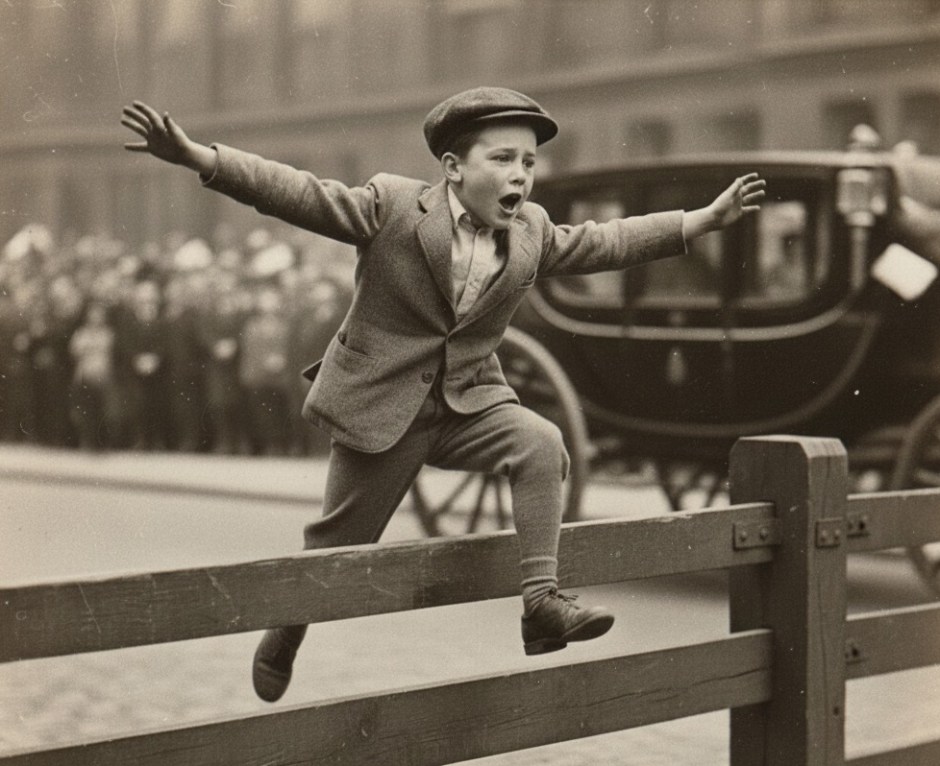
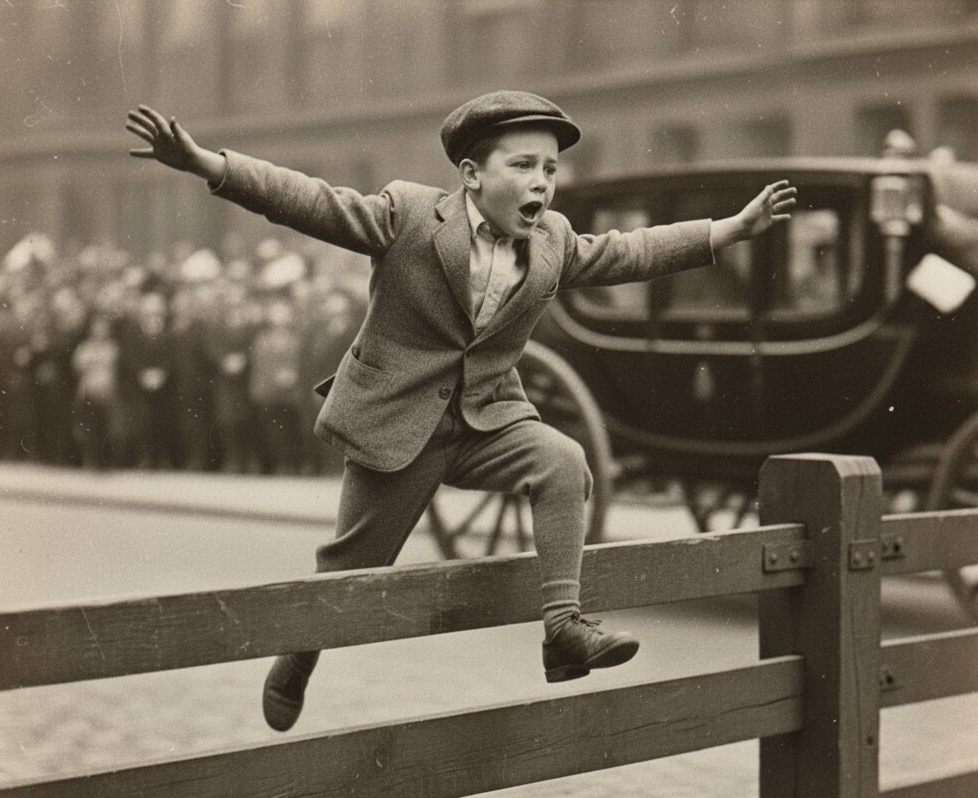
No. That wasn’t enough. So, as the royal carriage passed, he jumped the barricade.

He ran with all his might, a twelve-year-old boy with tears in his eyes and hope in his heart. But the royal guards tackled him to the ground and placed him in handcuffs.

The crowd gasped in surprise. So did the king. Peering out of the carriage, King George saw the boy and ordered, “Let him go.” He motioned to bring the boy into the carriage.

The boy stood up, shaken, his eyes wide. “Why did you run to me?” the king asked.

At first, the boy couldn’t answer. But then, through his thick accent and halting English, he said, “I was brought to England. I left my parents behind. I miss them. I need them.”

The king, himself a man who had once struggled to speak, understood.

“And what do you want from me?” asked the king.

“You’re the king of England,” the boy said. “Please… bring my parents to me.”

“We’re at war with Germany. That’s not something I can just do.”

“But you’re the king! You can do anything!”

The king’s eyes softened. “Don’t cry,” he said. “I promise I will try. I will do everything I can. Just… don’t cry.”

Two days later, a knock was heard at the orphanage door.

It was the boy’s parents.

Somehow, they had been brought out of Germany. Reunited with their son. Saved.

Back in the radio studio, decades later, the survivor finished telling his story. Then the tears came rushing back. “I will never forgive myself,” he admitted.

The host was puzzled. “Why? You were the one who asked. You were the one who was saved.”

“No,” the man said. “You don’t understand. It wasn’t me. I wasn’t the one who jumped the barricade. That boy, that hero, that child of courage — it wasn’t me. I was there. I watched. I stood frozen. And I will never forgive myself.

“Why didn’t I?”

As we prepare for the Days of Awe, we must know that the King is in the field. He is walking among us. Accessible. Listening.

And we, too, are standing behind the barricade — unsure, timid, hesitant.

But what if we were to jump?

What if we were to dare cry out with sincerity, “Ribbono shel Olam — I need You! I miss You! I want to be close to You again!”

What if we were to dare ask for the seemingly impossible?

What if we were to believe, really believe, that the King can do anything? 

○   TAKEAWAY   ○

Don’t let the moment pass. Don’t look back and ask yourself, “Why didn’t I?”

Jump the barricade. Now is the time.

DOWNLOAD + PRINT At The ArtScroll Yom Tov Table – Rosh Hashanah!

Dear Friends,

Below please find the latest edition of At The ArtScroll Yom Tov Table, containing inspiration and insight from classic ArtScroll titles.

This weekly publication will contain a rich collection of stories, divrei Torah and insights that are suitable for the Shabbos table – or for anytime. We hope you enjoy and look forward to future issues, as we tap into the unparalleled treasure trove that is the ArtScroll Library, sharing the depth and beauty of our Judaic and Torah literature with you.

Read it. Be uplifted. And share the inspiration.

A Ksivah V’Chasimah Tovah.

Click HERE to view, download At The ArtScroll Yom Tov Table – Rosh Hashanah

THE 13 MIDDOS: With Hopeful Eyes

Adapted from: The Master of Mercy…and Me by Rabbi Yechiel Spero

תַּאֲזִין שַׁוְעָתֵנוּ וְתַקְשִׁיב מֶנּוּ מַאֲמַר: כְּיוֹם וַיִּקְרָא בְשֵׁם ה’, וְשָׁם נֶאֱמַר: 

Give heed to our cry and be attentive to our declaration, as on the day “He called out with the Name Hashem,” and there it was said…

After we declare “Keil Erech Apayim Atah,” and acknowledge Hashem as the Master of Mercy Who has shown us the path to repentance, we move on to the next seven lines. Each one is a plea for Compassion, each one reflecting a different facet of Mercy.

The seventh and last one is, “Taazin shavaseinu, v’sakshiv menu maamar…Give heed to our cry and be attentive to our declaration.”

This is the final step. The deepest level of tefillah comes without words; it is shav’ah. A cry. A groan. A soundless plea that comes from the deepest place.

“Taazin — Give heed.” Bend down, so to speak. Come close.

We depend on You.

Just You.

The Pnei Menachem shared a meaningful story, told to him by Dr. Eizelbach, the personal physician of his father, the Imrei Emes of Ger.

Before Dr. Eizelbach came to care for tzaddikim, he trained under one of the greatest medical minds in the world, a master surgeon in Vienna, the capital of medicine at the time.

This story took place roughly a century ago, when medicine was far more art than science. There were no MRIs. No advanced antibiotics. No heart-lung machines or modern monitoring tools. Surgeries were high-risk procedures. Survival often depended as much on intuition as on skill. Every movement in the operating room could make the difference between life and death.

One day, Dr. Eizelbach, then a young intern, was asked by his mentor to assist in a particularly delicate operation. The patient’s stomach needed to be carefully sutured, and the surgeon needed another steady pair of hands to hold the two torn parts of the organ together while he stitched.

The room was still. Every breath measured. Every hand gloved and steady. Dr. Eizelbach focused completely on his task, his fingers applying gentle but firm pressure to the sides of the stomach, as his mentor sewed the tissue back together.

The Pnei Menachem

Suddenly, he felt a sharp, stabbing pain shoot through his hand. Real blinding pain.

His mentor, absorbed in the rhythm of stitching, had accidentally pushed the needle through the patient’s tissue, and then straight into his assistant’s hand. Though his mentor took it out right away, Dr. Eizelbach still suffered a piercing wound as a result of this medical mishap.

Any normal person would have gasped. Screamed. Pulled back reflexively in alarm and pain.

Not Dr. Eizelbach.

With superhuman self-control, he said not a word. He didn’t recoil. He didn’t move.

He knew that even a small jolt could cost the patient his life — a movement that disrupted the surgeon’s concentration, a tear in the delicate operation. So, he bit his lip. And stood firm.

After the surgery, he mentioned the incident to his mentor, to simply explain why he hadn’t reacted.

The senior doctor was flummoxed. “You mean you felt the pain? The entire time?”

He nodded.

The surgeon gazed at him in awe and said, “You will be an exceptional physician one day.” Slowly, he added, “Come. There’s something I want to show you, something I’ve never shown another soul.”

Flattered and curious, Dr. Eizelbach followed his mentor to a private inner office.

The great surgeon opened a locked drawer and took out a sealed envelope. Dr. Eizelbach peeped at it curiously.

His mentor held it up and said, “Inside this envelope is a list of every patient I’ve seen or operated on in the past month. Next to each name, I wrote a prediction, who I believe will live and who will not.”

Dr. Eizelbach was shocked. How could the senior doctor possibly know? These were complicated cases; some critical, some uncertain.

The doctor continued, “Take this envelope. In two weeks, open it. And see if what I’ve written holds true.”

Two weeks later, Dr. Eizelbach opened it. To his astonishment, it was exactly as predicted. Every person the surgeon had said would survive had lived. And every person he said would not had passed away.

Dr. Eizelbach returned to his mentor, both shaken and intrigued. “How on earth did you know? What was your method? You’re not a prophet; how did you do it?”

The doctor revealed the secret. “It’s the eyes, Dr. Eizelbach. When a patient walks into my room, I look into their eyes. And I can tell. Those who have hope in their eyes — they live. Those who have already given up — they rarely make it. The eyes tell me everything.”

The Pnei Menachem explained what this means for us.

In medicine. In life and death. And in our spiritual lives.

So many of us come to Elul and Tishrei wounded, spiritually unwell. We carry years of struggle, distance, coldness.

Sometimes, we wonder: Do we still have a chance?

The key lies in the eyes. As we say in Mussaf of Rosh Hashanah, “Eineinu lecha teluyos — Our eyes look toward and depend upon You.”

With hope. With yearning. With the silent cry of a heart… we will get there. 

TAKEAWAY

If you believe you will get there, then you will get there. As long as your eyes keep looking Upward.

GEDOLIM: Rosh Hashanah with the Rebbe

Adapted from: In The Rebbe’s Room by Yisroel Besser

In Vizhnitz, the Yamim Tovim were not just annual occurrences, great days that came and left. Rather, all twelve months of the year one could feel the awe of Rosh Hashanah and the teshuvah of Yom Kippur, the joy of Succos and the cheirus of Pesach.

If there was a reference to one of the Yamim Tovim in the weekly parashah, the Rebbe would seize the opportunity and speak about it at the tish. He might become passionate about Chanukah on a hot summer Friday night or express his longing for the Pesach matzah on an autumn Shabbos day.

The Rebbe was excited to mention any Yom Tov, but it was especially true with regard to the Yamim Noraim: Months before Tishrei, the Rebbe was already preparing for and anticipating the season.

The Imrei Chaim of Vizhnitz

“From my zeide, the Imrei Chaim, I learned that one can already be awaiting Rosh Hashanah months before it arrives,” the Slonimer Rebbe once told R’ Menachem Leizer. He recalled that when the Rebbe encountered a pasuk, whatever the parashah or topic being discussed, that appears in the nusach of Malchuyos, Zichronos, and Shofaros recited in the Shemoneh Esrei of Rosh Hashanah, the Rebbe would sing it in the tune of the Yamim Noraim. “And already in mid-Sivan,” the Slonimer Rebbe testified, “you could hear that it was coming from deep inside him, that he was already holding there.”

R’ Chaim Yaakov Goldwicht spent Shabbos Mevarchim for Rosh Chodesh Tammuz with the Rebbe, and throughout his spoken Torah, the Rebbe referenced the upcoming days of judgment, singing out parts of the tefillah with the proper nusach.

After the tish, the Ponevezher talmid reflected, “Some of us have to toil an entire Chodesh Elul to acquire the feeling that the Vizhnitzer Rebbe was able to instill in us during a single tish!”

In Chodesh Elul, the Rebbe was completely preoccupied with his preparations for Rosh Hashanah. 

Once the days of Selichos actually arrived, the feeling in the Rebbe’s room was different. One night, the line was particularly long and the Rebbe’s door was open until late at night. The early-morning Selichos did not leave the Rebbe much time to rest, and R’ Menachem Leizer prepared a cup of coffee for the Rebbe before Shacharis. The Rebbe acknowledged the efforts of the meshamesh, but he did not drink from the coffee. “Now is not the time for this,” the Rebbe said.

On the first day of Selichos, the Rebbe would go to daven at his father’s tziyun. He was always accompanied by a large crowd of chassidim. After saying Tehillim, the Rebbe would wait for them to leave and remain in the ohel by himself, with just the meshamesh there. Then he would sing the tefillah of Heyei Im Pifiyos, a special request made by the baal tefillah at that time of year, the hope that Hashem will “be with the mouths of the emissaries” of His people. 

The Rebbe explained his need for privacy to R’ Menachem Leizer: He did not want the chassidim to think that it was a Vizhnitzer minhag to sing at a kever, for it is not. Rather, it was just the Rebbe’s personal practice.

As tangible as the awe was during these days, the Rebbe himself preferred not to use the term “Yamim Noraim,” translated as Days of Awe. Instead, he referred to the period as the heilege teg, “days of holiness.”

“The focus should be purely on coronating the Ribbono shel Olam as our King,” the Rebbe explained to R’ Menachem Leizer, “and the awe is the consequence of being mamlich Him. There is certainly awe, the days are certainly nora, but that is not the goal — it is the outcome.”