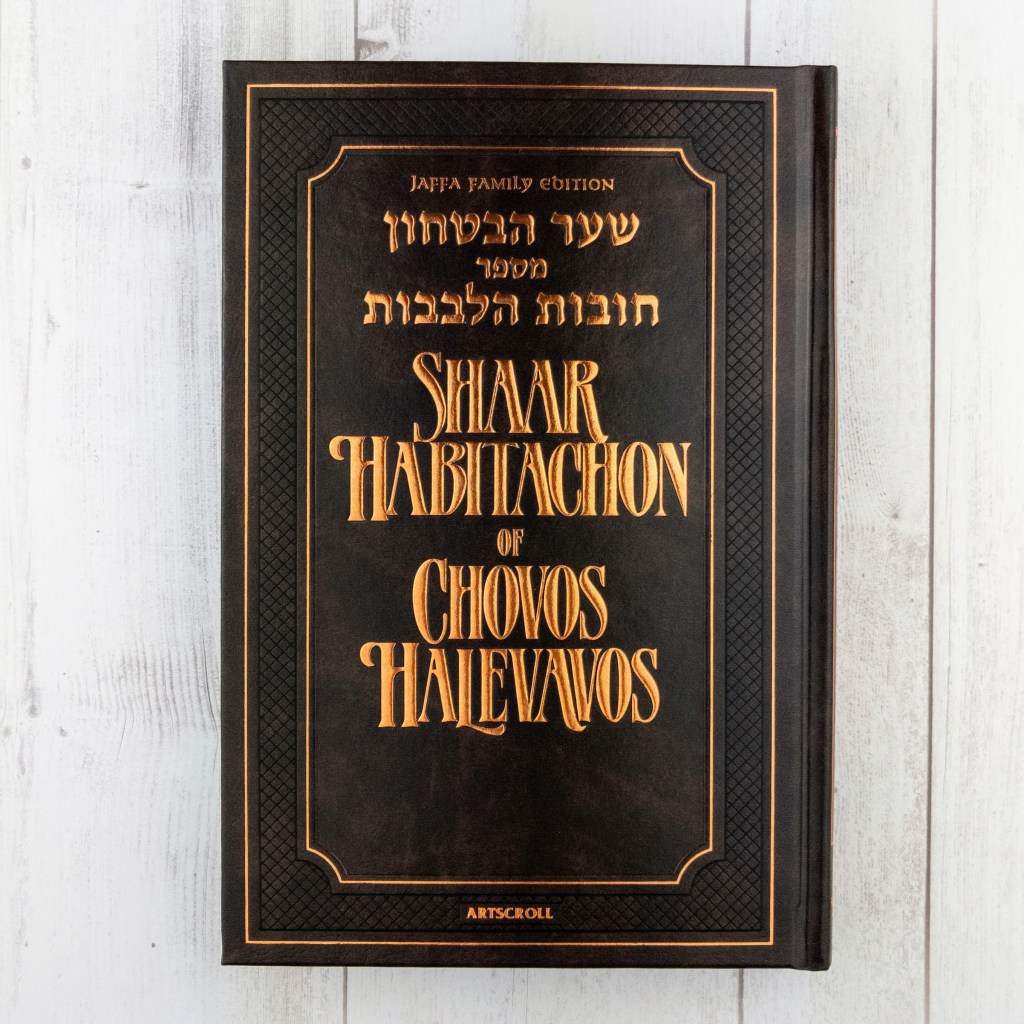
The Jaffa Family Edition Shaar HaBitachon of Chovos HaLevavos

Rav Chaim Soloveichik once saw his son, Yitzchak Zev, the future Brisker Rav, when he was a young boy, studying Chovos HaLevavos with intense effort. R’ Chaim said to him, with satisfaction: “Learn, learn. Chovos HaLevavos is the Shulchan Aruch of Yiddishkeit!”

Written almost a thousand years ago, Chovos HaLevavos is a revered classic, learned — and loved — by every generation since that time. A Shulchan Aruch, indeed: Just as the Shulchan Aruch guides our actions, showing us how to fulfill the mitzvos properly, Chovos HaLevavos guides our thoughts and feelings, gently but firmly teaching us how to create a strong, unbreakable connection to our loving Father.

Shaar HaBitachon, the fourth section of Chovos HaLevavos, is often studied as a self-contained work. It discusses many of the most fundamental Torah hashkafos. Its ancient words speak to our contemporary lives with amazing relevance, and it is studied especially by people needing encouragement in facing painful challenges.

How do I strengthen my bitachon, especially in these trying times? How do I find the right balance between hishtadlus — effort — and bitachon — faith? How can I experience the menuchas hanefesh, peace of mind, of someone who truly trusts Hashem? As Jews committed to Torah, mitzvos, and seeking a close connection to Hashem, the answers to these questions are vitally important to us.

This classic Torah masterpiece has now been translated and elucidated in a way that makes it accessible to all of us, scholar and layman alike. Created by the talmidei chachamim who brought us the bestselling classics Mesillas Yesharim and Shaarei Teshuvah, The Jaffa Family Edition Shaar HaBitachon of Chovos HaLevavos includes a phrase-by-phrase translation, in the format of the Schottenstein Talmud and the ArtScroll Rashi. Extensive explanatory notes, based on a broad range of commentaries and mussar classics, give us a deeper understanding, and the Insights section bring the words of Shaar HaBitachon into our lives, showing us how we can live in tranquility when we fully trust in Hashem’s goodness — and how to achieve that trust. This is a sefer that shows us the richness and depth of Shaar HaBitachon and how it relates to our everyday lives.

ArtScroll’s newly released Jaffa Family Edition Shaar Habitachon of Chovas HaLevavos will help us face the new year with serenity and confidence in Hashem’s compassion and goodness.

Order your copy TODAY on artscroll.com!

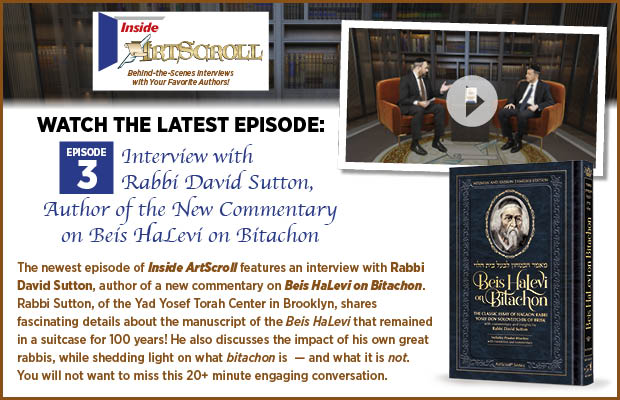
A Conversation with Rabbi David Sutton: Author of Bais Beis HaLevi on Bitachon with Commentary and Insights

AS: Beis HaLevi on Bitachon has an interesting history. Can you tell us about the manuscript and how it came to be published?

RDS: As Rosh Yeshivah of Volozhin, founder of the Brisk dynasty, and author of Beis HaLevi al HaTorah and Teshuvos Beis HaLevi, Rabbi Yosef Dov Soloveitchik is revered throughout the Torah world. The Beis HaLevi made another significant written contribution to the Torah world, which is much less known: the Ma’amar HaBitachon. It provides vital, all-encompassing insights on the true meaning of emunah and bitachon, as well as on the fundamentals of man’s relationship with God. The Beis HaLevi’s essay on bitachon was not published during his lifetime. The manuscript accompanied his descendants along a long journey until it was finally published as an appendix to Beis HaLevi al HaTorah in 1985. We now have the zechus of taking this hidden treasure of Torah and offering it to the general public. This volume includes the original text, a flowing and readable translation, commentary, insights, and an Overview.

AS: A unique feature is a section of pesukim to recite in order to strengthen bitachon. Tell us about this custom.

RDS: The more one has bitachon on his lips, the more it will enter his heart. Listen to what the Sefer HaChinuch says about this custom. “These pesukim in Tehillim about reliance on Hashem contain ideas that inspire the soul of a person who knows them, arousing him to rely on Hashem …. As a result of that inspiration, he will without any doubt be protected from all possible harm.” The Maharal said, “Every person must recite pesukim of reliance on Hashem to train and habituate himself in faith and belief in Hashem.” The Maharal also quoted his grandfather, saying, “We have received an accepted tradition … that reciting verses of reliance on Hashem has the power to annul all harsh decrees.”

AS: How can this sefer help us in these challenging times?

RD: To paraphrase a well-known saying: When the going gets tough — the Jew works on bitachon. Emunah and bitachon give us the strength to deal with the world around us. We are living in a period of challenges in many areas of life, throughout the world, so we are especially proud to present this book at a time when so many people will benefit from it.

Get your copy TODAY from artscroll.com

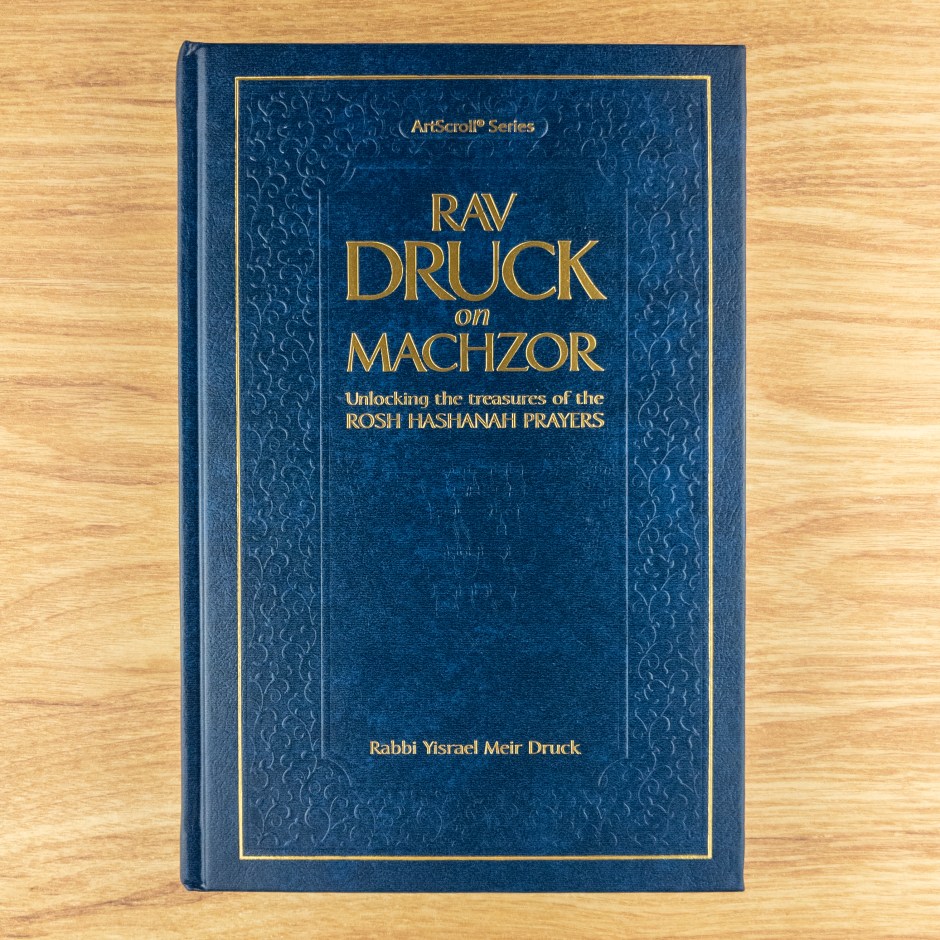
Unlock the Treasures of Your Rosh Hashanah Tefillos: Rav Druck on the Machzor

It’s going to be a very different Rosh Hashanah this year.

For some of us, in places where Covid-19 is raging, we may be davening in parking lots, backyards, or porches, locked out of our beloved shuls. 

Even for those fortunate enough to be able to daven in their shul this Rosh Hashanah, so many of the words of the machzor take on a special and different meaning. “Remember us for life” — in a year when Covid-19 is still running wild in many places, and the threat of a second wave is beginning to feel very real, and very frightening. “Inscribe us in the book of life, blessing, and peace, and good livelihood” — at a time when whole industries have collapsed in the shadow of coronavirus.

With all the challenges of the past year and our fears for the year to come, we want our tefillos to be especially fervent and sincere. ArtScroll’s newly-released Rav Druck on the Machzor: Unlocking the treasures of the Rosh Hashanah prayers will give us a whole new understanding of the tefillos and help us open our hearts with deep and authentic kavanah.  

Rav Yisroel Meir Druck is a Rosh Yeshivah and popular speaker who elevates audiences wherever he goes. He follows in the footsteps of his illustrious father, HaRav Mordechai Druck, the famed “Maggid of Yerushalayim.” For thirty years, Rav Yisrael Meir has been a chavrusa of Maran HaGaon Rav Chaim Kanievsky shlita. When Rav Chaim asked him to found Yeshivah Tiferes Yisrael, named for the Steipler Gaon, Rav Druck began in 2004 with a small cluster of talmidim. Since then it has become one of the world’s fastest growing yeshivahs, with 2,000 students, from beginners to advanced Kollel.

Rav Druck’s insights, firmly based on a large variety of classic Torah sources, are brief, readable, and very, very intriguing. He offers us a new clarity on concepts such as Hashem’s Kingship, mercy and judgment, the simanim of the holiday, the many dimensions of prayer, and much more. We will better understand the significance of the shofar and the inestimable power of teshuvah. And yes, as we gain these new understandings, we will daven with more intensity and sincerity, truly connecting with the words of the Machzor.

Use it to prepare yourself for Yom Tov, or take it with you to read during the quiet moments in shul. Your tefillos will never be the same!

Get your copy today here: artscroll.com

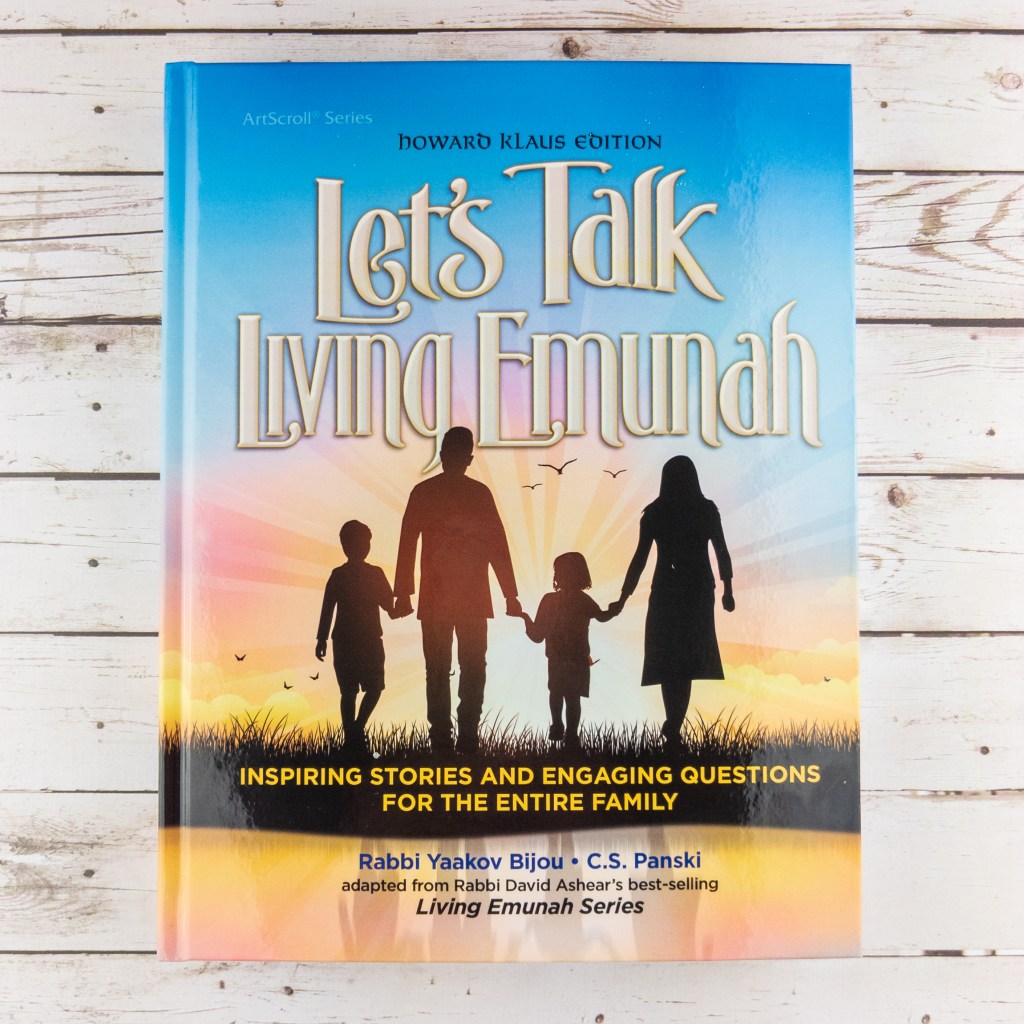
Bringing Parents and Children Together: Let’s Talk Living Emunah

You’re one of the tens of thousands who’ve discovered the power of emunah, through Rabbi David Ashear’s Living Emunah series. You see Hashem in your life, bring bitachon to your challenges, view events through a “gam zu l’tovah” perspective.

But what about your children and students? When things go wrong for them — troubles with friends, self-esteem issues — do they know the emunah approach?

And speaking of your children — when was the last time you spoke to them? Not about oversleeping, messy bedrooms, and when to be home for dinner — but about serious life issues? About emunah?

If you want to have meaningful conversations with your children and at the same time help them incorporate the eternal values of emunah into their lives, we have good news for you.

The good news is called Let’s Talk Living Emunah.

Rabbi Yaakov Bijou, rebbi and director of the Emunah Program in Yeshivat Shaare Torah of Brooklyn, shares the unique beginnings of a unique book. “I give a once a week talk to 6th – 8th grade boys. I wanted to make it hands-on, to get them involved. I would read an excerpt from Living Emunah, pause in the middle of the story and ask the boys a question about their experiences, or how they would react in such a situation, or what they thought Hashem wanted. The idea was to get the children to speak about it and bring emunah into their lives.” 

“The impact was enormous,” says Mrs. C. S. Panski, who crafted the stories and questions in the new book. “More and more students were talking about emunah, reacting with emunah. We knew it was time to bring the movement beyond the yeshivah’s corridors.”

Rabbi David Sutton, who coordinated the project, adds, “The purpose of this book is to create discussion within the family or classroom on the subject of emunah. We don’t want the stories to remain in the book; we want them to become part of the child’s life.”

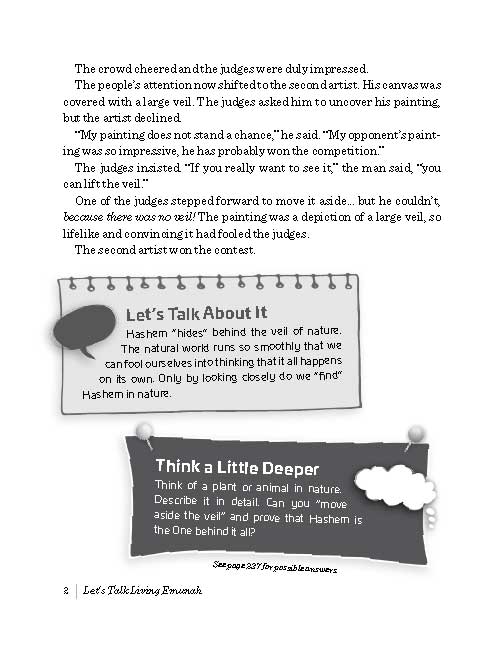
There are stories about Hashem’s wonders, hashgachah pratis, gratitude, and other emunah topics. The sidebars — “Let’s Talk About It,” “Think a Little Deeper,” and “It Happened to Me” — are designed to get the children thinking — and talking.

At the Shabbos table, or any time you want a meaningful and enjoyable conversation with your children, Let’s Talk Living Emunah!

Order your copy TODAY from artscroll.com

Rav Yaakov Feitman Speaks About His New Book – Blueprints: Torah views of the world and events around us

We spoke to Rabbi Yaakov Feitman about his new book, Blueprints. Here’s what he had to say about this unusual, groundbreaking book.

“A blueprint is used by an architect to design and plan a building project. Although, of course, Hashem did not need a blueprint, the Zohar teaches us that ‘Hashem looked into the Torah and created the world.’ This means that there is absolutely nothing in the world that is not explained by the Torah. I have always been fascinated by the myriad examples of this in our history and daily lives. If something is a part of our world, we can always find direction from the Torah for how to understand and even deal with it.

“The format, of pointing out a blueprint from the Torah and its application in real life, demonstrates how a Torah Jew can interface with the world around us. On the one hand, we need not accept secular interpretations about world events or scientific discoveries. We have a document — the Torah — that precedes them all. On the other hand, we need not ignore or escape from facts, figures, or occurrences. All we need to do is to look into our Torah. Of course, we cannot always do this for ourselves. Our gedolei Yisrael have always provided us with the applications of the Divine, from which we can derive the proper understanding of virtually anything that comes our way.

“Over the years, a process has emerged that entails identifying a ‘blueprint’ and discovering what we can learn from it on a practical level for our lives. I haven’t actually looked for these topics. They always find me. An article in a newspaper, the report of a scientific discovery, and many other human-interest events shout out to me, “This is a blueprint,” which turns into an article — and grew into a book.

“I must confess that each topic is as precious to me as a child, but if I had to choose, I love learning new things about the animal world and shining the brilliant light of the Torah upon each revelation. I hope that I have helped my readers to apply the Blueprint to the world and I would love to hear from them about their own applications.”

Order your copy today at artscroll.com!

A Conversation with the Chofetz Chaim Heritage Foundation (CCHF) about their new book, Live the Blessing: Daily wisdom on how to live in peace with family, friends, and yourself

AS: The Chofetz Chaim Heritage Foundation created a revolution in our shemiras ha’lashon. Your new book, Live the Blessing, explores making peace between people. Why shalom? Why now?

CCHF: Without shalom, shemiras ha’lashon will last only so long. People who are involved in personal disputes might try not to speak negatively about each other, but it often is just a matter of time before someone’s feelings leach out into the words they say. In addition, without shemiras ha’lashon, shalom doesn’t have a chance. Even if a dispute starts off as a reasonable difference of opinion, once the parties begin talking about each other it will turn into a machlokes. When we focus on shalom, we are not tempted to denigrate other people. This book is meant to show people what shalom and machlokes look like in real life, and to give them tools to choose the right path.

AS: Does making shalom mean we all have to think alike?

CCHF: Not at all. It means making space in our world for other people’s thoughts and perspectives. It doesn’t mean agreeing all the time, but rather, learning to disagree without personal animosity. We need only look at the Twelve Shevatim to know that Hashem had no intention of creating a nation that was all of a kind.

AS: There are chapters about peace between husband and wife, parents and children, neighbors and friends, even between divorced couples. Can we really make peace with everyone in our lives?

CCHF: The chapters give readers a peek at what happens to people’s lives when they stoke conflict and what happens when they work to resolve it or at least cool it down. In any situation, whether it’s family life, marriage, friendships, business relationships, or divorce, shalom brings blessing and machlokes brings destruction. Once we’re convinced of this, we still have much work to do to change our reactions and reframe what we tell ourselves about the people in our lives. We hope the book’s daily readings will spur people to realize that this is the right path — and to take it.

AS: Each chapter also contains advice from prominent rabbanim, therapists, and educators. They are very varied in their perspectives, but is there a theme that unites them?

CCHF: The most prominent common thread in their advice is this: Nobody has ever gained by stoking machlokes and nobody has ever regretted seeking shalom.

Get your copy today! From artscroll.com

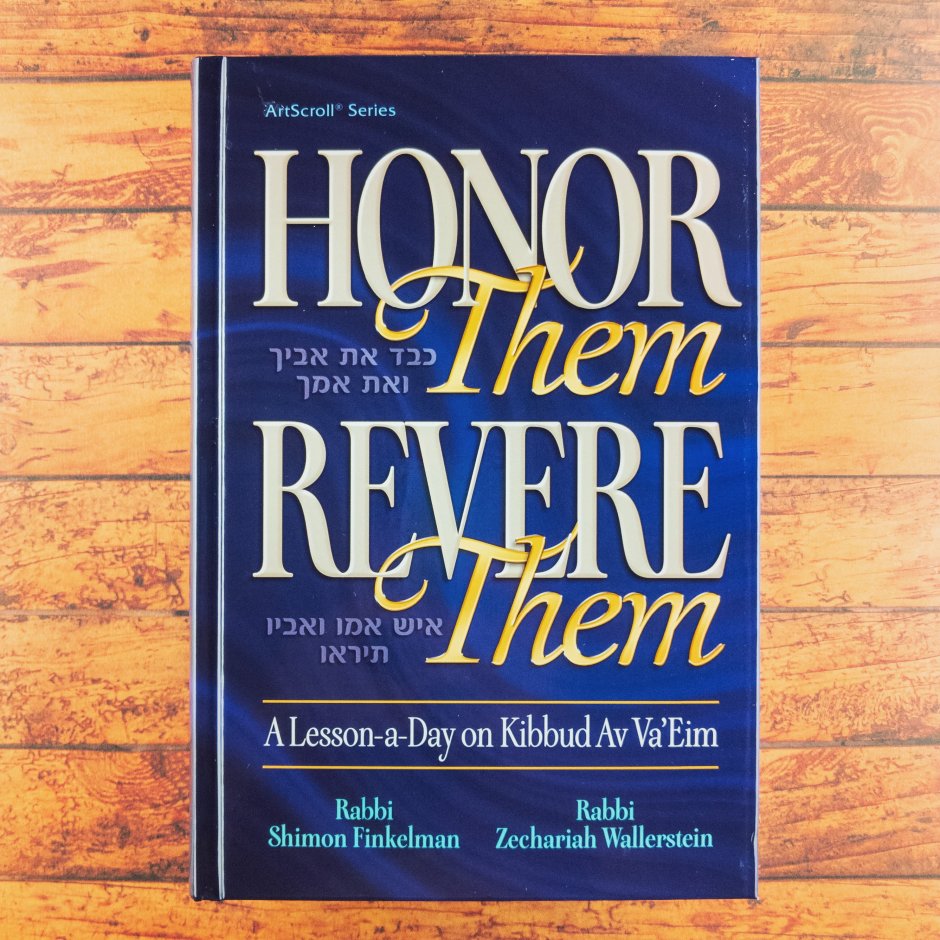
ArtScroll Speaks with Rabbi Shimon Finkelman Co-Author – with Rabbi Rabbi Zechariah Wallerstein – of Honor Them, Revere Them: A Lesson a Day on Kibbud Av Va’Eim

AS: Why did you and Rabbi Wallerstein decide to take on the topic of kibbud av va’eim for your newest collaboration?

RSF: Three years ago, Rabbi Wallerstein contacted me. He said that in his dealings with scores of teenage boys and girls, he found that many were simply unaware both of the centrality of kibbud av va’eim in Jewish life and of many of the halachos of this mitzvah. We had already collaborated on Let There Be Rain, our book on hakaras hatov, which, baruch Hashem, was very well received, so he wanted to do a similar book on kibbud av va’eim.

AS: Why did you choose the format of daily readings?

RSF: The two-page spread lesson-a-day format makes it possible for the reader to read a complete concept each day, along with a story, in five minutes or less. People find that by reading about a mitzvah daily, they maintain a subconscious awareness regarding that mitzvah. In this case, it reminds them to seek opportunities to honor their parents and to interact with them in the right way.

AS: You offer us many stories to illustrate the importance of kibbud av va’eim. What is one story that made a deep impression on you?

RSF: Rabbi Wallerstein’s father, a”h was vacationing in Florida, while his mother, Rabbi Wallerstein’s grandmother, was going to leave for Eretz Yisrael from Kennedy Airport in New York. Mr. Wallerstein flew in from Florida, met his mother in the airport, requested her berachah (as he did every Friday), bade her farewell, then immediately got on a plane and headed back to Florida. He took a round-trip flight just to see his mother for a few minutes and wish her well.

AS: Briefly — why is kibbud av va’eim so hard? And why is it so vital?

RSF: Talmud Yerushalmi says that kibbud av va’eim is one of the most difficult and most serious mitzvos. Rav Moshe Feinstein zt”l writes that one reason it’s so difficult is because of our closeness and familiarity with our parents. Because we feel so close to them, we are liable to treat them like friends, and that can lead to unintentional disrespect. Kibbud av va’eim is one of the most important mitzvos because our relationship with our parents is intertwined with our relationship with Hashem. And our connection to Torah and mesorah all the way back to Matan Torah is primarily through our parents.

Get your copy today here: artscroll.com

A Conversation with Danielle Renov author of Peas Love and Carrots: The Cookbook

AS: The buzz about Peas Love and Carrots: The Cookbook is extraordinary, with over 25,000 (!) copies pre-sold before it’s even been released! Where did all the excitement come from?

DR: I’ve developed a really close relationship with my community, and they’ve been with me as I collected and developed the recipes and narrowed them down to the ones that work the best. The community — tens of thousands of us, and growing every day! — worked with me to create this, and we’re all very excited about it.  We’re a very diverse group: Sephardim and Ashkenazim. Chassidim, yeshivah people, modern Orthodox, secular Jews. We’re all people who like to put beautiful food on the table, who enjoy eating, and serving, different, interesting foods. I bring them fantastic recipes and share techniques to make their cooking better.

AS: Tell us something about those recipes.

DR: They are very approachable. Most are budget-friendly, quick and simple to follow, but there are also the exotic, unusual recipes that need more preparation, for holidays, entertaining, or when you’re in the mood for cooking something really exciting. There is so much here: More than 250 recipes! About two-thirds of the recipes are for everyday meals, particularly dinner, which is always a challenge. The other third are designed for Shabbos and Yamim Tovim.

AS: How do you go about developing and taste testing your recipes?

DR: I wake up in the morning and see what kind of cuisine I’m in the mood for!  My kids are my guinea pigs, and I don’t know anyone who is a pickier eater than my husband. If a dish gets everyone’s approval, I make it a second time to tweak it to perfection, and then I make it a third time to make sure the results are consistent.

AS:  With so many recipes to choose from, what are your personal favorites?

DR: The ones that are meaningful for me, the foods that bring me back to my childhood and elicit memories of my grandmother, bring me to a special place and time. For me, food is so much more than sustenance. It is what ties our future to our past. It is what brought me to the table growing up in my parents’ home and what brings my own children to the table today.

Get your copy TODAY on artscroll.com!

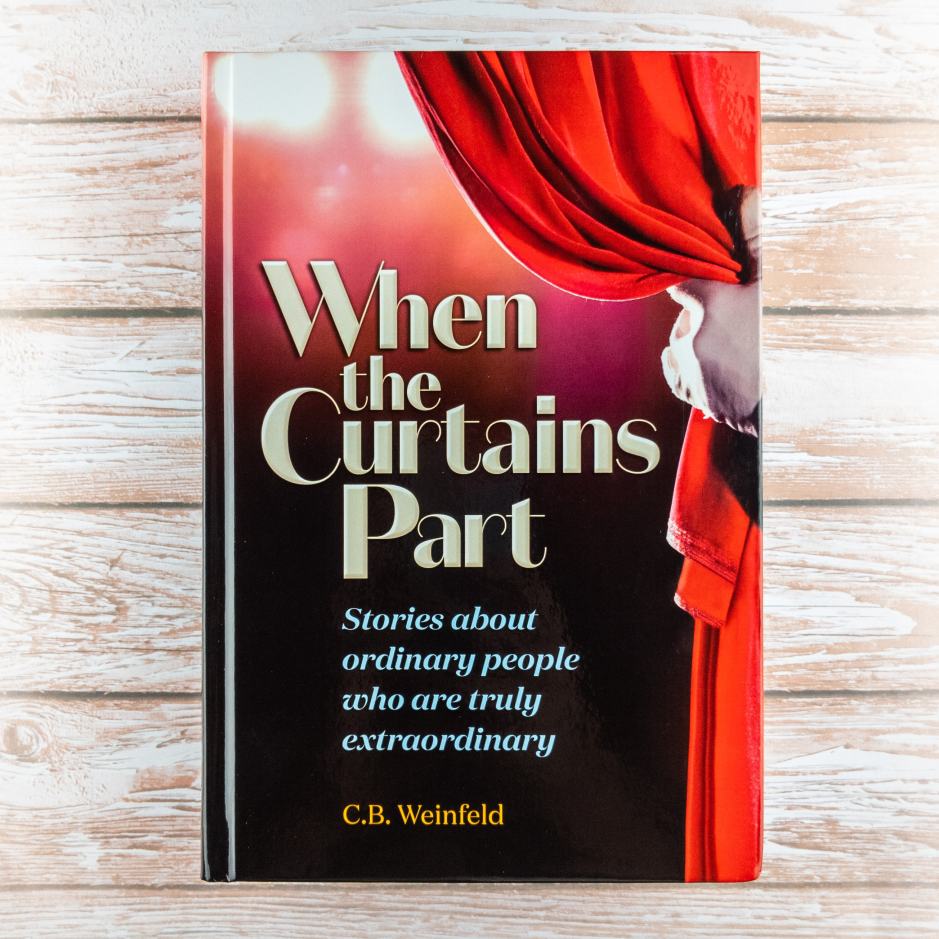
A Conversation With C.B. Weinfeld Author of ‘When the Curtains Part’

AS: Mazel tov! Your sixth collection of stories — just released and already a bestseller! So tell us — what do we see “when the curtains part”?

CBW: We see pain. We see angst and uncertainty and fear but we also see raw grit, the determination of the climb, and the joy of triumph. We see real people who are called upon to make excruciating choices. But most of all, in their struggle and, often, their ultimate victories we see ourselves.

AS: Over the years, you’ve written so many stories, each one unique. How do you work that magic?

CBW: It’s a gift from Hashem, nothing to do with me. But since I’ve published my first book nearly thirty years ago (Open House, long out of print), I have made it my business, when people share their stories, to try and penetrate their essence, to get to the core of what makes them unique.

AS: It’s been a tough year, with losses, lockdowns, parnassah woes, and sky-high anxiety. Can you give us an example of a story that will help us get through these challenging days?

CBW: The story “The Last Laugh,” about a Holocaust survivor whose aron was mixed up with that of a meis mitzvah during the height of the pandemic, is a perfect example of the unique hashgachah that we merited to see during these trying times. There are no accidents even if events may feel random. They are all perfectly orchestrated from Above.

AS: Whenever we ask for your favorite story, you say it’s like choosing your favorite child. So, we’ll ask you something different: Which story was the most fun for you to write? Which do you feel was the most challenging?

CBW: The first story in the book, “Behind Closed Doors,” was a lot of fun to write, because it was before Purim and everyone was in dress-up mode. Since I had once procured a similar Yerushalmi costume for a friend, with hilarious results, I relived that memory.

The story of Sani, a child who had two “mothers” vying for the privilege of raising him, was by far the most challenging to write, because there was so much pain involved, and there was no closure for one of the “mothers.” But today Sani is doing well, and his parents are seeing much nachas from him, so I guess that makes it a success story.

Order your copy TODAY on artscroll.com!

Rabbi Dovid Trenk: Still showing us how to live — and love — better.

To know Rabbi Dovid Trenk was to love him because he loved you. Even if he’d just met you.

Dovid Trenk was a once-in-a-lifetime kind of person, and Just Love Them: The Life and Legacy of Rabbi Dovid Trenk byYisroel Besser, published in time for Rabbi Trenk’s first yahrzeit, is a once-in-a-lifetime kind of book.

Exuberant, empathetic, and almost unbelievably energetic, Rabbi Trenk overflowed with simchas ha’chaim, with the joy of living in Hashem’s world. As a rebbe and rosh yeshivah, first in Yeshivas Mir, then in the Adelphia Yeshivah he helped create, and finally in his own yeshivah, Yeshiva Moreshes Yehoshua, he saw the good, the potential, and, yes, the holy neshamah in every talmid, and he drew out what was best in each of them. With his powerful personality, his humor and understanding, and, of course, his infinite love for his talmidim and for Torah, he showed thousands of people of all ages just how good they could be.

When he found his students breaking into the yeshivah kitchen at night, he led them to his own house and cooked up a pot of pasta (the boys still remember how good it tasted). A simple question asked by a weak student became, in Rabbi Trenk’s words, a “bomb kushya,” good enough to ask of the Rosh Yeshivah giving the student a much-needed and long-lasting boost of confidence and love for learning. The stories, and there are so many of them, beautifully illustrate his philosophy of chinuch, and of life: “Just go in and love them and teach them and listen to them and build them. That’s all you have to know!”

Written by master storyteller Yisroel Besser, Just Love Them is much more than an engrossing read and a great collection of stories (though it is that too!). In the hundreds of stories about him, each one as unique as Rabbi Trenk himself, we learn to dream big. To live big. And most of all, to love our children, our talmidim, our nation, and ourselves.

As Yisroel Besser says, “[This book] will change the way you look at everybody around you: Your wife, your children, your friends and neighbors. And the way you look at yourself.”

Order your copy TODAY from artscroll.com!