Think there’s never enough time in your day for everything you want to accomplish? Think again! In The 25th Hour, an unusual blend of Torah hashkafah, chizuk, and practical ideas, Rabbi Dov Keilson, Mashigach Ruchani of Yeshiva Darchei Torah, shows us how to maximize our time.
And, busy as he is, he even found the time (!) to speak with us about his new book.
AS: It’s a fascinating topic: time. What made you decide to write a book about it?
RDK: Time is something that has been on my mind for years; it truly mesmerizes me with its mysteriousness and its power. And I felt the best way to really delve into it would be to write about it.
AS: The book is divided into daily readings. Why did you choose this format?
RDK: One reason was to make it easier to learn the techniques. And a second reason was to show the greatness of each day by revealing how much a person can accomplish in one day!
AS: Time is, indeed, a precious gift. Yet nowadays no one seems to have enough. Why is that — and what can we do about it?
RDK: I believe that the reason people don’t seem to have enough time is only because they are not maximizing the time they already have. When one truly maximizes and keeps in perspective clearly what he is supposed to do and when he is meant to do it, he will find time for everything.
AS:What are some benefits of understanding the value of every minute of life?
RDK: When a person appreciates a minute of life, it will open to him a world to whichthat he did not have a connection before. The lethargy and laziness in regard to doing mitzvos, and wasting and killing time both stem from not appreciating how much opportunity one has in one moment in this world. If a person would constantly maintain awareness of how short life is, and how much eternity he can acquire in each and every second of life, he would have a much more fulfilling existence.
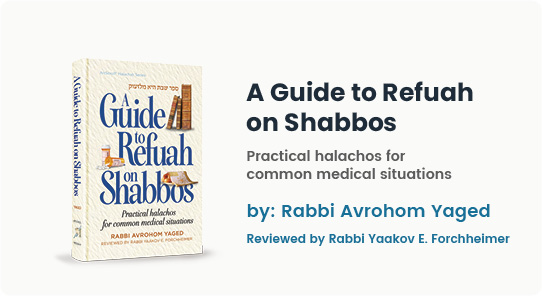
AS: What prompted you to write about the halachos of medicine on Shabbos?
RAY: I realized there was a void in this subject. Families with children, especially, have many questions, and those who must spend Shabbos in a hospital are sure to have halachic questions. It shouldn’t happen that when a medical situation arises it is surrounded with uncertainties, especially since a Rav may not be immediately available.
AS: Refuah on Shabbos is an easy-access guidebook for every home. Yet it also includes hundreds of source notes for those who want a deeper understanding. Tell us about the process of writing both for laymen and talmidei chachamim.
RAY: My goal was to make it as simple as possible, imagining actual people going through a medical scenario, what they need to know, and what other possible questions might arise. The sefer also gives introductions to many subjects, explanations of various halachos, and footnotes that range from simple references to detailed information. The sefer has been reviewed by Harav HaGaon Yaakov Forchheimer shlita, who enhanced the sefer with his many years of experience and acknowledged expertise in answering medical questions — from simple ones like giving Tylenol to an infant to complex questions of life and death.
AS: What are some of the features that make this sefer so user-friendly?
RAY: The topics are clearly organized by chapter. For example, one chapter walks an expectant mother through the entire birth process, from calling her doctor when she is in labor through being discharged on Shabbos, with everything in between. The ArtScroll staff worked very hard to prepare an extensive index. In addition, a chart lists close to 100 common ailments, illnesses, and injuries in alphabetical order. It tells the reader how to classify the problem — that is, is it life-threatening or not, etc.? — and then it directs the reader to the page where the topic appears.
AS: What are some of the topics that you cover?
RAY: From birth to end of life and everything in between: common illnesses, life-threatening diseases, fractures, stitches, mental health, carrying medical devices outside of an eruv, birth, physical therapy, child care and safety, visiting the sick on Shabbos, hygiene, and when hilchosYom Tov differ from the halachos of Shabbos.
It is my hope that Mashiach will come speedily in our days, and there will be no more illness. But until then, we need a Guide to Refuah on Shabbos.
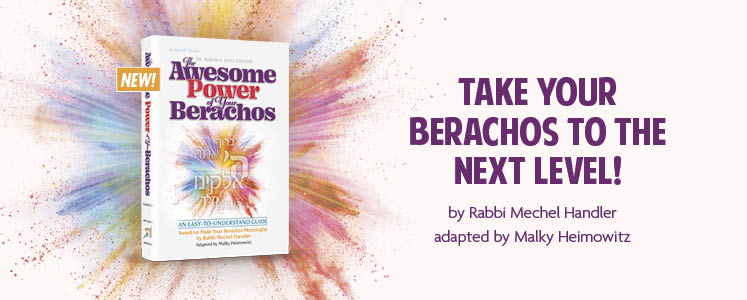
Many thousands learned to say their berachos with kavannah after reading Make Your Berachos Meaningful, by Rabbi Mechel Handler. Now, young adults and anyone looking for a simpler, faster guide can enhance their lives with The Awesome Power of Berachos, adapted by Mrs. Malky Heimowitz from Make Your Berachos Meaningful.
AS: Reciting a berachah with kavannah can change our day — and our lives. What is the awesome power that we tap into when we say a berachah?
MH: We remember Hashem. We remember that He’s in charge of the world. We remember that He loves us, and we love Him. And that awareness opens the channels of blessing and brings more berachah into our lives.
AS: Shortly before his passing, Rav Chaim Kanievsky zt”l said Klal Yisrael should improve our kavannah when saying berachos. How will this book help us do just that?
MH: We say berachos — but how much do we think about them? This book will help you understand what’s special about a berachah, so a berachah will no longer be something you’ll mumble.
AS: We all want to feel closer to Hashem. How can saying berachos help us do that?
MH: Berachos, Chazal tell us, are a shortcut to high levels of avodas Hashem — if we say them properly. From the time we wake up until the time we go to sleep, we are saying berachos: over food, over mitzvos, in davening, and more. If we say berachos correctly, each of them can give us a spiritual boost, and we’ll feel close to Hashem all day long.
AS: Graduation time is here! Why is this book so important for grads?
MH: It’s a lot easier to get into the habit of saying berachos carefully when we’re young than when we’re older and set in our ways. And what better gift to give a new grad than the key to a spiritually satisfying life?
AS: Chazal talk about the power of “100 berachos a day.” Why do we need to say so many berachos each day?
MH: Each time we recite a berachah, we train ourselves to stop and think about all the wonderful gifts in our lives. And the more we notice those gifts, the happier we’ll be. Hashem doesn’t need our “Thank You,” but He wants us to express — and feel — appreciation to Him for our own sake, so that we become happy, grateful people. This helps us to truly enjoy our lives and the many gifts He gives us.
Looking for a shidduch for your child, your best friend, your chavrusa — or maybe even yourself?
Send out those resumes. Contact those shadchanim. Network among neighbors, relatives, and friends. Power up that hishtadlus, and redt as many shidduchim as you can.
But don’t forget to do what Jews do best.
Turn to emunah.
With more than 300,000 copies in print, the Living Emunah series has taken us on quite a remarkable journey. Along the way we’ve learned to deepen our trust in Hashem. To see His loving intervention in every aspect of our lives. To understand that even the challenges, the hard stuff, are sent to help us grow in ways we could never have imagined.
In Living Emunah on Shidduchim, Rabbi David Ashear takes us into the challenging world of shidduchim. The Talmud likens finding a spouse to KriyasYam Suf (Sanhedrin 22a), and nowadays it seems that so many of our loved ones are waiting for that raging sea to split for them.
How can we stay calm and tranquil when the wait to find a shidduch for ourselves or people we love sometimes seems endless? How should a person react in the face of disappointment or rejection? How do we find the proper balance between hishtadlus and emunah? With sensitivity, compassion, and — of course! — emunah, Living Emunah on Shidduchim guides us through the “parashah” of shidduchim.
As in all his bestselling books, Rabbi Ashear combines Torah insights with real-life stories that show how Hashem is the Master Shadchan, and how trusting in Him brings great reward. We see how, indeed, Hashem’s salvation can come in the blink of an eye, as it does in many shidduchim.
A 36-year-old woman shared her story with Rabbi Ashear, saying, “When the right man finally came along, because the time was finally right, Hashem guided me through the process so easily … it was just the time that Hashem knew was right and He brought it about in a very simple way …. I don’t know why Hashem wanted me to wait so many years, but that’s fine. It’s okay not to understand Hashem; we’re only human.”
Yes, we’re only human but, as we see in every page, every story in Living Emunah on Shidduchim, we are Jews who trust Hashem. And we know He will split the sea for us, at the right time.
AS: You wrote Incredible, Living Legend, The Rebbetzin, and now 90 Seconds — four amazing books about four powerful, unique and incredibly successful personalities. What are some of the traits that Rabbi Wallis, Rabbi Grossman, Rebbetzin Jungreis, and Reb Eli Beer share, which allowed them to accomplish so much?
RNS: All of them were willing to jump into situations that other people would have stayed away from, and none of them would not take no for an answer. And, of course, they all dreamed big and were not afraid to work hard to turn those dreams into reality
AS: Since he was 14 years old, Eli Beer has devoted himself to saving lives, and 90 Seconds is full of dramatic rescue stories. Can you briefly share the one that touched you most?
RNS: It’s not quite a rescue, but I was very touched by Eli’s account of identifying Dr. David Applebaum as one of the terror victims when Dr. Applebaum and his daughter Naava were killed in a terrorist attack in Jerusalem, on the night before Naava was to be married. Eli was very close with Dr. Applebaum and he literally couldn’t believe what he was seeing when he found him beyond help in the restaurant. Eli’s only son was born just a few days later, and he was named partially for David Applebaum.
AS: What are some takeaways the average reader will get from reading about Eli’s life and accomplishments?
RNS: Don’t worry if you aren’t successful in school. You have your whole life ahead of you. Don’t be afraid to make mistakes, so long as you learn from them. Think big.
AS: Intriguing title, 90 Seconds. Can you explain what it refers to and why you chose it for Eli Beer’s memoir?
RNS: Eli’s dream has always been to be able to reach any emergency in the entire country in under 90 seconds. That is his goal and his mission statement and in my opinion it sums up his life and accomplishments in a very clear and dramatic way.
Twenty years ago, he was a yungerman in Ponevezh, known more for diligence than his oratory prowess, a scion of the rebbes of Lelov who reflected the energy and joy of his ancestors. Some American bachurim in the Slabodka Yeshivah discovered the thirty-something-year-old Rav Elimelech Biderman and formed a private chaburah with him. They started eating Shabbosseudos at his home, speaking to him in learning and about life, and found that interactions with him left them feeling rejuvenated, a bit better about themselves.
When one of the chaburah members continued on to Mir, he missed the weekly shmuess, and so he asked Reb Meilech to start coming up to Yerushalayim as well. On Thursday nights, a chaburah was formed near the Mirrer Yeshivah in Yerushalayim, a small group gathering in the apartment that had once belonged to Rav Shloim’ke Zhviller, one of the great tzaddikim of Yerushalayim — and a great-grandfather of Reb Meilech, who is married to the daughter of the Zutchker Rebbe, himself a son-in-law of Ray Mordechai of Zhvil, grandson of Ray Shloim’ke.
The Torah of Reb Meilech seemed to come from a place without boundaries, a rush of halachah, chassidus, and Kabbalah, classic mussar and drush, stories and lomdus. The people responded to his message, their hearts captured by his vision of what a Yid is, how precious every small tenuah that a Yid makes is, how beloved each Yid is to the Master of the universe. They found strength and courage in the steady, continuous flow of emunah that came forth, learning not just to accept, but to appreciate, to revel in the challenges and joyfully triumph.
Over the last two decades, Reb Meilech’s voice has spread, with derashos delivered in both Yiddish and Hebrew in Meah Shearim or the Ponevezher Kollel, in a yeshivah for Americans, at a Tel Aviv “chaburah” of secular high-tech entrepreneurs, at the famed Sephardic Yazdim beit haknesset, and in small neighborhood shuls. Clips and translations of his weekly shiurim are lifting neshamos across the world. His reach and impact have grown, but he himself remains the same, without a formal beis medrash, yeshivah, or kollel, without organizations or websites, dancing through life, from the deepest corners of his beloved Meron to side rooms at the Itzkowitz Shtieblach in Bnei Brak.
He is hard to pin down, his days a trail of tefillah and chizuk: in hospital wards, offering words of hope, at a shivah home telling mourners that the sun will rise again, in the center of a throbbing circle at the wedding of someone who didn’t have it easy, adding new dimensions of simchah. He can be standing on a Bnei Brak street corner listening to the suffering of an individual or hidden away in the back of an out-of-the-way beis medrash, humming by an open Gemara.
That’s the schedule — Torah, chizuk, emunah, simchah, little particles of life flowing from him to others, giving them a new burst of chiyus.
He is restoring the pride, the innate joy, the valor that comes with being a Yid. When he is dancing on the table, the wall of people around him soaring along with him, together they are reaching higher, dreaming of more, celebrating what they have.
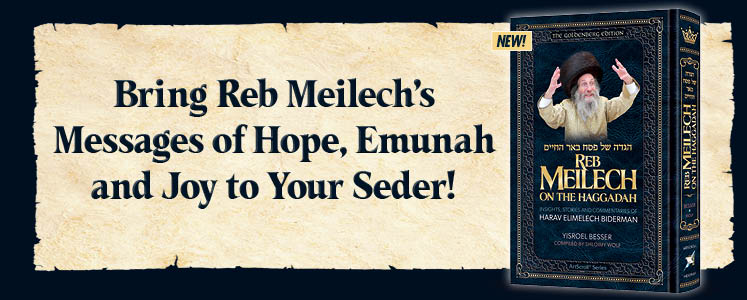
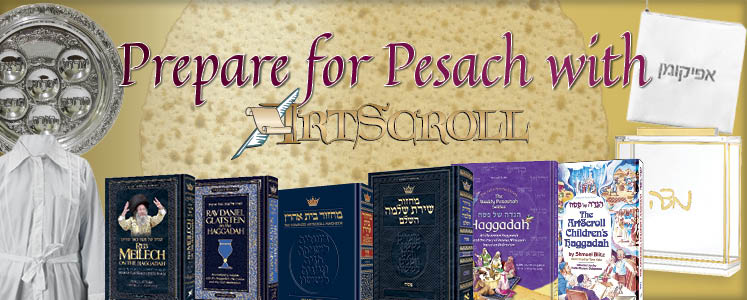
This is the call of Rav Meilech Biderman and this is the call of a brand new Haggadah published by ArtScroll, the lyrics of a whole year becoming full-throated song on the night of Pesach. Written by bestselling author Yisroel Besser, there is a theme that runs through the pages of Reb Meilech on the Haggadah, and it is one of clarity, courage, and most of all, freedom — the freedom of becoming His.
Becoming His, and understanding that He is ours as well.
He is watching, He is listening, He is waiting, and He is cherishing each word we say.
Reb Meilech has touched all of Klal Yisrael with his messages of chizuk, bringing us uplift and hope, filling us with confidence that we can make good things better.
Reb Meilech will enliven our Seder as only he can, with beautiful divrei Torah, delightful stories, and wise insights. This Haggadah will fill your home with Reb Meilech’s unique brand of simchah, the happiness of being part of Klal Yisrael, the joy of becoming aware of Hashem’s gifts all around, and the delight of knowing how much our Creator loves us and takes pleasure in all the good things we do.
They engage our attention. They inspire and educate, show us truths that we may overlook in the rush and scramble of today’s life, and — let’s admit it — they’re so much fun to read!
Here is a look at two new not-to-be-missed story collections.
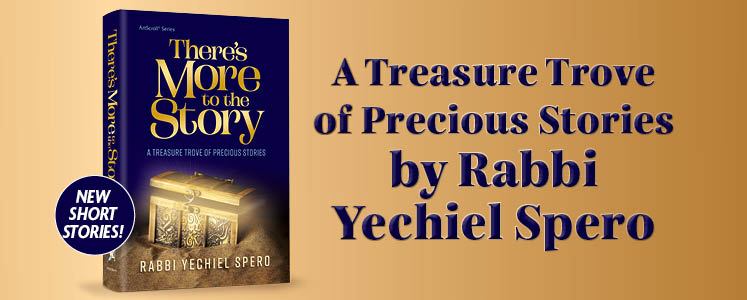
Rabbi Yechiel Spero has been engaging and inspiring us with his stories for almost twenty years. In There’s More to the Story: A Treasure Trove of Precious Stories, we will meet the man who ran the world’s most grueling marathon — in his bedroom, where he was trapped by Covid-19. An elderly woman who’d rejected her teacher, Sarah Schenirer, and who finds her way back to Yiddishkeit almost seven decades later, with the help of a young Bais Yaakov student. We’ll read about a Holocaust survivor who told the judge he’d earned his doctorate — in the university of life, and a mix-up that sent a gorgeous three-layered cake to a young boy’s classroom siyum and ensured he would stay Torah-observant many years later. The stories in this collection are, indeed, a treasure trove, gems sparkling with emunah, ahavas Yisrael, and the power of prayer and hashgachah pratis.
In Living Chessed,Rabbi Avrohom Asher Makovsky shares with us many Torah sources that discuss chessed, inspirational insights and guidance. Above all, he brings the concepts of chessed to life through stories of how chessed can transform the lives of both the giver and receiver. We will read about how the Tzemach Tzedek “opened” the gates of heaven — by racing home to help another Jew in business. How a man fulfilled his dream of having children — by opening a free-loan gemach. We will enjoy — and learn from! — story after story of people who took the opportunity to help someone, often with something as simple as a hug, a compliment, or even just a smile.
As we enter the pre-Pesach and Pesach season, with all its excitement, energy and, yes, stress, there is nothing like a really good story to keep us invigorated, to calm us when we’re feeling overwhelmed, and to assure us that we can reach higher, dig deeper, and be the best people we can be.
AS: How did your relationship with Rav Chaim and the entire Kanievsky family begin?
RNW: I started going to Rav Chaim in the mid 1990’s. In the late 1990’s, while he was guiding me through a personal matter, I would see him at least once a week. And for 28 years, though I don’t live in Eretz Yisrael, I would visit his home at least four or five times a year.
AS: We’ve already heard so many stories about Rav Chaim, yet this biography contains so many new stories and rare photos. How did you find them?
RNW: I spent many hours with his children, grandchildren, and great-grandchildren. I also did an extensive interview with his only surviving sibling, Rebbetzin Yuspa Barzam, and with his driver for more than 30 years, R’ Shaya Epstein, as well as with his fellow members of Kollel Chazon Ish, where Rav Chaim studied for several decades. The Kanievsky family graciously provided never-before-published photos of Rav Chaim as an infant, as a youngster, and from right after his bar mitzvah, as well as historical documents.
AS: Your biography of Rebbetzin Kanievsky sold more than 40,000 copies, and the new biography sold more than 15,000 copies in less than a week. How does it feel, to be influencing tens and perhaps hundreds of thousands?
RNW: I am just a reporter; it’s Rav Chaim who is influencing us. Rav Chaim sacrificed the thing that was most important to him — his time in learning Torah — to uplift others. From when he was a young avrech in kollel, till he passed away, he was available and accessible to every single person every day of the year. In his later years, hundreds of people visited him weekly to discuss personal matters or merely to bask in his presence. He positively impacted and changed the lives of thousands worldwide. Many of those people therefore feel very connected to him.
AS: A world without Rav Chaim — it’s difficult for you personally, and for all of Klal Yisrael. Can you share some words of chizuk?
RNW: The primary topic discussed in the book is Rav Chaim’s incredible middos tovos and how he dedicated himself to assist so many individuals. We can all learn from him to be there to help others. We can also try to replicate his incredible diligence in Torah study. This will be the most befitting tribute to his memory.
AS: How does this volume, on Sefer Yehoshua and Shoftim, enhance our understanding of the Navi?
RAB: This volume gives us “the rest of the story.” Neviim and Kesuvim are part of TorahSheBiksav, the Written Torah, which is explained and amplified by Torah Shebaal Peh, the Oral Torah. The teachings transcribed in the Talmud and Midrash give us both context and subtext — background on the personalities and incidents in Navi, as well as laws and lessons derived from the verses. By presenting, in readable English, the teachings in Bavli, Yerushalmi, and selected Midrashim that discuss the Navi text, we enable the reader to gain a greater understanding of what transpired and the implications of the Navi’s words.
RAB: People love it! Talmudic language is often technical and the dialogue is frequently challenging to follow. The language in the Tannaic Midrashim included in this volume is often cryptic and the lessons are sometimes hard to understand. This series extracts the essence of these teachings, retelling “what they say” in English. We also include the Talmud and Midrash texts for those who would like to see the original.
We’ve heard from older children, teens, and parents who use Chumash with the Teachings of the Talmud to find interesting insights on the weekly parashah for the Shabbos table. Rabbeim teaching Chumash consult it and Gemara rabbeim use it to find a simple way to explain a complex topic. Morahs, who have never studied Talmud, have told us that this opens an entire new world and provides an invaluable resource.
AS: Was the research for the Navi similar to that of the Chumash?
RAB: As with the Chumash, the presentation of the Talmudic passages was generally adapted from how they are explained in the Schottenstein Editions of the Talmud. Another advantage we had is that now the entire Schottenstein Talmud Yerushalmi is complete. The Midrashic selections proved more challenging and required much more research and analysis, especially since many of those passages have few or no commentaries. At times, the few commentaries had divergent approaches in how to understand the passage, and the writers and editors had to use their judgment as to which commentary to follow.














 The Official ArtScroll Blog