

Dear Friends,
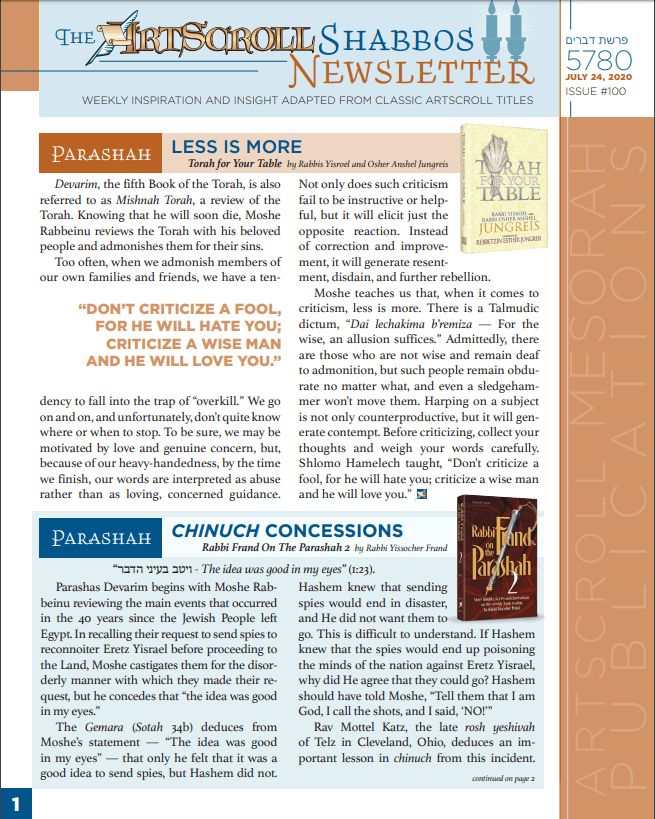
Below please find the inaugural edition of the ArtScroll Shabbos Newsletter, containing inspiration and insight from classic ArtScroll titles.
Click Here to download The ArtScroll Shabbos Newsletter – Devarim.
This weekly publication will contain a rich collection of stories, divrei Torah and insights that are suitable for the Shabbos table – or for anytime. We hope you enjoy and look forward to future issues, as we tap into the unparalleled treasure trove that is the ArtScroll Library, sharing the depth and beauty of our Judaic and Torah literature with you.
Read it. Be uplifted. And share the inspiration.
Have a good Shabbos.

During these challenging times, our thoughts and prayer are with Klal Yisroel. For the many people who live in neighborhoods where the shuls are closed for Shabbos, we are making this week’s Parashah and Haftorah available for a free download. Please share it with your friends and family.
We wish you a good Shabbos.
Mesorah Publications
Mesorah Heritage Foundation

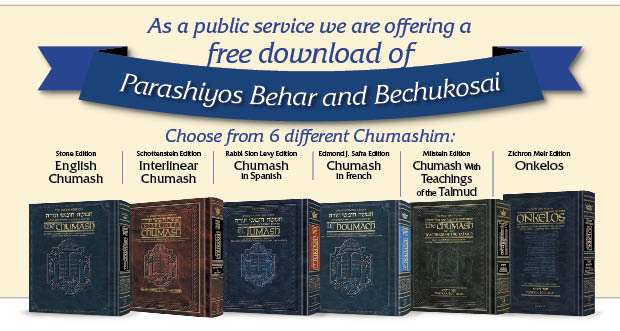
During these challenging times, our thoughts and prayer are with Klal Yisroel. For the many people who live in neighborhoods where the shuls are closed for Shabbos, we are making this week’s Parashah and Haftorah from six different Chumashim available for a free download. Please share it with your friends and family.
We wish you a good Shabbos.
Mesorah Publications
Mesorah Heritage Foundation

During these challenging times, our thoughts and prayer are with Klal Yisroel. For the many people who live in neighborhoods where the shuls are closed for Shabbos, we are making this week’s Parashah and Haftorah from six different Chumashim available for a free download. Please share it with your friends and family.
We wish you a good Shabbos.
Mesorah Publications
Mesorah Heritage Foundation

During these challenging times our thoughts and prayer are with Klal Yisroel. For the many people who live in neighborhoods where the shuls are closed for Shabbos we are making this week’s Parshah and Haftorah from the Stone Edition of the Chumash available for a free download. Please share it with you friends and family.
We wish you a good Shabbos.
Mesorah Publications
Mesorah Heritage Foundation
The pages are provided in memory of: Rabbi Meir Zlotowitz, z”l
HaRav Meir Yaakov ben HaGaon HaRav Aharon Zlotowitz z”l

PARASHAS MATTOS
1. The Sanctity of the Sages’ Words
‘וידבר משה אל ראשי המטות לבני ישראל לאמר זה הדבר אשר צוה ה
Moshe spoke to the heads of the tribes of the Children of Israel, to say: This is the thing that Hashem has commanded (30:2).
While the simple meaning of the phrase, וידבר משה אל ראשי המטות לבני ישראל,is Moshe spoke to the heads of the tribes of the Children of Israel, this phrase can also be interpreted as: Moshe spoke about the heads of the tribes to the Children of Israel. [The term אֶל can mean about, as in Shemos 6:13; see Rashi there.] What did Moshe tell the Children of Israel about the heads of their tribes? ‘לאמר זה הדבר אשר צוה ה ,[You are] to say: This is the thing that Hashem has commanded. I.e., when a Torah leader issues a ruling or gives an instruction, your attitude should be “This is the Word of Hashem” coming from the mouth of the Sage. It is indeed so, for the shepherds of Hashem’s flock merit to have Ruach Hakodesh, the Spirit of Holiness, speaking from within them (Chasam Sofer al HaTorah, p. 146b ד”ה וידבר משה א)
2. The Sanctity of Man’s Word
זה הדבר אשר צוה ה’ איש כי ידור נדר לה’ וגו’ ככל היוצא מפיו יעשה
This is the thing that Hashem has commanded. If a man will take a vow to Hashem … in accordance with whatever emerges from his mouth shall he do (30:2‐3).
Why does Moshe introduce this mitzvah with the words ‘זה הדבר אשר צוה ה, This is the thing that Hashem has commanded? After all, Hashem commanded us about all the mitzvos of the Torah! There is, however, an allusion in these words that applies specifically to nedarim (vows), as follows: What is the benefit of taking a vow that forbids oneself something which the Torah permits? The Mishnah teaches (Avos 3:17): נדרים סייג לפרישות, nedarim are a protective fence for abstinence. When a person wishes to elevate himself spiritually by abstaining from some form of material indulgence, but feels he is not strong enough to withstand temptation, he may undertake a neder that will obligate him to abide by his resolution. This type of neder is praiseworthy, and is the subject of our passage [as the verse says, ‘איש כי ידור נדר לה, If a man will take a vow “to Hashem”].
When a man takes a vow with this good intention, he may rest assured that Hashem is guiding him. Indeed, whenever a person expresses a worthy thought, the words merging from his mouth are driven by Hashem, as it is stated (Mishlei 16:1), לאדם מערכי לב ומה’ מענה לשון, Man can arrange feelings, but eloquent speech comes from Hashem. Thus, a person may decide in his heart to seek spiritual elevation through abstinence from some form of pleasure, and when he then expresses his inner wish in the form of a neder, it is actually Hashem Who places the words in his mouth.
This is alluded to in the words, ככל היוצא מפיו יעשה. The simple meaning is in accordance with whatever emerges from his (the person’s) mouth shall he do. But since the previous verse mentioned Hashem, this phrase can also be interpreted to mean: in accordance with whatever emerges from His (Hashem’s) mouth shall he do. The words of the neder that emerge from the person’s mouth actually originate from Hashem’s mouth, for it is He Who places those words in the mouth of the one whose heart inspired him to climb to a higher spiritual level.
We can now explain Moshe’s introductory words, ‘זה הדבר אשר צוה ה, This is the thing that Hashem has commanded. Rashi notes that most prophets would say, ” ‘כה אמר ה”,So says Hashem, which means that the prophet is conveying his own understanding of Hashem’s Word. Only Moshe was able to say, ‘זה הדבר אשר צוה ה, “This” is the thing that Hashem has commanded, meaning “This is precisely what Hashem commanded.” That is because Moshe was on the highest level of prophecy, at which שכינה מדברת מתוך גרונו, The Shechinah would speak from within his throat. When Moshe uttered prophecies, it was Hashem’s Word Itself emanating from his mouth.
Of course, we are not on Moshe’s level. But the fact that the Shechinah spoke from within Moshe should be a lesson to us that it is possible for Hashem to let his Word emerge from the mouth of a human being. This makes us realize that when we utter a neder for the sake of spiritual growth, it is Hashem Who places the words of the neder in our mouth, for each person according to his own level. As the verse states (ibid.), לאדם מערכי לב ומה’ מענה לשון, Man can arrange feelings, but eloquent speech comes from Hashem. We may thus be confident that any neder taken for the sake of Heaven is guided by Hashem (Chasam Sofer al HaTorah, p. 147 ב ד”ה זה הדבר).
In Memory of
R’ Yakov ben R’ Shmuel Yosef
and R’ Shimon ben R’ Moshe ע”ה
© Copyright 2019 by MESORAH PUBLICATIONS, Ltd.
Parashas Pinchas – The Righteousness of Pinchas
פִּינְחָס בֶּן־אֶלְעָזָר בֶּן־אַהֲרֹן הַכֹּהֵן
Pinchas, son of Elazar, son of Aharon the Kohen (25:11).
After Pinchas killed Zimri, the people protested: Since Pinchas was (maternally) a descendant of Yisro, who fattened calves to be sacrificed as idols, he should not have had the audacity to kill Zimri, a prince in Israel. In response, the Torah emphasizes that Pinchas was (paternally) a descendant of Aharon, who was known for his pursuit of peace (Rashi).
But this is difficult to understand. Didn’t everyone realize that in killing Zimri, Pinchas had acted zealously for the sake of Hashem’s Glory? Why would the fact that he was descended from an idol-worshiper diminish the significance of his great deed?
To address this, let us analyze the events that led to Pinchas’s deed. At the end of previous parashah, the Torah describes how the Jews became attracted to the Moavite women and their idols. Moshe set up tribunals to punish the sinners, and then a Jewish man (Zimri) came forward with a Moavite woman (Cozbi), and consorted with her in front of Moshe and the entire assembly. How could Zimri have been so brazen as to publicly engage in sin even while the sinners were being judged? Furthermore, Rashi tells us that when Moshe told Zimri that the Moavite woman was forbidden to him, he responded, “If so, who permitted you to marry the daughter of Yisro, a Midianite?” But did Zimri not know that Tzipporah had converted to Judaism? How could he use Moshe’s precedent as an excuse for sinning with the non-Jewish Cozbi?
It seems correct to explain that Zimri was aware of the prohibition against having relations with a non-Jewish woman, but he believed that the prohibition applied to the other Jews who sinned with the Moavites, but not to him. The Torah says (above, 25:2) that the Moavite women invited the Jews to join the feasts of their gods, indicating that the Jews who sinned had left the Jewish Camp and joined the Moavites in their camp. In that case, Zimri felt, having relations with the Moavite women was surely forbidden, since it would enable the women to entice the men into worshiping their idols. His case was different, though, since Cozbi had entered the Jewish Camp. Zimri therefore argued that she was not seeking to lure him into idolatry. To the contrary, she was apparently seeking to convert to Judaism, so he should be permitted to live with her!
Therefore,even as the other sinners were being sentenced to death, Zimri was unafraid to engage in his act; he felt that their punishment would not apply to him. And he further pointed out that Moshe himself married the daughter of Yisro, meaning to insinuate that just as she had converted, Cozby too could convert! Although Cozby might have an ulterior motive for converting, who could prove that her intentions were not sincere? Perhaps she would become an upstanding Jewess and produce righteous offspring. Claiming that his act was justified, he was unafraid to carry it out in public.
The people were swayed by Zimri’s argument and stood by while he sinned. Pinchas, however, understood that it had no merit, for Cozbi had surely entered the Jewish camp with the intent of helping the Moavite cause by seducing Zimri. Knowing that Zimri’s act could not be justified, Pinchas killed both him and Cozbi.
We can now understand the people’s reaction to Pinchas’s act of zealous revenge. Thinking that Zimri had a valid argument, they told Pinchas: You yourself are descended from an idol-worshiper who converted, yet you turned out righteous. How could you be so sure that Cozbi would not also have converted and produced righteous offspring, just as your ancestor Yisro did?
Hashem responded and validated Pinchas’s act, turning the focus to his paternal lineage from the perfectly righteous Aharon. Furthermore, the Torah stresses below (v. 18) that Cozbi was slain on the day of the plague for the matter of Pe’or. With this it clarifies that Pinchas’s judgment was correct. Cozbi could not have entered the Jewish camp with good intentions, for she did so on that terrible day when her people were actively luring the Jews into the worship of Pe’or. Clearly, she was part of their plot and both she and Zimri deserved to be put to death (Chasam Sofer al HaTorah, p. 131 ד”ה פינחס א).
In Memory of
R’ Yakov ben R’ Shmuel Yosef
and R’ Shimon ben R’ Moshe ע”ה
© Copyright 2019 by MESORAH PUBLICATIONS, Ltd.
 The Official ArtScroll Blog