
DOWNLOAD + PRINT At The ArtScroll Shabbos Table – Parashas Ki Seitzei!

Dear Friends,

Below please find the latest edition of At The ArtScroll Shabbos Table, containing inspiration and insight from classic ArtScroll titles.

This weekly publication will contain a rich collection of stories, divrei Torah and insights that are suitable for the Shabbos table – or for anytime. We hope you enjoy and look forward to future issues, as we tap into the unparalleled treasure trove that is the ArtScroll Library, sharing the depth and beauty of our Judaic and Torah literature with you.

Read it. Be uplifted. And share the inspiration.

Have a good Shabbos.

Click HERE to view, download At The ArtScroll Shabbos Table – Ki Seitzei

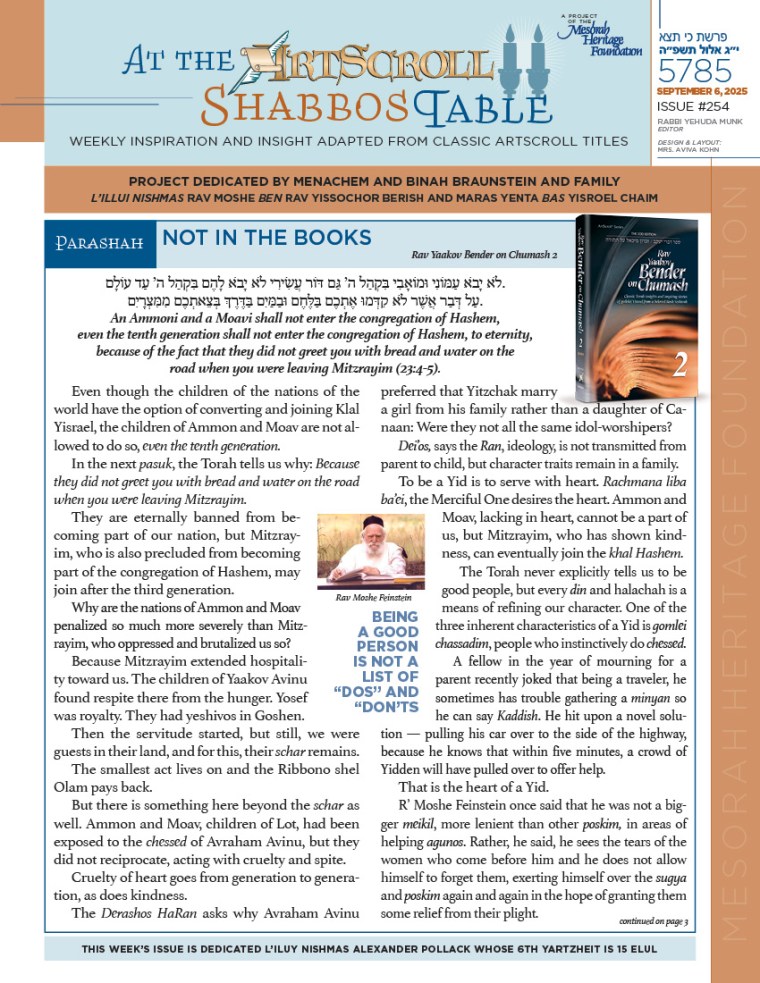
PARASHAH: NOT IN THE BOOKS

Adapted from: Rav Yaakov Bender on Chumash 2

לֹא יָבֹא עַמּוֹנִי וּמוֹאָבִי בִּקְהַל ה’ גַּם דּוֹר עֲשִׂירִי לֹא יָבֹא לָהֶם בִּקְהַל ה’ עַד עוֹלָם. עַל דְּבַר אֲשֶׁר לֹא קִדְּמוּ אֶתְכֶם בַּלֶּחֶם וּבַמַּיִם בַּדֶּרֶךְ בְּצֵאתְכֶם מִמִּצְרָיִם.

An Ammoni and a Moavi shall not enter the congregation of Hashem, even the tenth generation shall not enter the congregation of Hashem, to eternity, because of the fact that they did not greet you with bread and water on the road when you were leaving Mitzrayim (23:4-5).

Even though the children of the nations of the world have the option of converting and marrying into Klal Yisrael, the sons of Ammon and Moav are not allowed to do so, even the tenth generation.

In the next pasuk, the Torah tells us why: Because they did not greet you with bread and water on the road when you were leaving Mitzrayim.

They are eternally banned from marrying into our nation, but converts from Mitzrayim, who are also precluded from marrying into the congregation of Hashem, may join starting with the third generation.

Why are the nations of Ammon and Moav penalized so much more severely than Mitzrayim, who oppressed and brutalized us so?

Because Mitzrayim extended hospitality toward us. The children of Yaakov Avinu found respite there from the hunger. Yosef was royalty. They had yeshivos in Goshen.

Then the servitude started, but still, we were guests in their land, and for this, their schar remains.

The smallest act lives on and the Ribbono shel Olam pays back.

But there is something here beyond the schar as well. Ammon and Moav, children of Lot, had been exposed to the chessed of Avraham Avinu, but they did not reciprocate, acting with cruelty and spite.

Cruelty of heart goes from generation to generation, as does kindness.

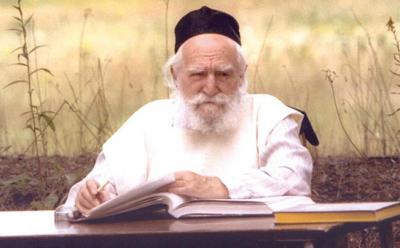
R’ Moshe Feinstein

The Derashos HaRan asks why Avraham Avinu preferred that Yitzchak marry a girl from his family rather than a daughter of Canaan: Were they not all the same idol-worshipers?

Dei’os, says the Ran, ideology, is not transmitted from parent to child, but character traits remain in a family.

To be a Yid is to serve with heart. Rachmana liba ba’ei, the Merciful One desires the heart. Ammon and Moav, lacking in heart, cannot fully be a part of us, but Mitzrayim, who has shown kindness, can eventually join Khal Hashem.

The Torah never explicitly tells us to be good people, but every din and halachah is a means of refining our character. One of the three inherent characteristics of a Yid is gomlei chassadim, people who instinctively do chessed.

R’ Moshe Feinstein once said that he was not a bigger meikil, more lenient than other poskim, in areas of helping agunos. Rather, he said, he sees the tears of the women who come before him and he does not allow himself to forget them, exerting himself over the sugya and poskim again and again in the hope of granting them some relief from their plight.

Rachmana, the Ribbono shel Olam is called, and the Torah meant to imbue us with that compassion.

My brother-in-law R’ Chaim Epstein once gave a shmuess to chassanim, discussing shalom bayis. He used the example of a sincere chassan who wants to have a happy home, so he reads all the guides on marriage and how to show respect for a wife.

Not long after the chasunah, he and his wife are walking and the woman’s shoe falls off and tumbles down the stairs. She stands there, with one shoe off and one shoe on, looking helpless while he stares right back, unsure what to do.

Finally, he shrugs and says, “The books never discuss this situation.”

R’ Chaim went on to explain that being a good person is not a list of “dos” and “don’ts,” and that a young man with seichel understands what to do in that situation as well, even if he was not specifically prepared for it.

That’s why we learn Torah, and through doing so, we become more refined, more kind, and more sensitive.

Those whose hearts are blocked by callousness have no connection to Torah, and thus, they will never be a part of us. 

YAMIM NORAIM: Rejoicing with Awe

Adapted from: A Daily Dose of Preparation for Yamim Noraim by Rabbi David Sutton

לְכוּ אִכְלוּ מַשְׁמַנִּים וּשְׁתוּ מַמְתַקִּים וְשִׁלְחוּ מָנוֹת לְאֵין נָכוֹן לוֹ כִּי קָדוֹשׁ הַיּוֹם לַאֲדֹנֵינוּ 

וְאַל תֵּעָצֵבוּ כִּי חֶדְוַת ה’ הִיא מָעֻזְּכֶם — 

Go, eat rich foods and drink sweet beverages, and send portions to those who have nothing prepared. For today is sacred to our L-rd. Do not be sad; the enjoyment of Hashem is your strength (Nechemiah 8:10).

This verse was spoken on the very first Rosh Hashanah after the Jewish people returned to Yerushalayim following seventy years of exile in Bavel. The people gathered in the plaza before the Shaar HaMayim, the Water Gate, and asked Ezra to read to them from the Sefer Torah, and he granted their request. Soon, the Jews began to cry, as they realized they had been neglecting the mitzvos written in the Sefer Torah; they understood how many halachos they had forgotten during Galus Bavel. Ezra, Nechemiah, and the Leviim consoled them and told them not to be sad on Rosh Hashanah.

Rav Wolbe

But, we may ask: If the Jews felt overwhelming regret for their sins, which is a good thing, why did Nechemiah and the others tell them not to be sad? It was Rosh Hashanah, after all, and they were demonstrating such powerful repentance, to the point of tears.

Because, as Nechemiah continued in our pasuk, חֶדְוַת ה’ הִיא מָעֻזְּכֶם — The enjoyment of Hashem is your strength. Our strength lies in rejoicing with Hashem, in serving Him out of simchah.

For this reason, after blowing the shofar, we recite the pasuk (Tehillim 89:16): אַשְׁרֵי הָעָם יֹדְעֵי תְרוּעָה ה’ בְּאוֹר פָּנֶיךָ יְהַלֵּכוּן — Praiseworthy is the people who know the shofar’s cry; Hashem, in the light of Your countenance they walk. As mentioned, R’ Wolbe notes that this is a pasuk of joy; we are thrilled with our good fortune. How fortunate are we to know the secret of the shofar, the way to stir ourselves to repentance when we hear its sound! Furthermore, when we listen to the call of the shofar and repent, we merit walking in the light of Hashem’s countenance. As the next pasuk in Tehillim says: בְּשִׁמְךָ יְגִילוּן כָּל הַיּוֹם וּבְצִדְקָתְךָ יָרוּמוּ — In Your Name they will rejoice all day long, and through Your righteousness they will be exalted. Who wouldn’t long to rejoice along with Hashem all day?

R’ Wolbe states that at the time of the shofar blowing, our Sages chose to recite verses of joy, because there is no greater joy than accepting the yoke of Hashem’s Kingship, which is what we do on Rosh Hashanah. We should, in fact, be dancing in the middle of our Mussaf prayers. When we say עָלֵינוּ לְשַׁבֵּחַ לַאֲדוֹן הַכֹּל — It is our duty to praise the Master of all, we should stop and transform the moment into a Simchas Torah of sorts. Yet, at the same time, we still feel eimas haDin, the awe of judgment — which is why we don’t dance.

It is fitting for the days of repentance to begin with accepting the yoke of Hashem’s Kingship with joy. After this foundational acceptance, we can then move on to repentance for specific sins, which culminates on Yom Kippur.

The concept of accepting Hashem’s Kingship in joy can also be found in our evening prayers, when we say, וּמַלְכוּתוֹ בְּרָצוֹן קִבְּלוּ עֲלֵיהֶם מֹשֶׁה וּבְנֵי יִשְׂרָאֵל לְךָ עָנוּ שִׁירָה בְּשִׂמְחָה רַבָּה — And His Kingship they accepted upon themselves willingly. Moshe and the Bnei Yisrael raised their voices to You in song with abundant gladness and sang a song to You.

This took place at the time of Krias Yam Suf. And what verse did Klal Yisrael exclaim in this state of joy, as they willingly accepted Hashem’s Kingship upon themselves?

The verse that became the first verse of the Malchuyos of Mussaf of Rosh Hashanah: ה’ יִמְלֹךְ לְעֹלָם וָעֶד — Hashem shall reign for all eternity (Shemos 15:18).

The objective isn’t to serve Hashem with bitterness or sadness. On the contrary, the aim is to be thrilled to be an eved Hashem, a servant of God, one who carries His yoke willingly and gladly. 

GREATNESS: Supernatural Sensitivity

Adapted from: Flashes of Inspiration by Rabbi Shlomo Landau

It was a sweltering evening in Bnei Brak in 1991. A middle-aged gentleman slowly made his way to Rechov Chazon Ish #5. He found the apartment that he was looking for and gave a gentle knock on the door.

A moment later the door was opened by none other than Harav Aharon Leib Shteinman who immediately recognized the man as one of the local Yidden who frequently came to collect tzedakah to support his family.

As he usually did, Rav Shteinman reached into his pocket, took out a few shekel, and kindly handed it to the Yid wishing him much hatzlachah.

The fellow accepted the money with words of thanks on his lips and headed to the next apartment. 

Rav Shteinman

A few minutes later, there was a knock on Rav Shteinman’s door. Once again, Rav Shteinman opened the door and was surprised to see the same man. With sensitivity he indicated that he had just given him a donation, but this time the man asked if he could come in, as there was something important that he needed to discuss with the Rosh Hayeshivah. 

Rav Shteinman warmly welcomed the Yid into his home and the man shared that he was hoping that Rav Shteinman could assist him with getting his son accepted in Yeshivah Ketanah of Ponevezh, where Rav Shteinman served as Rosh Hayeshivah. 

As always, Rav Shteinman replied that acceptances were under the jurisdiction of Rav Michel Yehuda Lefkowitz and that it was not his decision. Additionally, the yeshivah was already full to capacity and that the chances of being accepted were slim to none.

Rav Shteinman continued, “I am a bit confused, just two minutes earlier you knocked on my door to collect tzedakah and you didn’t mention anything about your son. Was your son’s yeshivah a sudden after thought”?

The Yid stammered and replied, “When I first knocked on your door it was to discuss my son’s yeshivah future, but before I even had a chance to say anything, you had reached into your pocket and kindly given me tzedakah. So I decided to continue on and collect from your neighbors and then come back on my way down.

When Rav Shteinman heard this his face turned white. He suddenly realized that when the man had initially knocked at the door it was not to collect tzedakah as usual, but rather to discuss his son. 

“Oy vey!” Rav Shteinman moaned, “I automatically identified you as a tzedakah collector when in truth you had come to discuss something of such importance; your son’s future. I beg you for mechilah. Woe is me for slighting your honor…”

The man immediately responded that he was not at all hurt and that there was absolutely no reason to ask forgiveness. 

“Since I often knock at your door to collect tzedakah and you always respond generously, there was absolutely no reason for you to assume differently.” 

Even so, Rav Shteinman was beside himself and would not accept the explanation.

Rav Shteinman responded, “Listen, I was not careful enough with your honor and therefore it is incumbent on me to figure out a way to make this right. 

You should know that I never get involved with acceptances to Ponevezh Yeshivah Ketanah, but this time I am going to make an exception and im yirtzeh Hashem do everything I can to ensure that he is accepted.” 

From that moment on, the son became a real priority in Rav Shteinman’s life and Rav Shteinman ensured the bachur was accepted into the Yeshivah Ketanah and joined his shiur. He personally followed the boy’s progress daily, showing deep care and treating him like a son.

When it was time for Yeshivah Gedolah, Rav Shteinman again got involved, guiding the decision and ensuring his acceptance to Ponevezh — a rare move for him.

The bachur thrived, becoming a star talmid, then a respected marbitz Torah.

It is truly incredible that this was all a result of a totally unintentional assumption by Rav Shteinman, and his regret that he may have slighted the fellow.

Rav Shteinman’s hanhagah raises the bar on how we must conduct ourselves when interacting with others. 

DOWNLOAD + PRINT At The ArtScroll Shabbos Table – Parashas Shoftim!

Dear Friends,

Below please find the latest edition of At The ArtScroll Shabbos Table, containing inspiration and insight from classic ArtScroll titles.

This weekly publication will contain a rich collection of stories, divrei Torah and insights that are suitable for the Shabbos table – or for anytime. We hope you enjoy and look forward to future issues, as we tap into the unparalleled treasure trove that is the ArtScroll Library, sharing the depth and beauty of our Judaic and Torah literature with you.

Read it. Be uplifted. And share the inspiration.

Have a good Shabbos.

Click HERE to view, download At The ArtScroll Shabbos Table – Shoftim

CHESSED: The $26,000 Spark – From Tragedy to Teshuvah

Adapted from: Chessed Under Fire by Rabbi Nachman Seltzer

Just because there was a war going on and Israel was fighting on five different fronts didn’t mean that the terrorists inside the country had stopped trying to harm Jews. With the army preoccupied, they saw opportunities to attack innocent civilians. And while most plots were stopped — some slipped through.

One such attack took place at the entrance to Yerushalayim. Several were killed, and others badly injured.

“On the day of the attack,” Shai recalls, “I was at Hadassah Hospital and entered the room of a chareidi girl who had been wounded in the attack earlier that day. Her mother sat at her bedside.

“What can I do for you that will cheer you up?” he asked gently.

He expected her to ask for a computer, or perhaps a new jacket — hers had been ripped by a bullet. But her answer caught him completely off guard.

“There’s only one thing I want,” she said, eyes brimming with tears. “My father is a rosh kollel. He travels to America often to raise funds. It’s hard when he’s away, for us and for him. If you could somehow help him stay in Israel without needing to travel, I’d be so happy.”

Shai was deeply moved. Of all the things she could have asked for, she chose something so selfless — to give her father peace of mind so he could stay home and learn.

“First things first,” Shai said with a smile. “I’m giving you money to buy a new jacket. And now, what’s your father’s phone number?”

She gave it, and moments later, Shai was speaking with him.

“Shalom aleichem. I’m here with your daughter. She didn’t ask for anything for herself — she just wants to help you. How many avreichim are in your kollel?”

The man gave the number.

“Great. We’re wiring you twenty-six thousand dollars right now. It’s 2:30 p.m. You’ll see it in your account by 4:30.”

Shai had helped distribute millions for Rav Chaim Kanievsky zt”l over the years, especially before Yom Tov. But the joy he felt in transferring those $26,000 was unlike anything else. It was a zechus — an honor — to help a rosh kollel spend more time at home and learning Torah.

As he hung up, the hospital room filled with spontaneous song. Everyone — family, visitors, Shai’s helpers — burst into “Mah Ashiv LaShem,” praising Hashem for the opportunity to bring happiness to a girl who’d been shot for no reason other than being a Jew — and to her father, who devoted himself to Torah.

But that was just the beginning.

Someone in Lakewood who had followed Shai’s updates reached out. “I saw you gave $26,000 to a rosh kollel. I want to match it.” Soon after, a campaign was launched, and it didn’t take long to raise the full amount. Now the rosh kollel had been gifted a total of $52,000 — enough support to remain focused on learning for months.

Months later, while biking with his sons in Har Nof, Shai stopped for a rest. A yeshivah bachur approached and suddenly burst into tears.

Shai jumped off his bike. “What’s wrong? Do we know each other?”

The bachur shook his head. “No. But I have to tell you something.”
He explained how, even before the war, he had been spiraling spiritually. Learning had become difficult. He eventually left yeshivah, deciding instead to cook for soldiers and find other ways to help.

“One day I found out about the girl who was shot — and how all she wanted was help for her father’s kollel. That changed me. I felt something spark inside. I dropped everything and returned to yeshivah.”

He smiled. “I’ve been back for seven months now. I’m learning three sedarim a day, and today I’m one of the top boys in my yeshivah — all because you shared that story.”

Two days later, Shai spent Shabbos in Petach Tikvah. After davening, while waiting for his mother, a woman approached him.

“Are you Shai Graucher?”

He nodded.

“My son met you in Yerushalayim and told you how that story changed his life.”

“I remember.”

“You don’t understand,” she said. “He doesn’t just learn now — he loves it. That girl could’ve asked for anything. But she asked for Torah support — and that changed my son forever.”

As Shai walked home with his mother, he reflected on how one act of kindness, one moment of selflessness, could ripple across the world, transforming people he had never even met. It felt like a kiss from Hashem — a clear message to keep going, keep helping, and keep spreading light.

DOWNLOAD + PRINT At The ArtScroll Shabbos Table – Parashas Eikev!

Dear Friends,

Below please find the latest edition of At The ArtScroll Shabbos Table, containing inspiration and insight from classic ArtScroll titles.

This weekly publication will contain a rich collection of stories, divrei Torah and insights that are suitable for the Shabbos table – or for anytime. We hope you enjoy and look forward to future issues, as we tap into the unparalleled treasure trove that is the ArtScroll Library, sharing the depth and beauty of our Judaic and Torah literature with you.

Read it. Be uplifted. And share the inspiration.

Have a good Shabbos.

Click HERE to view, download At The ArtScroll Shabbos Table – Eikev

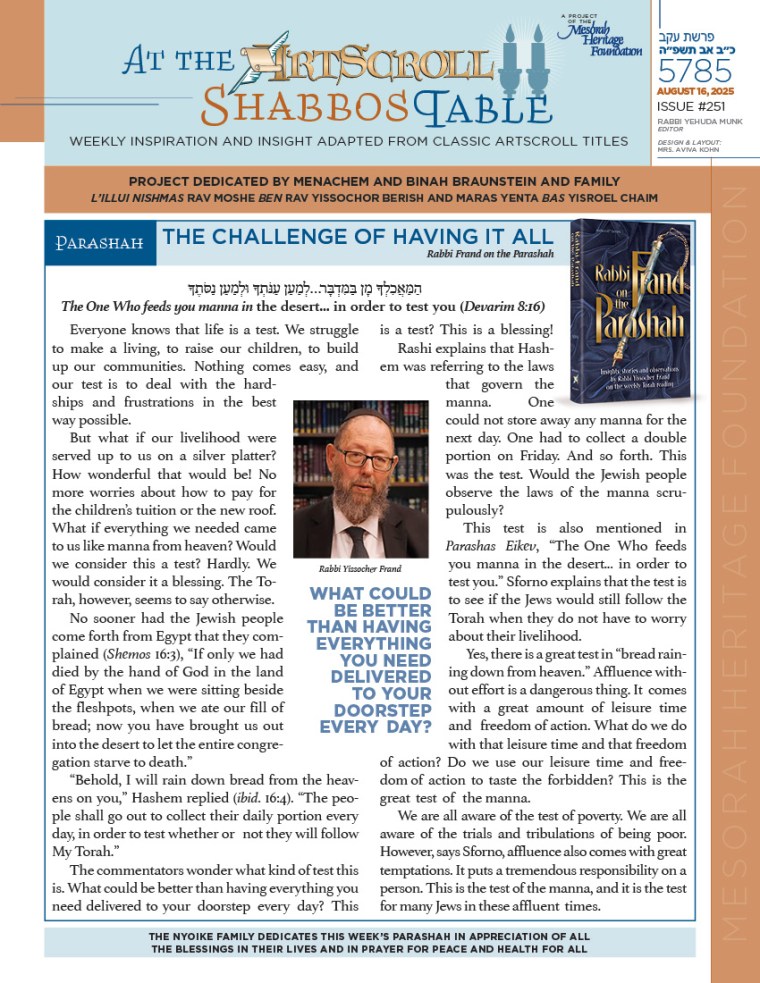
PARASHAH: The Challenge of Having it All

Adapted from: Rabbi Frand on the Parashah

הַמַּאֲכִלְךָ מָן בַּמִּדְבָּר…לְמַעַן עַנֹּתְךָ וּלְמַעַן נַסֹּתֶךָ 

The One Who feeds you manna in the desert… in order to test you (Devarim 8:16)

Everyone knows that life is a test. We struggle to make a living, to raise our children, to build up our communities. Nothing comes easy, and our test is to deal with the hardships and frustrations in the best way possible.

But what if our livelihood were served up to us on a silver platter? How wonderful that would be! No more worries about how to pay for the children’s tuition or the new roof. What if everything we needed came to us like manna from heaven? Would we consider this a test? Hardly. We would consider it a blessing. The Torah, however, seems to say otherwise.

No sooner had the Jewish people come forth from Egypt that they complained (Shemos 16:3), “If only we had died by the hand of God in the land of Egypt when we were sitting beside the fleshpots, when we ate our fill of bread; now you have brought us out into the desert to let the entire congregation starve to death.”

“Behold, I will rain down bread from the heavens on you,” Hashem replied (ibid. 16:4). “The people shall go out to collect their daily portion every day, in order to test whether or not they will follow My Torah.”

The commentators wonder what kind of test this is. What could be better than having everything you need delivered to your doorstep every day? This is a test? This is a blessing!

Rashi explains that Hashem was referring to the laws that govern the manna. One could not store away any manna for the next day. One had to collect a double portion on Friday. And so forth. This was the test. Would the Jewish people observe the laws of the manna scrupulously?

This test is also mentioned in Parashas Eikev, “The One Who feeds you manna in the desert… in order to test you.” Sforno explains that the test is to see if the Jews would still follow the Torah when they do not have to worry about their livelihood.

Yes, there is a great test in “bread raining down from heaven.” Affluence without effort is a dangerous thing. It comes with a great amount of leisure time and freedom of action. What do we do with that leisure time and that freedom of action? Do we use our leisure time and freedom of action to taste the forbidden? This is the great test of the manna.

We are all aware of the test of poverty. We are all aware of the trials and tribulations of being poor. However, says Sforno, affluence also comes with great temptations. It puts a tremendous responsibility on a person. This is the test of the manna, and it is the test for many Jews in these affluent times. 

SHALOM: Negativity – Better Left Unsaid

Adapted from: Live the Blessing – Chofetz Chaim Heritage Foundation

Obviously, if everyone could hear all our thoughts, the average person with the average level of tolerance would be leaving emotional casualties all over the highways and byways of his life. We don’t want people to know everything we think, because sometimes those thoughts will discourage or hurt them. They don’t need to know that we think their business idea will never amount to anything, or that their new spouse seems a bit odd, or that we find their conversation boring. Many such thoughts are just fleeting impressions, but if we focus on them or voice them, they change our reality.

Negativity can sour relationships even when it’s not personal. Nobody enjoys the company of the person who always finds the downside of every situation and complains about it. The food isn’t hot enough, the band is too loud, the speaker goes on too long, the teacher is too strict, the room is too cold; people who share these thoughts regularly seem to be forbidding those in their circle to have a moment of unadulterated enjoyment.

Many people have trouble recognizing where to draw the line between what they think and what they say. While the best of all possible solutions is to see and think only good, this is a level that may take a lifetime to reach. In the interim, a person who wishes to sow goodwill and live in peace with others has to learn the fine art of leaving certain negative thoughts unsaid.

What are those thoughts? They’re the ones that say, “I don’t trust your judgment,” or “He always has to do everything his way,” when a person is doing things differently than we would. They’re the thoughts that cast a shadow over another person’s joy or call into question a decision that he has finalized. In the vast majority of situations, negative thoughts should remain just where they were born – inside our own head.

Peaceful, positive relationships can’t compete against the constant din of negativity. Hashem taught us this when He brought us out of Egypt. The splendor of that moment would have been thrilling enough for the Jews who followed Moshe out of slavery; but to make our joy complete, Hashem restrained the dogs of Egypt from barking as we left. We learn from this that when the only result of our noise will be to vex another person, silence is a far better option.

Menachem and Dave, old classmates, started out together in new jobs at the same company. They worked in two different departments, but both took their lunch from 1 to 1:30 in the small company dining room. Each was happy to see a familiar face, and they began eating together every day.

Over the course of a few days, they caught up with each other’s lives. Then they began talking about the jobs they now held and the company they worked for. “Baruch Hashem, this job came up at exactly the right time,” Dave said. “I had really outgrown my other position and was looking for a challenge, not to mention a raise. There’s lots to learn here.”

“Sure, but I wish they’d get their act together,” Menachem commented. “I don’t know about your work in the IT department, but let me tell you that in sales, no one’s got a plan. You’re really on your own, learning the job.”

“Well, that’s part of the challenge,” Dave said.

“I don’t buy it. They just don’t want to invest in training,” Menachem answered. “If I want to know anything, I have to track someone down who’ll give me a minute of his time, and if I need more than that, I’m sunk.”

Now Dave began pondering his own “learning curve” and thinking about the distracted, incomplete answers he was getting to his own questions. Maybe Menachem was right. The company wasn’t well run. “Maybe I should have taken a different offer,” he thought, feeling just a bit deflated. 

Before voicing your negativity about something, ask yourself if your words are likely to sour the other person’s mood or outlook [or if they are loshon hora]. If so, try to find the positive, or simply leave your comment unspoken. 

MASHIACH: The Night Watchman

Adapted from: Yearning for Redemption by Rabbi Daniel Glatstein

The following verse (Tehillim 130:6) requires explanation: נַפְשִׁי לַה’ מִשֹּׁמְרִים לַבֹּקֶר שֹׁמְרִים לַבֹּקֶר., My soul [yearns] for the Lord among those longing for the dawn, those longing for the dawn.

The Malbim explains that a watchman longs for the dawn; he eagerly awaits the morning because when it becomes light outside, he can see more clearly and his work will be easier. He will be safer in the morning. The arrival of the day also likely means the end of his shift.

When the watchman is engaged in his work throughout the night, he has no doubt in his mind that morning will come. He knows with certainty that the night will not last forever. He has complete confidence, because that is how the world works.

The Chasam Sofer

The watchman waiting for morning is not at all like someone awaiting the arrival of a guest. A guest may be late or may encounter a pressing issue he cannot postpone, or may not come at all. Perhaps he was the victim of an accident as he made his way to your home, and he will never show up. Thus, waiting for a guest’s arrival will not be with confidence and certainty that he will come, while, in contrast, anticipating the morning is with complete conviction that it will arrive, without any shadow of a doubt.

What does this pasuk mean? Why are we even more eager than the watchman for the morning? Furthermore, why does the pasuk repeat the phrase שֹׁמְרִים לַבֹּקֶר, those longing for the dawn.

Dovid HaMelech is saying that his soul awaits the coming of Mashiach with even more certainty than the night watchman’s conviction that the sun will rise. He then continues: In what way does he wait with more certainty than the night watchman? Because the watchman is merely שֹׁמְרִים לַבֹּקֶר, longing for the dawn! It will most certainly come, but no matter how eagerly and passionately he wishes the morning to come, it will not come any sooner. The sun will rise at the predetermined moment, regardless of the intensity of the watchman pining for the dawn of the new day. The new day will come when it is supposed to, and not a moment sooner. However, there is a difference when we wait for Mashiach. When Klal Yisrael longs for the Geulah, then it can come earlier!

Dovid HaMelech continues (ibid. vs. 7–8), advising, יַחֵל יִשְׂרָאֵל אֶל ה’ כִּי עִם ה’ הַחֶסֶד וְהַרְבֵּה עִמּוֹ פְדוּת. וְהוּא יִפְדֶּה אֶת יִשְׂרָאֵל מִכֹּל עֲוֺנֹתָיו, Let Israel hope for Hashem, for with Hashem is kindness and with Him is abundant redemption. And He shall redeem Israel from all its iniquities.

When we are languishing in galus, yearning for Hashem to redeem us, it can come earlier! Hashem can bring Mashiach earlier than He intended! We therefore await Mashiach with an even deeper sense of longing than the watchman who knows with complete confidence that the night will end, because he can do nothing to make it happen sooner. However, in regard to Mashiach, Hashem gives so much chessed, so much lovingkindness toward His children, Klal Yisrael, that He can revise His initial plans and redeem us early.

The Chasam Sofer had the custom to begin Rosh Chodesh bentching with the paragraph of מִי שֶׁעָשָׂה נִסִּים לַאֲבוֹתֵינוּ…הוּא יִגְאַל אוֹתָנוּ בְּקָרוֹב, He Who performed miracles…may He redeem us soon…

The Ba’er Heitev amends the text, writing that the word בְּקָרוֹב, soon, should be omitted. The reason for this is because it is significant when this tefillah contains precisely twenty-one words, which is the gematria of the Name of Hashem (Aleph–Kei–Yud–Kei). It is also the numerical equivalent of the word אַךְ in the phrase אַךְ טוֹב, only goodness.

The Chasam Sofer vehemently disagrees; he holds that the word בְּקָרוֹב is critical to the tefillah! Our being redeemed is a given; thus, it does not require us to pray for it. Hashem promised that He will take us out of exile, and we know with absolute certainty that this will occur. There is therefore no need to daven for the Geulah, argues the Chasam Sofer. What can make a difference is if we ask Hashem to redeem us בְּקָרוֹב, very soon! Our tefillos can serve to bring Mashiach sooner! The Chasam Sofer maintained that the word בְּקָרוֹב is the crux of the entire tefillah. It is the main point that we are asking Hashem: Bring Mashiach imminently! Immediately! Right now! 

Watch our Inside ArtScroll interview: Tzipisa L’Yeshuah, Yearning for Redemption