R’ Yosef, a talmid of R’ Yitzchok Hutner, would often bring his father, R’ Avrohom,* to the rosh yeshivah for chizuk and encouragement. At the time, R’ Avrohom was out of a job and his parnassah struggles left him despondent. Amazingly, after each “session” with R’ Hutner, R’ Avrohom emerged as if transformed. He was able to unburden himself to the rosh yeshivah, who had the right words for him, and he walked out like a new person, upbeat, positive, and optimistic.
One time, R’ Avrohom asked his son to make an appointment for him with R’ Hutner. R’ Yosef hesitated, however, explaining to his father that, after all, R’ Hutner was extremely busy, with no time on his hands. Between his shiurim and maamarim, and all the issues that came across his desk, he didn’t have time. How could he ask R’ Hutner to give away an hour or two just to shmooze? For this reason, they decided not to bother R’ Hutner any longer with this matter.
Sometime afterward, R’ Hutner saw R’ Yosef and asked him, “How’s your father doing? I haven’t seen him in a while. Has anything changed with his parnassah?”
R’ Yitzchok Hutner
R’ Yosef responded that no, nothing had changed, as his father was still jobless and parnassah was a challenge.
“So why haven’t you brought your father to see me?” asked R’ Hutner.
R’ Yosef explained that his father did indeed wish to come, but after thinking it over, they felt bad taking up the rosh yeshivah’s precious time just to shmooze about such mundane matters.
“Zog mir Yosef, tell me,” said R’ Hutner, “es iz em gringer oifen hartz ven ich rett mitt em? — Does he feel better after I speak with him?”
“Absolutely!” said R’ Yosef.
Now R’ Hutner grew animated. “Hust du ah besserer zach tzu ton mit tzeit vi tzu machen ah Yid feelin besser oifen hartz? — Do you have something better for one to do with his time that to make a Yid feel better in his heart?”
Indeed, there is nothing better to do with one’s time than to remove or ease the burden on the shoulders of a fellow Yid. Even one as busy as R’ Hutner felt that bringing a smile to another’s face has priority.
In this episode of Inside ArtScroll, Rabbi David Sutton discusses his latest work, Beis HaLevi on Anavah, a translation and elucidation of Rav Yosef Dov Soloveitchik’s (the Beis HaLevi) timeless essay on humility.
Rabbi Sutton explores how true anavah (humility) enhances our relationships with Hashem, others, and ourselves. He shares insights into the Beis HaLevi’s teachings, practical lessons for personal growth, and inspiring stories that bring the concepts to life. This conversation offers a profound look into cultivating genuine humility and its transformative impact on our lives
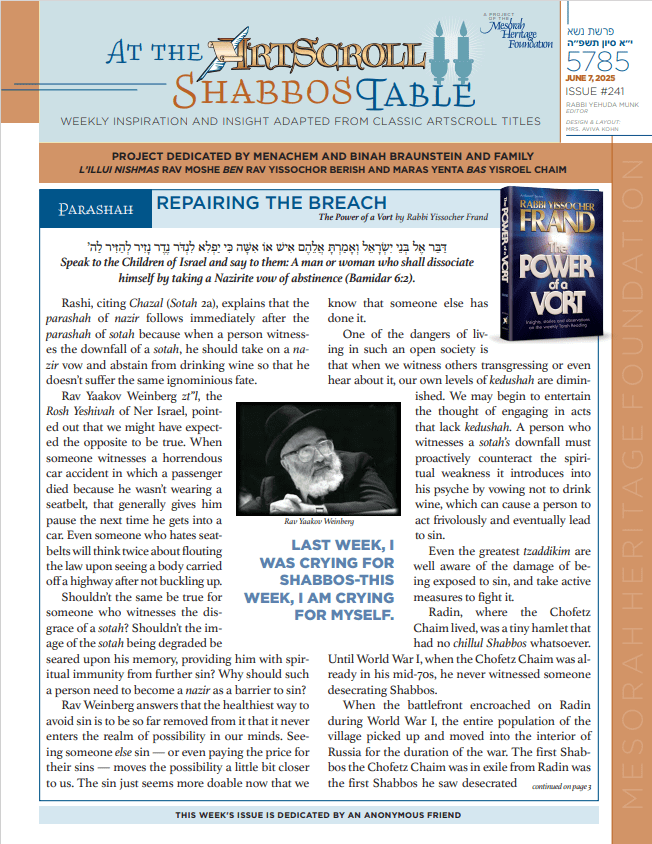
Below please find the latest edition of At The ArtScroll Shabbos Table, containing inspiration and insight from classic ArtScroll titles.
This weekly publication will contain a rich collection of stories, divrei Torah and insights that are suitable for the Shabbos table – or for anytime. We hope you enjoy and look forward to future issues, as we tap into the unparalleled treasure trove that is the ArtScroll Library, sharing the depth and beauty of our Judaic and Torah literature with you.
Speak to the Children of Israel and say to them: A man or woman who shall dissociate himself by taking a Nazirite vow of abstinence (Bamidar 6:2).
Rashi, citing Chazal (Sotah 2a), explains that the parashah of nazir follows immediately after the parashah of sotah because when a person witnesses the downfall of a sotah, he should take on a nazir vow and abstain from drinking wine so that he doesn’t suffer the same ignominious fate.
Rav Yaakov Weinberg zt”l, the Rosh Yeshivah of Ner Israel, pointed out that we might have expected the opposite to be true. When someone witnesses a horrendous car accident in which a passenger died because he wasn’t wearing a seatbelt, that generally gives him pause the next time he gets into a car. Even someone who hates seatbelts will think twice about flouting the law upon seeing a body carried off a highway after not buckling up.
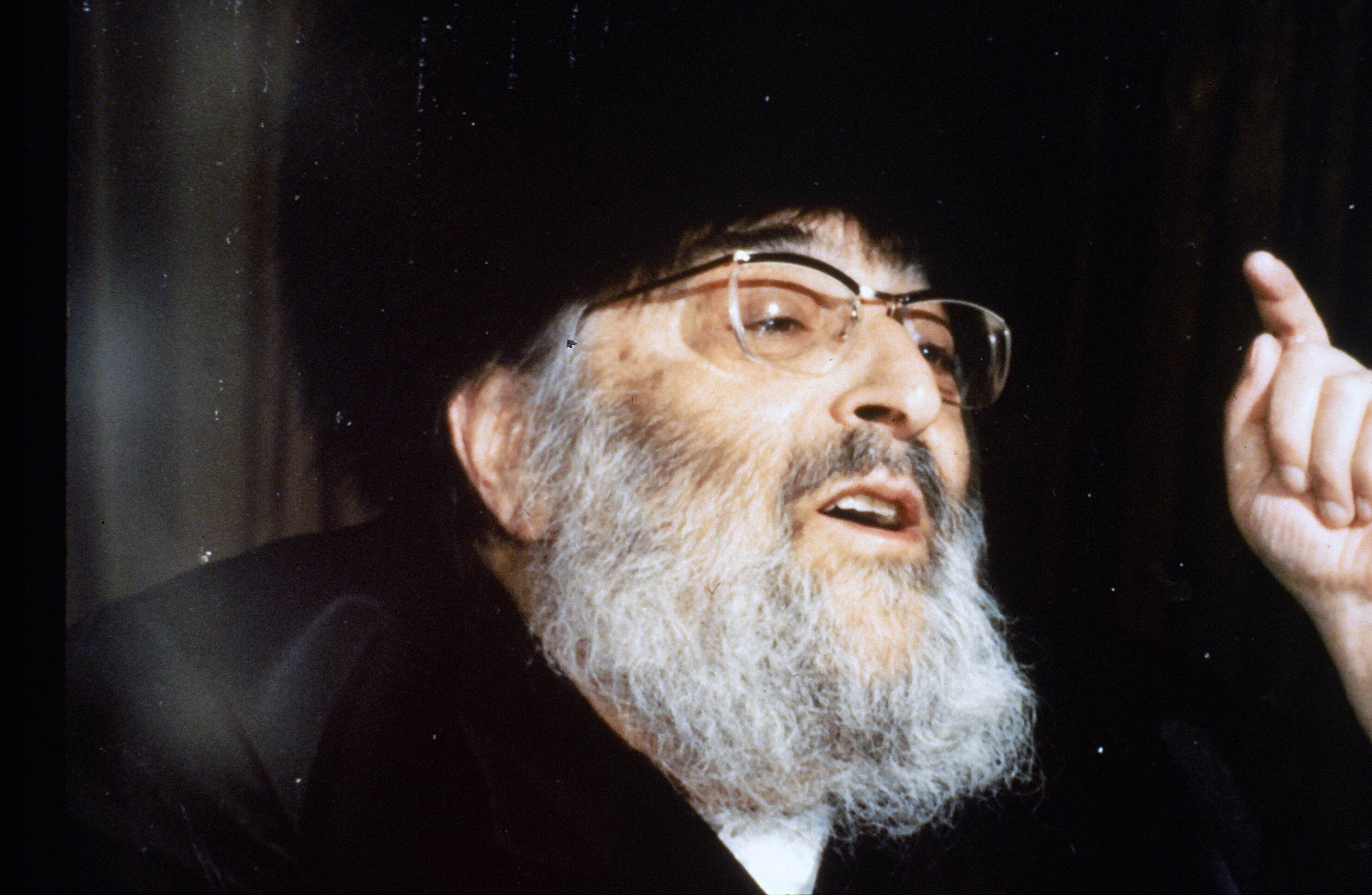
Rav Yaakov Weinberg
Shouldn’t the same be true for someone who witnesses the disgrace of a sotah? Shouldn’t the image of the sotah being degraded be seared upon his memory, providing him with spiritual immunity from further sin? Why should such a person need to become a nazir as a barrier to sin?
Rav Weinberg answers that the healthiest way to avoid sin is to be so far removed from it that it never enters the realm of possibility in our minds. Seeing someone else sin — or even paying the price for their sins — moves the possibility a little bit closer to us. The sin just seems more doable now that we know that someone else has done it.
One of the dangers of living in such an open society is that when we witness others transgressing or even hear about it, our own levels of kedushah are diminished. We may begin to entertain the thought of engaging in acts that lack kedushah. A person who witnesses a sotah’s downfall must proactively counteract the spiritual weakness it introduces into his psyche by vowing not to drink wine, which can cause a person to act frivolously and eventually lead to sin.
Even the greatest tzaddikim are well aware of the damage of being exposed to sin, and take active measures to fight it.
Radin, where the Chofetz Chaim lived, was a tiny hamlet that had no chillul Shabbos whatsoever. Until World War I, when the Chofetz Chaim was already in his mid-70s, he never witnessed someone desecrating Shabbos.
When the battlefront encroached on Radin during World War I, the entire population of the village picked up and moved into the interior of Russia for the duration of the war. The first Shabbos the Chofetz Chaim was in exile from Radin was the first Shabbos he saw desecrated — and the sight made him break down into copious tears.
The next week, when the Chofetz Chaim experienced chillul Shabbos again, he cried for even longer than he had the previous Shabbos.
“We understand why you cried so much last week,” the people who were with him said. “Witnessing chillul Shabbos for the first time was a traumatic experience, and you were so shocked by it that you cried. But by this week you should have expected it already. Why did you cry at all, and moreover, why did you cry with more intensity this week than you did last week?”
“The first time I saw another Jew violate the holy Shabbos,” replied the Chofetz Chaim, “I was crying for the problem itself. This week, it didn’t hurt me nearly as much — and that’s why I cried even more. I am concerned that I have become callous toward Shabbos because I have fallen from my own spiritual level and I no longer feel Hashem’s pain when his children desecrate Shabbos.
“Last week, I was crying for Shabbos,” summarized the Chofetz Chaim. “This week, I am crying for myself.”
If the Chofetz Chaim considered himself spiritually vulnerable after witnessing chillul Shabbos when he was over 75 years old, how much more are we susceptible to becoming spiritually weak if we witness a sin being committed?
This is the message the Torah is imparting to us. If a nazir does not take on a vow of abstinence from wine, not only won’t experiencing the sotah’s downfall prevent him from sinning, it might actually lead him to sin.
A person who sees another sinning — and in today’s world, we are exposed to such transgressions with frightening frequency — must realize that they have become vulnerable. Those sins no longer seem as distant and undoable as they were before. Although we may not have the nezirus vows today, when our spiritual firewalls are breached by witnessing others sinning or even being disgraced for their sins, we must repair that breach immediately to prevent ourselves from becoming corrupt.
It is very easy, R’ Moshe Eliezer Rabinowitz would remark, to delegate jobs, making sure that everyone else is put to work. True greatness, he said, is when the “delegator” is the one working the hardest to see a task through. Yes, a person may ask for help, because one cannot do everything on his own. A human being is, after all, limited in his own capabilities. However, he must not be lazy. He must do his utmost, asking others to join only because it will increase the overall accomplishment.
R’ Rabinowitz shared the following touching story.
R’ David Twersky, the Skverer Rebbe of Boro Park, was an exceptional baal chessed. In particular, he helped many Yidden in the medical field, bringing them to the highest quality doctors, and seeing to it that patients were cared for in the best manner possible.
The Skverer Rebbe of Boro Park
In one instance, a Jewish patient required surgery during the time of the secular New Year holiday. The Rebbe contacted a top-notch surgeon and asked him to perform the surgery.
“I understand that this is your vacation and that it is difficult for you,” the Rebbe told him, “but there is a life in danger. Please, you must help this person.”
The surgeon was moved by the Rebbe’s plea and agreed to perform the surgery. The surgery was scheduled to begin at night and was to take six hours.
As the surgeon was about to enter the operating room, the Rebbe was there to wish him success. The Rebbe then sat down and began saying Tehillim along with the family members, remaining there throughout the night. In fact, he was there even as the surgeon emerged from the operating room many hours later.
“Rabbi,” the surgeon exclaimed in surprise, “you didn’t tell me that this was your family member!”
The Rebbe shook his head. “No,” he said, “he is not a family member.”
“Then why were you sitting here praying through the night?” asked the doctor.
The Rebbe explained, “I was not going to call you to come here and spend the night doing surgery while I am sleeping at home in bed. If you are spending the night here, so am I! True, I cannot perform the actual surgery, but I can still be here with you, praying for your success!”
R’ Eliezer Yosef Lederberg was a storekeeper who lived in Batei Varsha in Yerushalayim; he used every spare moment to learn Torah.
R’ Eliezer Yosef was diagnosed with a disease that affected his eyes and was informed that he would have to undergo surgery, which would likely cause him much discomfort afterward and possibly even render him blind.
“How long can I wait until I undergo the surgery?” asked R’ Eliezer Yosef.
They told him that he can wait six months, but not longer than that.
R’ Eliezer Yosef realized that once the operation was performed, it was probable that he’d never be able to look into a Gemara ever again.
If that was true, he had work to do.
For the next half a year, he spent every waking moment of every day focused on one thing: learning two masechtos by heart. He learned Rosh Hashanah and Beitzah over and over, day in and day out. The only thing that consumed him was mastering those masechtos. R’ Eliezer Yosef prepared himself for the challenge that he might be forced to face on the road ahead.
On the day of the operation, his family wept while saying Tehillim, hoping and davening for a positive outcome.
As he was about to be brought into the operating room, he gazed at his family, knowing that this might be the last time he would be able to see them.
He thought of all the moments he had wasted during his lifetime. But now he had achieved something remarkable. He had mastered those two masechtos.
When he woke up after the surgery, his eyes were bandaged. They wouldn’t know for a few days if the operation was a success and whether he’d ever be able to see again.
Finally, the day arrived. Thick apprehension filled the air. R’ Eliezer Yosef took off the bandages and couldn’t hold himself back from crying.
He was able to see!
For the rest of his life, wherever he went, he reviewed the masechtos that he had mastered before his operation.
After his petirah in 1954, his children read his will. In it, he instructed them to write on his matzeivah that he had learned Rosh Hashanah and Beitzah over 4,000 times. He explained his reasoning: “Perhaps one day someone will read this and accept upon themselves to do the same.”
When I heard this story, I wondered if it was true. Then a friend of mine told me that he had gone to Har HaMenuchos himself to find the kever. There, he saw that the words were indeed inscribed on R’ Eliezer Yosef’s matzeivah.
Despite the fact that Hacham Baruch was such a scholar and so brilliant, he never made a big deal about the amount of knowledge he possessed or the fact that he had a mind and memory that were razor-sharp. He was naturally humble and instinctively shied away from drawing attention to his greatness. But the signs were there for anyone who cared to connect the dots.
David Abe Kassin recalls an incident that illustrates Hacham Baruch’s incredible memory. He was learning halachot shehita in the Shulhan Aruch with the Rabbi in the Lawrence Avenue shul. One day they were learning together, and Hacham Baruch was reading to him from the words of the Shach, breaking down the intricate laws in a way that was easy to understand. Suddenly David, who’d been looking into the Shulhan Aruch, realized that the Rabbi’s voice had become harder to hear. He looked up, only to see that the Rabbi had left his spot at the table and had gone to the nearby kitchen to make himself a glass of tea. What was fascinating was that, although he was no longer at the table and not looking into the sefer, he continued reciting the words of the Shach as if the sefer were still sitting open before him!
“Until today,” David said, “I’m trying to figure out how a person knows every word of the Shach on the very complicated halachot shehita by heart…”
Hacham Ovadia and Hacham Baruch
In the Syrian community, there was a longstanding tradition in which people would come together at the office of a business that was being established and recite selected pieces from different sources (similar to a hanukat habayit), as a segula for the success of the new enterprise. Hacham Baruch was always invited to take part in these gatherings, and he always attended them, as he did every other celebration, shiva, or event in the community. There he would go through the Zohar they were reading, stopping every so often to explain what they were reading and adding stories to bring the lessons to life.
One day, a group of people gathered at a brand-new office in Manhattan to mark a firm’s opening. As the group took their seats around the polished conference table, people began asking one another who had brought the books containing the pieces of Zohar they were supposed to be read. To their chagrin and disappointment, everyone admitted that they’d forgotten to bring the sefarim, which were still sitting peacefully back in Brooklyn.
Now what? Who was going to go back to Brooklyn to bring them?
Hacham Baruch was not fazed.
“It’s okay,” he said.
Everyone there looked at one another. What did the Rabbi mean?
The question was settled moments later, when Hacham Baruch began reciting the words of the Mishnayot, Gemara, Rambam, and Zohar aloud without hesitation, from memory, without missing a beat and without skipping a word.
And on the topic of Zohar:
Hacham Baruch would recite the words of the Zohar at any event where it was called for, be it the opening of a business or the night before a baby’s berit. However, he had his own way of doing it. Whereas most people recite the Zohar as quickly as possible before carrying on with their lives, Hacham Baruch would stop after every two paragraphs and explain the ideas contained in the words that had just been read, usually bringing the message home with a story that resonated with the people in the room. It was his way of turning something esoteric into an idea that everyone was able to relate to in their own way.
R’ David Seruya understood why the Rabbi went out of his way to attend every huppa he was invited to. But he didn’t quite grasp why Hacham Baruch felt the need to go to every Zohar reading as well. He once asked the Rabbi to explain his reasoning.
“When I come to read the Zohar,” the Rabbi said, “I am being invited into a person’s home and tasked with giving a speech. This gives me an opportunity to tell every person and family what they need to hear. I cannot tell you how many lives were changed because I came to recite the words of Zohar in so many homes and businesses.”
Hacham Yaacov Ben-Haim had this to add:
“My father told me that the two places where he was able to have the most influence on the people were during the Zohar readings and when a family was sitting shiva for a loved one. And because he was able to change their lives during those times, he never missed going.”
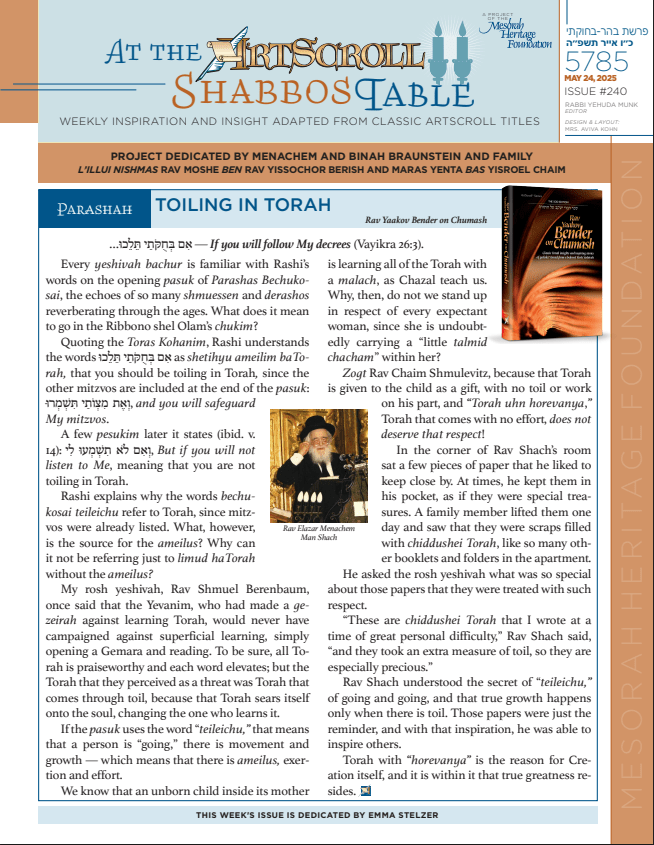
Below please find the latest edition of At The ArtScroll Shabbos Table, containing inspiration and insight from classic ArtScroll titles.
This weekly publication will contain a rich collection of stories, divrei Torah and insights that are suitable for the Shabbos table – or for anytime. We hope you enjoy and look forward to future issues, as we tap into the unparalleled treasure trove that is the ArtScroll Library, sharing the depth and beauty of our Judaic and Torah literature with you.
He was a towering leader, a brilliant orator, a beloved rebbi, and a visionary builder of Torah life in America. He was the Rabbi’s Rabbi. He was Hacham Baruch Ben-Haim zt”l.
In this unforgettable episode, Rabbi Shlomo Landau sits down with two people who knew Hacham Baruch best: his son, Yaacov Ben-Haim, and Rabbi Raymond Beyda, a close student who became a respected educator and leader in his own right.
Together, they share personal memories, powerful insights, and moving stories about a man who changed the face of the Syrian Jewish community in America. From his decades of leadership on Brooklyn’s Ocean Parkway to his role as the spiritual heart of an entire generation, Hacham Baruch’s life was one of quiet greatness and enduring impact.






























 The Official ArtScroll Blog