Weekly Learning Download: Parashas Vayikra

frphThis week’s Parashah download comes from a popular ArtScroll classic, Rabbi Frand on the Parashah.

One of the world’s most popular speakers, Rabbi Frand delivers lessons on the week’s parashah and carries them into our daily lives.The weekly Torah readings will be immeasurably enriched by Rabbi Frand’s well-reasoned, solidly constructed presentations. This book is a pleasure to read — and its many messages will remain with the reader long after it is put down.

Click here to view or download – Weekly Learning Download – Parashas Vayikra

Click here for book details and exclusive online savings.

Prepare for Purim: Let My Nation Live

It’s that time of year! Jewish folks around the world are busy preparing for Purim. There are costumes to arrange, Hamantaschen to bake, shalach manos to pack…but what about learning?

Megillas Esther, read on Purim eve and again the next morning, tells the story of Mordechai, Esther, and the Jewish triumph over evil Haman. Sometimes we get so caught up in the excitement over the costumes, the parties, all the fun, that the deep history and the incredible story behind the megillah can get lost. It’s time to include the Purim story in your preparations.

Concisely written, Megillas Esther tells the basics of the Purim story. Pulling details from the midrash, Let My Nation Live teaches about Purim in richly detailed story form. The inner workings of Persian politics, the back-story behind the hatred that Haman had for Mordechai…these are issues that are hard to fully understand until reading this book.

Let My Nation Live reads like a novel, but it’s all true. It’s the story of Purim as described by the medrash and our sages, giving you a deeper understanding of the significance of every detail of the story. This book explains the significance of the Bigsan and Seresh angle. It describes, in harrowing detail, Haman’s decent from the top of the world to the lowly figure begging Esther for his life. It provides a deeper understanding of the party that started the chain of events leading to Vashti’s demise and Esther’s ultimate position in the Palace.

If you haven’t yet read this remarkable classic, pick up a copy. Prepare for Purim properly this year.

Click here for book details and exclusive online savings.

Click here to read a sample chapter from this book: The Throne Room.

Click here to shop all Purim titles.

Weekly Learning Download: Kol Dodi on the Haftaros

Every week, the Official ArtScroll Blog features a free learning download to enhance your shabbos and your learning. This week: Parashas Shekalim.

This shabbos we read Parashas Shekalim, the first of the four special Torah readings between now and Pesach. For our weekly learning download, we’ve chosen to present the Haftara for Parashas Shekalim, excerpted from a brand new title, Kol Dodi on the Haftaros, by Rabbi Dovid Feinstein

In this masterpiece, the Rosh Yeshivah introduces each Haftarah, explains its historical context where necessary, shows its relationship to the Parashah, and offers an enlightening commentary in his own unique, original manner. The reader marvels at the clarity and the depth of the insights. At the same time, the content is easily accessible to everyone, regardless of background. This volume will be welcomed wherever there is a thirst for knowledge. It adds an important new dimension to the Shabbos and Yom Tov Torah readings. And it is an unusual opportunity to be welcomed into the mind of one of the great men of our time and “join him” as he explores the teachings of the Nevi’im in the light of Chazal

Click here to view, download or print: Weekly Torah Download – Parashas Shekalim

Click here for book details and exclusive online savings

Click here for all titles by Rabbi David Feinstein


A Taste of Pesach: Cookbook GIVEAWAY!

Giveaway is over!

And the winner is… #14 – Tamar S. Congratulations Tamar – see your email to claim your prize!

ArtScroll’s brand-new Pesach cookbook is almost here, and we’re so excited about it!

A Taste of Pesach features:

·         Over 150 tried-and-true recipes for Pesach and year round

·         Stunning, full-color photographs accompany every recipe

·         Breathtaking layout, clear design

·         Triple-tested recipes allow you to cook with confidence

·         Over 140 gluten-free, non-gebrokts recipes

·         Oversize hardcover edition, 240 full-color pages

·         Cross-referenced index to help you find your favorite recipes

This book would make a great gift – either in a shalach manot – or as a Passover hostess gift. And as our gift to you, we’re going to give one of our readers a copy of this book – for free!

All you have to do to enter is comment below, and tell us what your favorite Passover food is. 

**Giveaway ends on Monday, March 3rd at 11:59 eastern time. Prize can be shipped within the USA. Winner will be notified via email. Valid email address must be provided to claim prize. Limit one entry per person. 

Make sure to keep following The Official ArtScroll blog – where we’ll soon be sharing sample recipes from this exciting new cookbook!

Click here for cookbook details and exclusive online savings.

It’s Not As Tough As You Think: 15 Years of Inspiration

Fifteen years after its initial publication, Rabbi Dr. Abraham J. Twerski’s Classic It’s Not As Tough As You Think is as inspirational and relevant as ever. 

Arranged into short chapters, this iconic best-seller provides quick bursts of inspiration to help you tackle life’s challenges. It’s Not As Tough As You Think has lessons about perspective, relationships, attitude and more, making it ideal for anyone looking for motivation and encouragement in life’s journeys.

“Rabbi and psychiatrist Twerski draws upon his numerous years of counseling experience to offer advice and guidance on approaching the little and big annoyances of life with positive thinking. Interweaving biblical lessons, rabbinic teachings and psychotherapeutic coping techniques into 102 brief anecdotal meditations, Twerski teaches lessons on topics as diverse as how to “Avoid the Need for Regrets,” “Judge Favorably and Act Accordingly” and “Hear No Evil, Speak No Evil.” […] Twerski’s sparkling wit and animated prose will touch the hearts and souls of his readers.” -Publishers Weekly

If you haven’t yet read this timeless classic, here’s a sample chapter to give you a taste of the wit and wisdom of Rabbi Dr. Twerski:

May You Have Many Worries

(Excerpted from It’s Not As Tough As You Think by Rabbi Dr. Abraham J. Twerski, published by ArtScroll Mesorah publications.)

Life is full of annoyances. You open your washing machine and discover that all your whites have a blue hue, because somehow a dark-blue sock was mixed in with the load. Or you rush downtown to take advantage of a spectacular sale, only to find that there are enormous bargains to be had — in every size but yours. Or you turn the key in the lock and it breaks off, and your husband, who has the other key, is away on a business trip. There are minor annoyances or major annoyances. Obviously you become irritated, but how much irritation is justifiable?

On one of my trips to Israel I visited a friend, and asked him to pray at the Western Wall for my brother, who was ill with cancer. As I was leaving, he said, “May you have many worries.”

I was taken aback by this remark. “What kind of blessing is that?” I asked.

My friend explained, “You see, it is impossible for there not to be any annoyances and irritations in life. Nothing ever goes completely smoothly . But if there is no single problem that is overwhelming, then we are bothered by a number of things that upset us. If there is one problem that is extremely grave, it obscures every other annoyance, and we are focused totally on that one major problem.

“Right now,” my friend continued, “you are so concerned about your brother’s illness, that nothing else bothers you. That is why having only one problem or one worry is not good, because it means that this one problem is terribly serious. If you have many worries, that means that nothing is so bad that it drives away all the rest, and that is about as good as life can be.”

So next time you are irritated — as, for example, it is late at night, say, 1 A.M., and your automobile alarm goes off, and you are simply beside yourself — just think. Aren’t there other things on your mind? Perhaps you just got the bill from the dentist for your son’s braces, or there was water in the basement from the heavy rains this week.  If you have any kind of normal life, you should be able to find a few other irritations. Then give thanks to God that you have many worries. God forbid you should have only one worry! The car alarm going off is not the end of the world by any means. It will shut off and resolve itself, just as the other worries — if there are many — will be resolved in one way or another.

Some psychologists may teach you how to relax by expelling an irritating thought from your mind. My friend suggests another method, one which is much easier to accomplish and at far lesser cost: Bring in a few more worries, and then feel relaxed precisely because you have so many.

Click here for book details, additional sample chapters, and exclusive online savings.

Click here for all titles by Rabbi Dr. Abraham J. Twerski.

Weekly Learning Download: Parashas Vayakhel

Every week, the Official ArtScroll Blog features a free learning download to enhance your shabbos and your learning.

This week’s free learning download is excerpted from Torah for Your Table, by Rabbi Yisroel Jungreis and Rabbi Osher Anshel Jungreis with Rebbetzin Esther Jungreis. This warm volume centers around the Shabbos table and invites the exchange of ideas and discussion.

Whether you are a newcomer to Torah thought or have dedicated many years to its study, Torah for Your Table will enhance the flavor of your every meal.

Make sure to visit the blog every Thursday for the week’s free learning download!

Click here to view or print the FREE Weekly Torah Download -Parashas Vayakhel

Click here for book details and exclusive online savings.

Click here to additional titles by Rebbetzin Esther Jungreis.

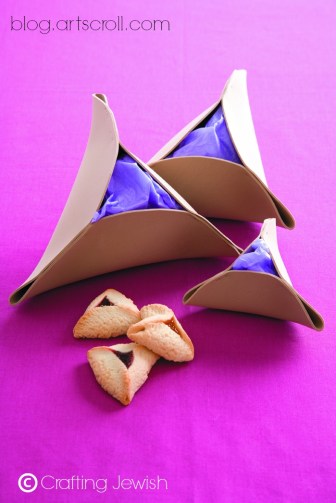
Crafting Jewish: Shalach Manot Hamantaschen

Thinking about Shalach Manot? Make these adorable fill-able hamantaschen for a fun and affordable packaging option!

Crafting Jewish by Rivky Koenig helps you prepare for the holidays with creative and inventive crafts geared at enhancing your celebration and giving kids – and adults! – a great time.

To help get you ready for Purim, we are sharing one of the Purim crafts in this book. These adorable hamantaschen are perfect for filling with candy and other treats. Some of the other purim crafts in Crafting Jewish include purim puppets, grand graggers, and lots of DIY costumes, masks and hats.

Hamantaschen Craft  The Official ArtScroll BlogShalach Manot Hamantaschen

What You Need:

dinner plate

1 (12″x18″) sheet of beige or brown craft foam

pencil

scissors

hamentashen, food, or candy

stapler

purple tissue paper or cellophane paper

6″-7″ plate, optional

How to do it:

1.  Place the plate on the craft foam and trace around the plate.

2.  Cut out the circle of craft foam. Place the hamantashen, food, or candy into the center of the circle.

3.  To make the hamantash’s triangular shape, lift up two sides of the circle and staple together on top, where the two sides meet. Lift up the remaining side and staple to each of the other sides (see photo).

4.  Cut out a square of tissue paper or cellophane slightly larger than the hamantash’s opening. Stuff the tissue paper or cellophane into the opening to cover the food.

Optional: Use a 6″-7″ plate as your template to make a smaller hamantash (see photo).

Estimated time: 10 minutes

Click here for exclusive online savings on Crafting Jewish.

Excerpted from Crafting Jewish by Rivky Koenig. Copyright ArtScroll/Mesorah Publications.

ArtScroll’s “French Revolution” continues! The Edmond J. Safra French Edition Talmud

The Schottenstein Edition Talmud Bavli sparked an ongoing revolution in the Jewish world, opening the Talmud’s vast wisdom to hundreds of thousands. The Schottenstein Edition Hebrew Talmud continued bringing ArtScroll’s innovative features to tens of thousands more.

And then, about a decade ago, it was the turn for French speakers to rejoice, as the first volume of the Edmond J. Safra French Edition Talmud was published. In France, Switzerland, Belgium, Israel, and Canada, French speakers could now enjoy the many features of the Schottenstein Edition, beautifully adapted into French by a team of scholars, translators, and editors.

Just released is the 19th volume of the series, Maseches Chagigah, dedicated by Mrs. Safra in memory of her son, daughter-in-law, and grandson. Maseches Sukkah, volume 2, will be released soon after Pesach, and more volumes are in the works.

Can you “parlez-vous francais?” Then you, too, can discover the wisdom of the Talmud.

Click here for the entire series (to date) of the Edmund J. Safra Edition French Talmud.

Click here for all French titles from ArtScroll.

Announcing: New Pesach Cookbook!

Pesach might seem like it’s way off in the distance, but here at ArtScroll we’re already getting ready for Pesach with a brand new, soon to be released cookbook!

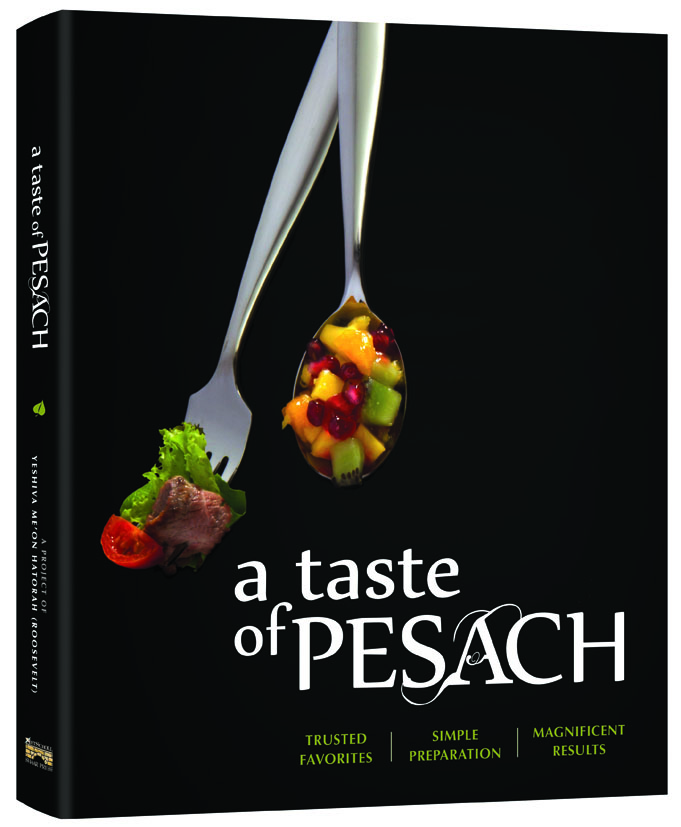
Introducing: A Taste of Pesach: Trusted Favorites. Simple Preparation. Magnificent Results. 

Taste of Pesach_dust jacket-2.indd

A Taste of Pesach is compiled from the wildly popular mailings to benefit Yeshiva Me’on Hatorah and features over 160 recipes (many of which have never been published before!), each with a beautiful, full color image. Best of all, over 140 of the recipes are gluten and gebrokts free!

Make sure to subscribe to the blog (you can sign up for email on the right sidebar) to get future updates – including free sample recipes from this book!

A Taste of Pesach is scheduled for release on March 3rd.

Click here to pre-order your copy with exclusive online savings.

Humble Beginnings and Lofty Legacies: A Talk with Rabbi Paysach Krohn

ArtScroll talks with internationally acclaimed speaker and best-selling author, Rabbi Paysach Krohn about the start of his illustrious career, the legacy he carries, and the family traditions he’s passing on.

They say that behind every great man is a woman, and that adage is true in the case of Rabbi Paysach Krohn –  his illustrious writing career started with his mother. “My mother was a marvelous writer. As I was growing up we used to sit together and read well-written newspaper articles, editorials, and op-ed pieces, all so I would learn to express myself with concise clarity.”

And thus began Rabbi Krohn’s lifetime of writing.

Before he was a bestselling author of the popular Maggid Series of books, Rabbi Krohn wrote for periodicals such as The Jewish Observer and Olomeinu. “In 1976, ArtScroll published its first book and I was so impressed with the quality of the work and the writing. I decided that I wanted to write for ArtScroll.”

“I called Rabbi Meir Zlotowitz and asked about publishing with ArtScroll. At first, we discussed a book on Mishlei, but I realized that would be a major undertaking.” Shortly thereafter, ArtScroll began to publish books on various topics, in addition to Tanach commentaries, so Rabbi Krohn’s next idea seemed obvious. “As a mohel I knew exactly what would be needed in a book on Milah.”

Rabbi Krohn tells of the favorable impression ArtScroll made on him. “Rabbi Nosson Scherman took his little phone book out from his inner jacket pocket and wrote my name and phone number in it. He pocketed the book, saying, ‘Now you’re one of us.’ I’ll never forget that.”

After Rabbi Krohn submittedwrote some sample chapters, ArtScroll accepted the concept and a contract was signed. But instead of a deadline, Rabbi Krohn was given a goal. “They told me, ‘Write a book on bris milah that is so thorough and so good, nobody will even consider writing another one for at least ten years.’” Thirty months later, Rabbi Krohn felt he had achieved that goal, and Bris Milah/Circumcision, was published.

Ready for his next writing challenge, Rabbi Krohn was inspired by short stories. His personal connection with Rav Sholom Schwadron, the Maggid of Yerushalayim, gave him the idea for his second book. Rabbi Krohn approached Rav Sholom and asked for permission to trasncribe his stories in a book accessible to the English reader.

“I wrote up the stories, and my cousin translated them for Rav Sholom. Then the most amazing thing happened: Rav Sholom called me and said that he liked what I had done with the stories, but that in many of them I had gleaned a different lesson from the story than he had.

“That is why The Maggid Speaks uses a different typeface for the introduction and epilogue than it does for the story itself. The stories belong to Rav Sholom, but the lessons and introductions are mine. This format worked so well that I continued to use it for all of my subsequent books. A story is like manna; just as everyone tasted the manna according to what they enjoyed, everyone can read a story and enjoy it, but they can each learn different lessons from it.”

After The Maggid Speaks, Rabbi Krohn believed he had finished writing short stories, but Rabbi Scherman had other plans. “Rabbi Scherman said that he had just come from South Africa where he saw a rebbi teaching his class from my book. He told me, ‘If rebbeim are teaching from your book, you need to write more.’”

Just as Rabbi Krohn worried that he didn’t have enough material for another book of stories, another amazing thing happened. “Rabbi Boruch Grossman called and asked me to speak at the graduation of his high school for Russian boys. That was my first public-speaking engagement. Following that, Mrs. Shanni Perr asked me to come to Camp Bnos to speak on Shabbos.” After those events, Rabbi Krohn received calls from other camps, and it wasn’t long before he had speaking engagements every Shabbos. Next, Rabbi Hillel David’s rebbitzen  invited him to speak to a ladies’ group, and things snowballed from there.

Along with the speaking invitations came another benefit. “People began to realize that if I was writing stories, I probably wanted to hear stories as well. Acquaintances and strangers approached me to tell their stories – on a plane, while crossing the street, anywhere. And they still do.” Rabbi Krohn collected stories for his next book, Around the Maggid’s Table. “It was called Around the Maggid’s Table, because that’s how stories are gathered. Rav Sholom would tell some stories, and others around his table would tell others.

The third book no longer contained stories from Rav Sholom, but rather – stories that Rabbi Krohn himself had collected and compiled. The book is therefore called In the Footsteps of The Maggid.

The format of Rabbi Krohn’s latest release differs from that of his previous books. “When Zman magazine originally began publishing, the editor-in-chief, Rabbi Yaakov Astor, asked if I would be willing to have my speeches transcribed to create articles for the magazine. I agreed, and ever since the first issue, one of my speeches has been the leading article.” After 25-30 issues had been published, Rabbi Gedaliah Zlotowitz thought of publishing these articles in book form. They worked it out with Zman, and published Perspectives of the Maggid.

His latest book, The Maggid at the Podium, is the second compilation of his speeches. “I knew that books of stories sell well, but I was amazed by the reception to this book.” Rabbi Krohn commented. The Maggid at the Podium sold over 5000 copies in its first couple of weeks, and “The feedback from readers has been wonderful, Boruch Hashem. People enjoy stories, but with this book, they get the lecture structure as well. There’s a buildup, development of the theme and a whole chapter for each topic.”

When asked if he prefers writing or speaking, Rabbi Krohn insists that he loves both, as each is uniquely rewarding. “But Bris Milah will always be first for me. It’s my main parnassah and a family tradition.” Both Rabbi Krohn’s father and grandfather were mohelim, and his son and son-in-law now continue the tradition.

Rabbi Krohn proudly recounts that his children are also continuing other family traditions. “My daughter Chaviva continued the writing tradition, first with stories from the Maggid books that she adapted for children.” Her newest children’s book, Making Hashem Proud is due out soon from ArtScroll. Rabbi Krohn’s daughter-in-law Genendel is achildren’s book author as well.” Speaking has also become a family tradition; Rabbi Krohn’s son Eliezer is a seminary teacher and popular speaker.

So much harbotzas Torah, such lofty legacies and traditions, one could wonder where they all comes from. But Rabbi Krohn sums it up simply. “Being a mohel is from my father, the writing is from my mother, and the speaking is from Rav Sholom Schwadron.”

Click here for exclusive online savings on Rabbi Krohn’s latest release: The Maggid at the Podium 

Click here for all titles by Rabbi Paysach Krohn