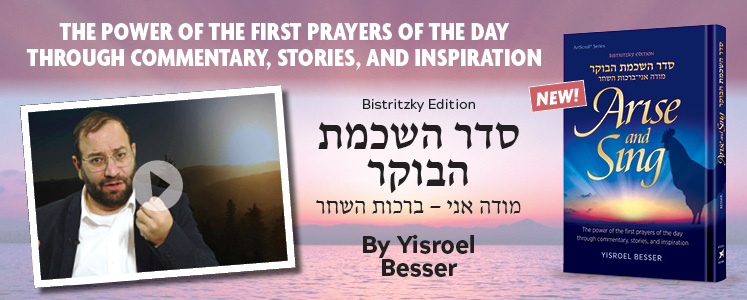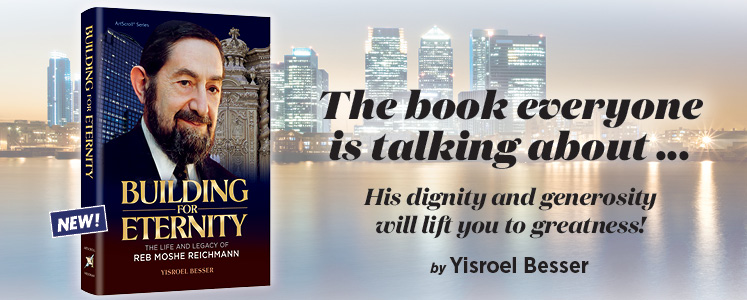
Two Major New Books by Yisroel Besser: Arise and Sing: The power of the first prayers of the day through commentary, stories, and inspiration and Building for Eternity: The life and legacy of Reb Moshe Reichmann

Quick Kislev riddle: What could be better than a new Yisroel Besser book for Chanukah? The answer? TWO new Yisroel Besser books for Chanukah!

That’s right. ArtScroll presents two new books by Yisroel Besser that are very different — but that both provide the engaging stories and soul-stirring insights and inspiration that we’ve come to expect from him.

How does your day begin? With yawns and half-opened eyes? With pulsing adrenaline and mental to-do lists that shatter any possibility of tranquility? 

Chazal show us a different way to start the morning: with gratitude, anticipation, joy and, yes, kedushah

With Birchos HaShachar.

Following the amazingly successful format of Yisroel Besser’s bestselling Nishmas: Song of the Soul, we can now enjoy Arise and Sing: The power of the first prayers of the day through commentary, stories, and inspiration.  

Speaking with Yisroel Besser, you feel his passion, his belief that we can make a “good morning” into a great day. “The Anshei Knessess HaGedolah gave us a gift: tefillah,” he explains. “Every word of the morning tefillos is laden with significance, with the possibility to transform your whole day.” 

Arise and Sing gives us a meaningful understanding of the prayers we say daily, while inspiring us through fascinating stories.

“Not only will it change your morning,” says the author, “it will change your whole day — and maybe your life.”

In Building for Eternity, Yisroel Besser brings us the extraordinary story of Reb Moshe Reichmann. It’s a story of honesty, modesty, bitachon — and deep love for Hashem, His Torah, and His people.

From modest beginnings, Reb Moshe Reichmann built his family firm, Olympia and York, into one of the world’s largest construction and real estate empires. It became a symbol of business integrity, a global kiddush Hashem. But He built more than skyscrapers. He built shuls and schools, kollels and kehlilos, impacting almost every aspect of Torah life. He gave more than just funding: He gave time, genuine concern, and spot-on advice. 

The most respected financiers on earth were in awe of him. World leaders paid him homage. Yet he remained the modest ben Torah that he’d been as a young man, deferring always to the gedolim and making Torah study the central part of his life.

The author of the bestseller Just Love Them brings us another captivating biography that shows us just how much potential for greatness lies in every one of us. 

Rosh Hashanah and Beyond … Inspiration X 4!

How did it happen? One minute we’re sitting poolside or enjoying road trips … and suddenly, Rosh Hashanah is almost here. This year more than most, we need our inspiration, and we need it fast!

ArtScroll has four (!) new books to help us take advantage of Hashem’s closeness during these days of holiness, connection, and prayer. 

Yom Tov Messages from Rav Pam: Rav Yaakov Kamenetzky called Rav Avrohom Yaakov Pam “the Chofetz Chaim of our time.” In this collection, based on Rav Pam’s shiurim and arranged according to the Yamim Tovim, we can almost hear Rav Pam’s voice: perceptive and sensitive, humane and wise. Yom Tov Messages from Rav Pam also includes a special feature: A 50-page supplement, “To Be a Ben Torah” on growth in Torah and middos development, as well as sections on enriching Erev Shabbos, Shabbos, and Rosh Chodesh. 

Rav Nosson Wachtfogel on Elul and the Yamim Noraim: As mashgiach ruchani of Lakewood’s Beis Medrash Govoha for close to half a century, Rav Nosson Wachtfogel stood beside Rav Aharon and Rav Shneur Kotler, zt”l, helping to build the yeshivah and, indeed, to build Torah Jewry in America after the Holocaust. Leket Reshimos — literally, Collected Notes — are a collection of short nuggets of inspiration assembled by Rav Nosson’s students, who heard them directly from Rav Nosson himself. Now translated into flowing English, this work also includes his students’ memories of the Mashgiach and his inspirational life, as well as stories Rav Nosson told them about his own illustrious rebbeim. The vorts here are brief. And brilliant. And, often, life-changing. 

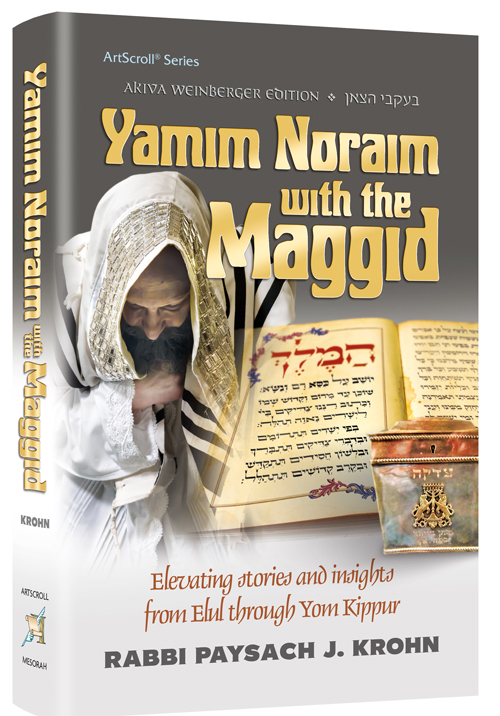
Yamim Noraim with the Maggid: In a previous column, we spoke with Rabbi Paysach Krohn, the famous “American maggid” about his new book, which help us understand the Yamim Noraim, and particularly the tefillos, through his insights and, of course, his inimitable stories. As Rabbi Krohn told us, “We’re all good Yidden and we all do wonderful things, but we can all raise ourselves up a notch.” Thousands have already “raised themselves up a notch” with the help of this instant bestseller. 

Olam HaAvodah: In Rabbi Moshe Don Kestenbaum’s Olam HaMiddos essays, thousands found a way to improve themselves and their lives. Now this acclaimed educator, writer, and speaker shares with us forty daily readings that show us how we — “regular” people, with flaws and imperfections — can achieve a wondrous closeness to Hashem. 

What Does Shemittah Have to Do With Me? Find out with Rav Chaim Kanievsky on Shemittah!

This will be iy’H my fourth Shemittah in Eretz Yisrael, but never have I felt its presence so clearly. I can actually feel the excitement among so many different sectors of the population. People are crowding into plant nurseries, discussing house plants and Shemittah. In the boulevards and traffic circles, city workers are racing to plant flowers and trees before Rosh Hashanah. And — with more than 50 percent of Jewish-owned land going to be taking its well-earned Shemittah rest — farmers are doing whatever they have to do to prepare for this once-in-seven-years mitzvah.

That’s great for those of us privileged to live here. But if you live in Lakewood, Cleveland, Manchester, or anywhere outside of the Holy Land — you may be wondering: what does Shemittah have to do with me?

Much more than you think.

Rav Chaim Kanievsky on Shemittah is a fascinating work compiled by Rav Avraham Yeshayah Steinman, grandson of both Rav Chaim shlita and Rav Aharon Leib Steinman zt”l. Newly translated into English, its stories and insights show us that while the mitzvah of letting the land rest belongs to farmers, the lessons of Shemittah belong to us all: lessons of humility, of attaining the proper balance between hishtadlus and bitachon, and, above all, lessons of emunah

Rav Chaim Kanievsky on Shemittah includes hashkafic perspectives on the mitzvah of Shemittah, dozens of inspiring stories of Shemittah observance, and selected halachos of Shemittah based on the piskei halachah of the Chazon Ish and Rav Chaim himself. It also includes “The Nine Mitzvos of Shemittah,” excerpted from The Schottenstein Edition Sefer HaChinuch, The Book of Mitzvos

Just as Galus Bavel came upon us partly because the people did not keep Shemittah, so too the mitzvah of keeping Shemittah is inextricably linked to the Geulah. As Rav Chaim reminds us, the Chazon Ish said that if we observe Shemittah properly, we merit redemption at the end of the Shemittah year. 

How important is it for us to learn about Shemittah? Rav Chaim has advised thousands of people seeking all different kinds of yeshuos, “Learn the laws of Shemittah and Hashem will grant you blessing.”

Chazal calls Shemittah-observing farmers  “giborei koach, powerful warriors.” No, we in chutz l’Aretz are not parking our tractors for a full year. But by learning the laws and lessons of Shemittah, we can have our own small portion in this vital and rare mitzvah.  

A Conversation with Rabbi Paysach Krohn author of Yamim Noraim with the Maggid!

I’m speaking with Rabbi Paysach Krohn, the legendary “American Maggid” who has inspired thousands … tens of thousands … no, hundreds of thousands … okay, forget numbers — who has undoubtedly inspired, in his decades of writing and speaking, every one of us …. 

We’re talking about Rabbi Krohn’s new book, Yamim Noraim with the Maggid. The book opens with a poignant personal story about Rabbi Krohn’s encounter with a famed “vekker” — the man who walks Yerushalayim’s predawn streets, awakening people for Selichos. “Now that Elul is here,” I ask him, “how do we wake ourselves up?”

“Stories inspire,” he says simply. Then he goes on to explain. “When you go through Elul, Selichos, the Yamim Noraim, there is so much davening, and many times people are puzzled by the tefillos and piyutim. What I’ve tried to do is it take segments of Selichos, Avinu Malkeinu, Vidui, and the tefillos and explain them so that people will relate.”

They relate through his commentary — and through stories. “Look at the story about 7,000 Danish Yidden saved during the Aseres Yemei Teshuvah. It’s a fascinating story, and it shows us how we should never give up, an important message to hear at this time of year. There are also many stories of ‘regular people.’ When people read stories of people like you and me, they feel — if this person could do it, I can do it, too. We’re all good Yidden and we all do wonderful things, but we can all raise ourselves up a notch.”

Here’s one more story — not by, but about, Rabbi Krohn. In my many years working in Jewish publishing, I’ve written book cover copy for literally hundreds of titles. When I joined ArtScroll, one of the first books I wrote about was by Rabbi Krohn. Not long afterward, I got a phone call from Rabbi Krohn himself. He’d found out from the office that I had written the copy, and he wanted to thank me for it. Since then, he has called or written to thank me every time I’ve written about one of his books. What a wonderful lesson in gratitude! 

Let me take this opportunity, Rabbi Krohn, to thank you for teaching me hakaras hatov in such a meaningful way. Stories inspire — and so do you.

Order your copy TODAY on ArtScroll.com!

A Conversation With Sina Mizrachi author of Good Food: Inspired by my Middle Eastern roots and the places I’ve called home

AS: Can you tell us a little about your background and your culinary journey?

SM: I was born in Israel and grew up in the Moroccan community in Montreal, Canada. My grandparents are from Morocco and Libya. My mother was forever doting on us with her “bishulim,” her cooking. When I married, I thought I’d naturally fall into that role, but it took time for me to learn the principles and methods of cooking. I developed a passion for photography and cooking and started sharing recipes on a blog.

AS: Over 16,000 people turn to you for recipes. What’s the secret of your amazing popularity? 

SM: There is no secret. I think that when people are passionate about what they do, they’ll attract people who want to share in that passion. I love our community and how we share a love of cooking. Practically speaking, people want dinner ideas, because we all need to eat.

AS: What is your process for developing a recipe? Can you share with us how you developed a specific recipe in the book?

SM: Sometimes it’s reviving an old family favorite that needs accurate measurements. Sometimes it’s coming up with a whole new concept. Once you understand cooking methods, flavor pairings, and seasonings, then you can get creative and develop new dishes. For example, I love a good Tunisian sandwich (it’s in the book), but I wanted a fish recipe with those flavors that’s more elevated, so I developed the Harissa Fish that has olives, thinly sliced lemons, garlic, and cumin. I also aim to make prep simple and efficient.

AS: So many people today want to bring the food they serve up to a higher, more creative level, yet are afraid they won’t have the time. How can aspiring cooks deal with that? 

SM: Creativity does not need to be complicated or time consuming. It can be as simple as pairing flavors that are unexpected yet delightful. Think of adding a gremolata to a roast to cut through the richness and lend a bright acidity. Even adding pomegranate seeds would add a fruity tang. Or blending spices to create your own spice blends — that’s the fastest way to flavor. I believe the simple things are best.

Order your copy on ArtScroll.com today!

A Conversation with Rabbi Daniel Glatstein author of The Darkness and the Dawn

AS: With the Three Weeks and Tishah B’Av approaching, we know a lot about “Darkness.” Tell us about “Dawn” — and how the saddest time of the year is filled with hope.

RDG: When R’ Akiva saw the success of Rome and when he saw the destruction of Yerushalayim, they brought him simchah. He said, “If this is the reward of the wicked, imagine the reward of the righteous. And if Hashem fulfilled the prophecy of destruction, He will fulfill the prophecy of rebuilding.” Hashem’s middah of granting us goodness is hundreds of times greater than when He strikes us with din. So Tishah B’Av gives us a glimpse into the magnitude of acharis ha’yamim. Imagine the happiness in store for us at the Geulah. Similarly, the Navi Yeshaya says, “Hashem’s anger is ‘rega katan,’ a fleeting moment.” If 2,000 years of suffering is a “moment,” then the time of chesed we await — which the Navi calls “eternal” — boggles the mind. Imagine the magnitude of the consolation that’s in store for us.

AS: Your revered grandfather passed away recently. How did he inspire some of the messages of this book?

RDG: Tishah B’av is called a “moed.” What are we celebrating? Tishah B’Av is a celebration of the indomitable spirit, pure emunah, and great bitachon of the Jewish people throughout the ages. R’ Yaakov Emden writes that the greatest miracle is the eternal existence of the Jew, and that’s what Tishah B’Av celebrates. My grandfather, despite seeing the annihilation of European Jewry, emerged with unbending emunah and awaited every moment for the redemption. That kind of emunah is one of the themes of this sefer.

AS: What message does this book have for us today, during the increasingly challenging times we are facing?

RDG: When the Nazis ym’sh were primed to invade Israel in 1942, a group of rabbanim voiced their fears. The Torah institutions of Europe were destroyed, they lamented. What will be with the Jewish people? The Ponovezher Rav answered that though the situation seems bleak, Hashem has promised that His Torah would never be forgotten by His people. It’s specifically at a dark and frightening time that Hashem gives individuals siyata d’Shmaya. And indeed, after the Holocaust there was amazing and miraculous rebuilding of Torah. In times like these, a person who holds fast to the ideals of Torah will get supernatural siyata d’Shmaya.

Order your copy today on artscroll.com!

Free Downloads to Enhance Your Tishah B’av

The Official ArtScroll Blog

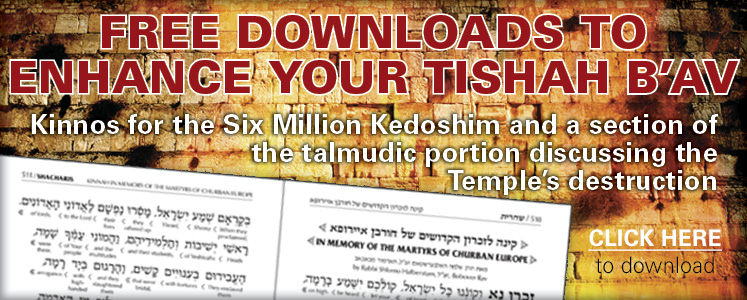
With Tishah B’Av approaching, we want to help our readers prepare to have a meaningful fast. This week we are sharing two free downloads that will make your Tishah B’Av more meaningful.

Kinnos for the Six Million Kedoshim

The destruction of the Six Million is our own generation’s stark connection to the eternal Tishah B’Av. Two great and inspiring spiritual leaders of our time, The Bobover Rebbe and Rav Shimon Schwab composed Kinnos lamenting and memorializing the unspeakable tragedy. Adopted by many congregations worldwide, these painful laments are read on Tishah B’Av.

Click here to download the excerpt from the Schottenstein Edition Interlinear Kinnos / Tishah B’Av Siddur.

A Portion of the Talmud Related to the Destruction of the Temple

On Tishah B ’Av, it is customary to study the interpersonal conflicts which led to the ruin of the Second Temple. One well-known source comes from the Schottenstein Edition…

View original post 56 more words

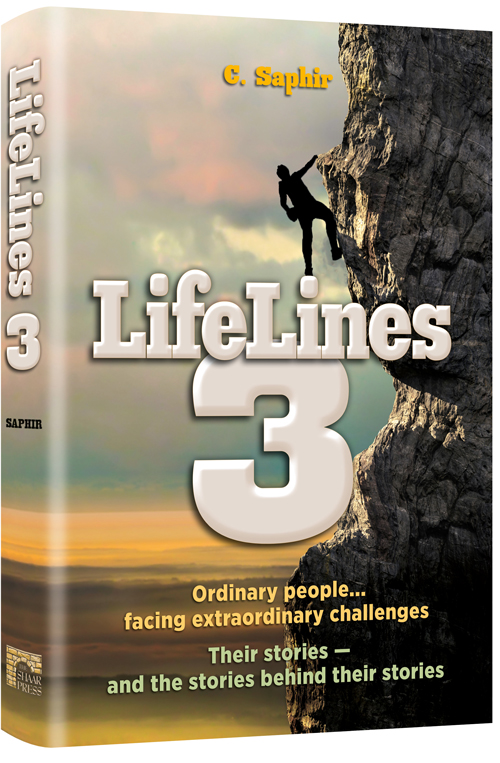
A Conversation With C. Saphir – Author of LifeLines 3

ArtScroll: This is your third LifeLines volume, yet the stories are still so varied and intriguing. How do you keep them so fresh?

C. Saphir: It’s partly because I’m very selective about the stories I’ll write. I won’t write a story that is too similar to something I’ve already written. More fundamentally, though, people’s lives are fascinating, because Hashem is writing the script! No two people experience life the same way, and the world is constantly changing, so there are always new and intriguing stories unfolding.

AS: These stories are very popular and generate many comments from readers. Why do you think people are so engaged when they read them?

CS: I try hard to maintain the narrator’s voice, rather than inserting myself as the writer. I’ve heard readers say that it’s fascinating to meet a new person, talking in his or her own voice, in each story. Although I change identifying details, I keep the story authentic — which means letting events speak for themselves, rather than embellishing facts, including extraneous details, or pontificating. I trust my readers to glean the message themselves, without my being too obvious about it.

Also, as varied as the stories are, one thing virtually all of them have in common is that the narrators experience meaningful growth due to adversity they faced. That makes them seem very human and vulnerable — and therefore relatable.

AS: Your postscripts in this volume don’t seem to follow a standard formula. What kind of extras do you give us in the postscripts?

CS: In the postscript to the story about the young woman who married a quadriplegic, you’ll read about their lives, years after their marriage. In the postscript to the story about a couple that struggled with mild infertility, you’ll see that reader reactions to that story were the opposite of mild. In the postscript to the story about a rosh yeshivah who remarried, you’ll hear his thoughts as to why a second spouse is typically different from the first. In other postscripts, you’ll hear about some of the dilemmas I face in writing LifeLines, such as how to showcase people’s greatness of spirit without making them sound arrogant. Basically, the postscripts are my opportunity to step out of storyteller role and add spice to the story.

Order your copy TODAY! From artscroll.com

Free Download of this week’s Parshah and Haftorah: Tazria-Metzora

During these challenging times our thoughts and prayer are with Klal Yisroel. For the many people who live in neighborhoods where the shuls are closed for Shabbos we are making this week’s Parshah and Haftorah from six different Chumashim available for a free download. Please share it with you friends and family. 

We wish you a good Shabbos. 

Mesorah Publications 

Mesorah Heritage Foundation 

TO DOWNLOAD, CLICK HERE: Parashas Tazria-Metzora