FREE DOWNLOAD – ONKELOS!

Targum Onkelos – the translation of the Chumash into Aramaic by Onkelos – is so important that the Sages included it in the obligation to read the weekly Chumash portion “shnayim mikra v’echad Targum” the Torah text twice andTargum Onkelos once. Now you will be able to gain a better understanding of the interpretation of Onkelos and enhance your understanding of Chumash.

ArtScroll proudly presents the Zichron Meir Edition of Targum Onkelos: The definitive Aramaic interpretive translation of the Torah, elucidated and annotated.

The Zichron Meir Edition of Targum Onkelos includes:

  • Chumash, Rashi, and Targum Onkelos fully vowelized
  • An elucidation of Targum Onkelos, following the style of the Sapirstein Edition of Rashi and other ArtScroll classics
  • An interlinear design, with the words of Targum Onkelos placed directly under the Hebrew of the Chumash text
  • A flowing translation of the Chumash, based on the Stone Chumash. This includes words marked in bold when the translation differs from that of Onkelos
  • Text that is highlighted when Onkelos deviates from the literal translation into his own interpretation
  • Notes that explain and clarify those places where Onkelos appears to add his own phrase or where he deviates from the simple meaning of the verse.
  • Footnotes that include background information and insights of other commentators

See for yourself! Click HERE to download the first Aliyah of Bereishis for free: Onkelos – Bereishis First Aliyah. Print it out and learn it this Shabbos!

Visit artscroll.com to order your copy today!

onk1h.jpg

Welcome back to Khazar! The Dark Secrets: The new novel in the Khazar saga by M. Kenan

The saga of the mythic realm of Khazar and its unforgettable inhabitants began with The Betrayal, the hugely popular (and huge — over 600 pages) epic novel. Thousands and thousands of readers found the novel to be a very new and different genre: This was fiction on a grand scale, the kind of book that transports us to a whole new reality. With its page-turning pace and plot twists, The Betrayal was a riveting historical thriller, but it was also so much more: a novel about personalities, about a young man growing up, about the choices that every person must make — and live with. It was peopled with close to 100 (!) characters — minstrels and artists, noblemen and fencing masters, demonic villains and a young ruler determined to do his best in a kingdom collapsing into civil war.

The breathtaking story continued with The Outcast, a novel as big and explosive as the war-torn Kingdom itself. Here we met Mahalalel, a boy whose very identity was taken from him as a child. Revolving around the mystery of his birth is a fascinating, compelling cast of characters, all with their own history, many with their own secrets. In this epic we read about a young boy, unwanted and alone, who holds the fate of an entire nation in his hands.

And there, for five long years, the story rested.

In the ArtScroll office, letters and emails poured in from readers longing to revisit the legendary kingdom, all asking the same question: When will there be a sequel?

The answer? Right now. Here it is, bigger (more than 800 pages this time!) and more exciting than ever: The Dark Secrets, the newly released continuation of the Khazar saga by M. Kenan.

Seven years of civil war have passed in Khazar, and people on both sides of the border are fed up with the fighting. Supporters of both kings long for the return of the old tranquility. The time is ripe for unscrupulous individuals to cobble up a scheme that will offer them a tantalizing — and dangerous — third option.

If you’ve read the two previous novels, you’ll happily greet old friends while meeting an entirely new cast of characters as well. And if you’re new to Khazar — welcome, you’re going to love it!

Click HERE to get your copy today!

darkh

A Conversation with Rabbi Yisroel Besser Author of The Chasam Sofer

AS: In your introduction, you say the Chasam Sofer “reshaped the Jewish world and changed the course of history.” Is it possible, in a few sentences, to tell our readers how he did that?

RYB: He did it by showing that being courageous and firm isn’t a contradiction to being a kind, generous, loving rav; by providing a living example of compassionate leadership — what we might call incredible kannaus, butalso  incredible Ahavas Yisrael. He was the single most effective figure in stopping the Reformers, yet a beloved, revered kehillah rav in a major city.

AS: The book opens with a haunting photograph of the Chasam Sofer. It’s almost as if he’s staring at you, and he knows a lot about you. Is that the impression he made on you as you researched his life?

RYB: The picture was purchased from a respected auction house, which had it authenticated. It was originally painted by a non-Jewish artist, and when you look at it, there is a certain feeling of awe, which makes sense. In the book, we tell how the Chasam Sofer’s talmidim and even his own children felt they had to avert their gaze from him at times.

AS: Wars. Trouble with congregants. Financial worries. Messages brought in dreams. Mystical encounters. The Chasam Sofer’s life seems to be both similar to other people’s situations, and yet so very different. How can we reconcile his profound spiritual powers with the everyday challenges he faced?

RYB: That is precisely what makes this story unique. To be one with the Torah, with halachah, with yiras Shamayim, and still incorporate that into real life, practical rabbanus and being a rosh yeshivah. He was a gadol hador in so many different areas, yet none of them came at the expense of any other.

AS: This is a well-researched biography, yet it reads like a novel. How did you manage that?

RYB: I didn’t manage anything. Every project takes siyatta d’Shmaya, and this one is no different.

AS: What do you think the Chasam Sofer’s message would be to Jews today?

RYB: We are where we are because we hold on. We have a Father and He hasn’t changed. What was true remains true. You can be a relevant, successful person, a contemporary person, without compromising that which your fathers believed in.

Get your copy today in time for Yom Tov! artscroll.com/f/CHASH

chash

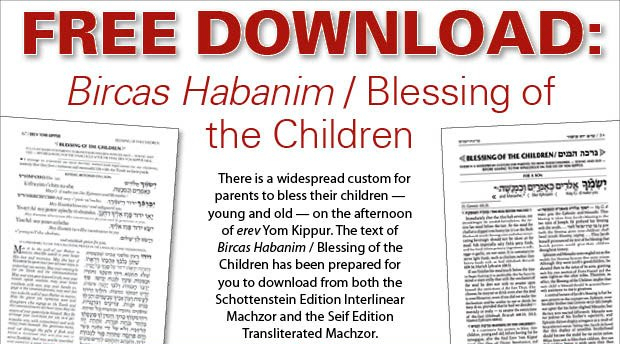
FREE DOWNLOAD: Bircas Habanim / Blessing of the Children

There is a widespread custom for parents to bless their children – young and old – on the afternoon of erev Yom Kippur. The text of Bircas Habanim / Blessing of the Children has been prepared for you to download from both the Schottenstein Edition Interlinear Machzor and the Seif Edition Transliterated Machzor.

Click here to download from the Schottenstein Edition Interlinear Machzor

Click here to download from the Seif Edition Transliterated Machzor

G’mar Chasima Tova!


unnamed

A Conversation with Rabbi Heshy Kleinman Author of Praying with Fire for Teens

Tens of thousands have had their davening transformed through the bestselling Praying with Fire series. Now, it’s time for teens to enhance their tefillos. ArtScroll spoke with Rabbi Heshy Kleinman, author of the Praying with Fire books.

AS: What makes this new book especially for teens?

 RHK: The scenarios and stories we use to illustrate the concepts of tefillah were revised to relate to the experiences of teens and young adults. In this way,  the teen reader gets a direct sense of how the concept can help him or her. We also used the more concise, direct writing style that younger readers prefer. And we added new material that opens pathways for finding an emotional connection to Hashem through prayer.

 AS: Can teenagers really change the way they daven in just 5 minutes a day?  

RHK: Of course! Both teens and adults benefit from small daily doses of learning. This method gives the reader time to more fully focus on and absorb what he’s learned and to try putting it into practice. The words on each page are like a powerful multivitamin; if you took the whole bottle in one day, your body couldn’t stand it. Small daily doses, on the other hand, make a noticeable difference over the course of time. 

 AS: We know davening is important, but what are the benefits teens will see in their everyday lives if they learn to connect to Hashem through tefillah? 

RHK In Tehillim we say, “Gam ki eilech b’gei tzalmoves, lo ira ra ki Atah imodi,” – Even if I go through the most frightening experience, knowing Hashem is there with me prevents me from feeling panic and despair. A person who learns to connect with Hashem through tefillah feels the comforting presence of his loving Father in every situation. There is not a more valuable acquisition for a teen or young adult — or anyone.

AS: Did you have input from teens as you wrote the book?

RHK:  Much of our input came from the tefillah program we are already successfully running in both boys and girls high schools, which is currently available by request. The overwhelming majority of these students wanted a book that would make a positive difference in their lives. This book is our response. We are confident that they will grab this opportunity and use it to bring yeshuos and berachah to themselves and to all of Klal Yisrael.

Get your copy today – artscroll.com/f/PWFTH!

FREE DOWNLOAD – TOSAFOS!!

The “learning revolution” that began with the Schottenstein Edition Talmud continues…

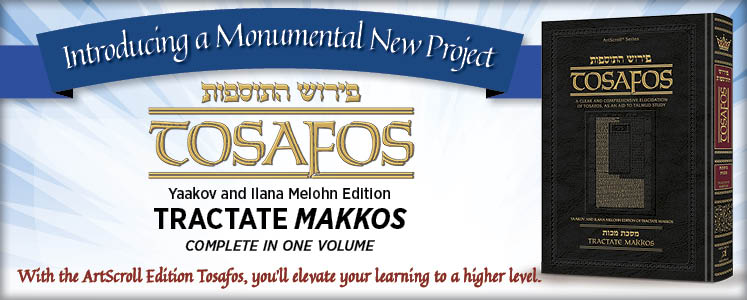
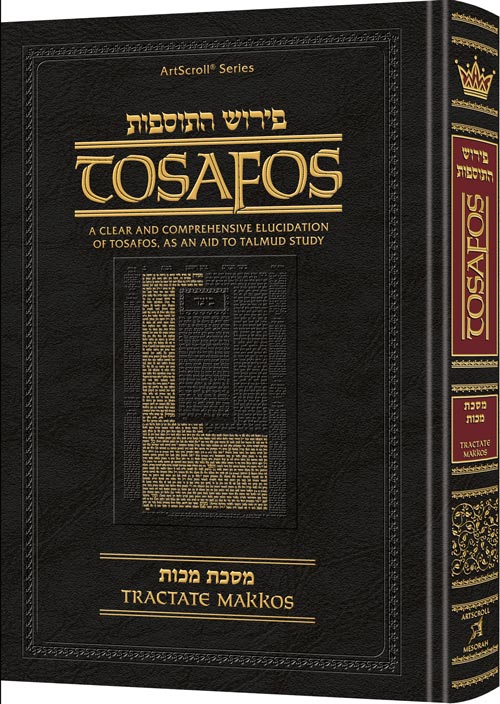
The ArtScroll Edition of Tosafos

An extraordinary achievement in Talmudic scholarship that will bring your Talmud study to a whole new level.

To understand the Talmud, you need Rashi’s commentary. But to fully appreciate the Talmud’s depth and unity of structure, you need the commentary of the Baalei Tosafos. ArtScroll now offers a path to understanding this vital yet difficult commentary.

The groundbreaking ArtScroll Edition of Tosafos features:

  • Introduction to each Tosafos that gives vital background information and defines important terms
  • Flowing translation in the format of the Schottenstein Talmud
  • Tosafos’ questions and answers clearly explained
  • Notes that add more information
  • A summary after each Tosafos that shows the flow of the entire Tosafos, a unique and important feature even for those who already study Tosafos

You can do it. You can learn Gemara with Tosafos.

See for yourself! Download the first Amud of this revolutionary volume of Makkos for free, here: Tosafos – Makkos 2a Download


Click Here to order your copy today!tfmak.jpg

Click Here to order your copy today!


ArtScroll Fully Loaded iPad Giveaway!!

🌟GIVEAWAY!!🌟 Yes, you are seeing correctly, we are giving away the complete ArtScroll Digital Library loaded on a new iPad, a $1,500 value! How do you enter? Go check out our instagram post to enter: https://www.instagram.com/p/BnFQaYqAnPo/
Contest is open until Mon 9/3 at 11:59pm
The iPad comes pre-loaded with:
🔶 The Complete Schottenstein English Talmud
🔶 Kleinman Edition Kitzur Shulchan Aruch
🔶 Wasserman Digital Smart Siddur
🔶 Jaffa Edition Tanach
and so much more! It also includes a magnificent leather iPad cover!

ENTER NOW!squareiPadgiveaway


Rare Photos, Hundreds of Stories, Boundless Inspiration: Reb Aharon Leib: The Life and Wisdom of Rabbi Aharon Yehudah Leib Shteinman

How do you portray close to a century of utter genius, unique humility, unparalleled diligence, profound caring — and, yes, loving warmth and a gentle sense of humor?

How do you capture the greatness of Reb Aharon Leib Shteinman, zt”l?

With true stories.

Reb Aharon Leib: The Life and Wisdom of Rabbi Aharon Yehudah Leib Shteinman, written by Rabbi Naftali Weinberger, author of the huge bestseller Rebbetzin Kanievsky: A Legendary Mother to All,  and edited by Nina Indig, is a biography featuring hundreds of stories of Reb Aharon Leib, as well as many never-before published family photos and documents.

The source of many of these stories, particularly of his youth, was … Reb Aharon Leib himself. When he was in his nineties, Reb Aharon Leibs’s grandchildren took turns sleeping in his apartment. To show his thanks, Reb Aharon Leib, a master of gratitude, told them stories of when he was young, knowing how much they enjoyed them — stories of the Brisker Rav and Rav Simcha Zelig Riger, of the “potch” he never forgot, of the only time he made a “goral haGra,” which ultimately saved his life. Rabbi Weinberger spent many hours interviewing grandchildren and great-grandchildren, as well as talmidim and Rav Chaim Kanievsky shlita, discovering these treasures.

Moving past his youth, we see Reb Aharon Leib’s relationship with the Chazon Ish and other great men. We are amazed by his incredible patience and compassion in his “kabbalas kahal,” as he spoke to countless people looking for a berachah, an eitzah, or just some comfort.

We visit that legendary two-bedroom apartment on Rechov Chazon Ish, and meet the beloved and illustrious Rebbetzin Tamar Shteinman, who truly found her home — with its two propane burners, peeling paint, and backless chairs — beautiful and complete. We learn of her remarkable chesed and see how she raised a Torah-true family with the utmost simplicity — and the greatest simchah.

In the beis midrash, in his home, flying all over the world to bring chizuk to other Jews — wherever Rav Aharon Leib went, he strengthened the people he met in their emunah and their love for Torah. So it’s very appropriate that this major biography, too, will strengthen and inspire us.

Get your copy today at artscroll.com!

ralh

FREE DOWNLOAD – Talmud Yerushalmi…Discover the Hidden Treasures!

Click HERE to download the excerpt from the Schottenstein Talmud Yerushalmi Berachos – English Edition

Click HERE to download the excerpt from the Schottenstein Talmud Yerushalmi Berachos – Hebrew Editionybr1.jpg

ArtScroll Yerushalmi Ready for the New Learning Cycle! The next Daf Yomi begins August 4!

by Rabbi Nosson Scherman

It was at the Sixth Knessiah Gedolah of Agudath Israel, in Yerushalayim, that a historic proclamation was made. The day was 18 Teves, 5740/January 7, 1980. The speaker was the Lev Simchah, the Gerrer Rebbe, zy”a.

The proclamation was that it was time for the Torah world to begin a new Daf Yomi program: the daily study of Talmud Yerushalmi. The Yerushalmi Daf Yomi program takes four and a half years and it is now celebrating its ninth siyum.

The Schottenstein Editions of the Talmud Bavli in Hebrew and English — and in French, as the Edmond J. Safra Edition — have contributed tremendously to the spread of Talmud study in general, and Daf Yomi study in particular.

It has been estimated that of the 90,000 participants at the MetLife Stadium celebration of the last siyum, more than half were there thanks to ArtScroll’s authoritative editions. Now the same is happening regarding the Yerushalmi.

New Era of Yerushalmi Study

In recent years, the Yerushalmi Daf Yomi program has gained growing impetus, thanks to ArtScroll/Mesorah’s Schottenstein Edition in both Hebrew and English.

Historically, study of Yerushalmi was extremely limited and difficult. Roman hatred and persecution of the Jewish yishuv in Eretz Yisrael remained intense after the destruction of the Second Beis Hamikdash and the failed Bar Kochba rebellion. In approximately 400 C.E., Rome’s relentless pressure forced an end to the development of the Yerushalmi, before it could be completely organized and edited.

The style of the Yerushalmi is terse and difficult, and its Aramaic dialect is different from that of the Talmud Bavli. Due to Roman cruelty, there were very few handwritten  manuscripts and they were not available for centuries; according to many authorities, Rashi never saw the Yerushalmi. And when texts were found, they were filled with errors. The result was that Yerushalmi was neglected for centuries and could be understood only by the greatest scholars. And — there was no Rashi commentary!

The Necessity to Study Yerushalmi

Such historic luminaries as the Arizal and the Vilna Gaon advocated study of Yerushalmi. The Rambam frequently rules like the Yerushalmi over the Bavli. Harav Chaim Kanievsky, shlita, urges that Yerushalmi be studied in conjunction with the Bavli, and his regular shiurim on Yerushalmi are transcribed and
published.

Especially in our time, study of Yerushalmi is essential because only the Yerushalmi — not the Bavli — has Gemara on Seder Zera’im, which makes it the primary source for the day-to-day agricultural laws of Israel. Study of the Yerushalmi is becoming more popular.
But the lack of commentaries and the difficulty of the text make Yerushalmi study almost impossible for the ordinary scholar, much less the layman.

The ArtScroll/Mesorah Edition

Now, thanks to ArtScroll/Mesorah, that has changed. In the words of Rabbi Yehezkel Danziger, editorial director of the project, “The Schottenstein Edition provides a thorough explanation of the text and makes the Yerushalmi accessible to everyone, in both English and Hebrew.”

It includes a corrected text of the Gemara. At the urging of Rav Kanievsky, ArtScroll has added commentaries not readily available, including that of Harav Shlomo of Sirilio, which Rav Chaim recommends most highly. The ArtScroll elucidation is based not only on the commentaries printed in the familiar Vilna Edition, but also on other excellent works. In addition, where necessary, the editors include an elucidation of alternate versions of the Talmud text, such as that of the Vilna Gaon. This edition also discusses cases where the Yerushalmi diverges from the Bavli.

Encouragement of Gedolim

The work was begun with the encouragement of Harav Yosef Shalom Elyashiv, zt”l, and other great Torah leaders in Israel and America. After examining the new edition, Harav Aharon Leib Shteinman, zt”l, was so impressed that he adopted it as the text for his weekly shiur in Yerushalmi, and he graciously sent a letter of commendation.

To date, the ArtScroll/Mesorah edition comprises all of Seder Zera’im and Seder Moed in Hebrew and English, as well as some of Seder Nashim and Seder Nezikin. Forty-three volumes are currently available in English and 29 in Hebrew. The elucidation is already acknowledged as a classic. Large teams of scholars in America and Israel are hard at work producing further volumes.

In the words of Rabbi Meir Zlotowitz, z”l, the founder of ArtScroll/Mesorah, “This may well be the most important project we have ever undertaken, because Yerushalmi was like a treasure locked in a vault without keys for more than 16 centuries. Baruch Hashem, that is no longer the case.”

The next cycle starts on August 4.
Now you can be a part of it.