A Great Light: Rabbeinu Yaakov Abuchatzeira’s Pituchei Chotam

A great light began to shine more than two centuries ago — and, finally, it illuminates our lives today, in our own language. It is the light of Rabbeinu Yaakov Abuchatzeira’s masterly commentary on the Torah, Pituchei Chotam.

The Abuchatzeira name is undoubtedly familiar to our readers. Who has not heard of the Baba Sali, Rav Yisrael Abuchatzeira zt’l, Rabbeinu Yaakov’s grandson, and Rav David Chai Abuchatzeira shlita, of Nahariya, Rabbeinu Yaakov’s great-great-grandson?

Now we can get to know their saintly ancestor — and, even more important, the Torah that he taught — through his unusual, inspirational, and fascinating Torah commentary.

Who was Rabbeinu Yaakov Abuchatzeira?

Later known as the Abir Yaakov, Rabbeinu Yaakov was born in 1806. At the tender age of sixteen, he became rav of his town in Morocco, and soon afterward he became the leader of all Moroccan Jewry. For close to 60 years he led his community with almost superhuman dedication. He was famed for his miracles and loved for his devotion, and after his death his grave became a site for pilgrimage and prayer.

And he was a talmid chacham. Oh, what a talmid chacham! He immersed himself in the study of both Talmud and Kabbalah, achieving mastery of all areas of the Torah and a profound understanding of its secrets.

In Pituchei Chotam, Rav Yaakov explores vital concepts that we can learn from the holy words of Chumash — the nature of our world, the unique Jewish mission, the primacy of Torah, the eternal battle between the yetzer hara and the yetzer tov. While the concepts are deep, the commentary can be understood on many levels, by scholars and laymen alike.

ArtScroll’s Pituchei Chotam gives us the text of his commentary in a flowing translation. (The most esoteric teachings were omitted.) The first volume includes Rabbeinu Yaakov’s commentary on Sifrei Bereishit, Shemot, and Vayikra, while Volume 2, Sifrei Bamidbar and Devarim, is in preparation and iy’H will be released in time for the weekly Torah reading.

Rav David Chai Abuchatzeira says of his great-grandfather’s sefer, “It is a … storehouse of fear of God and encouragement to serve Him wholeheartedly. May [those who learn his Torah] and all who aid in this endeavor merit all that is good, physically and spiritually. May all their desires be fulfilled in the best possible way….”

Amein!

To order your copy of Pituchei Chotam today, click here: artscroll.com

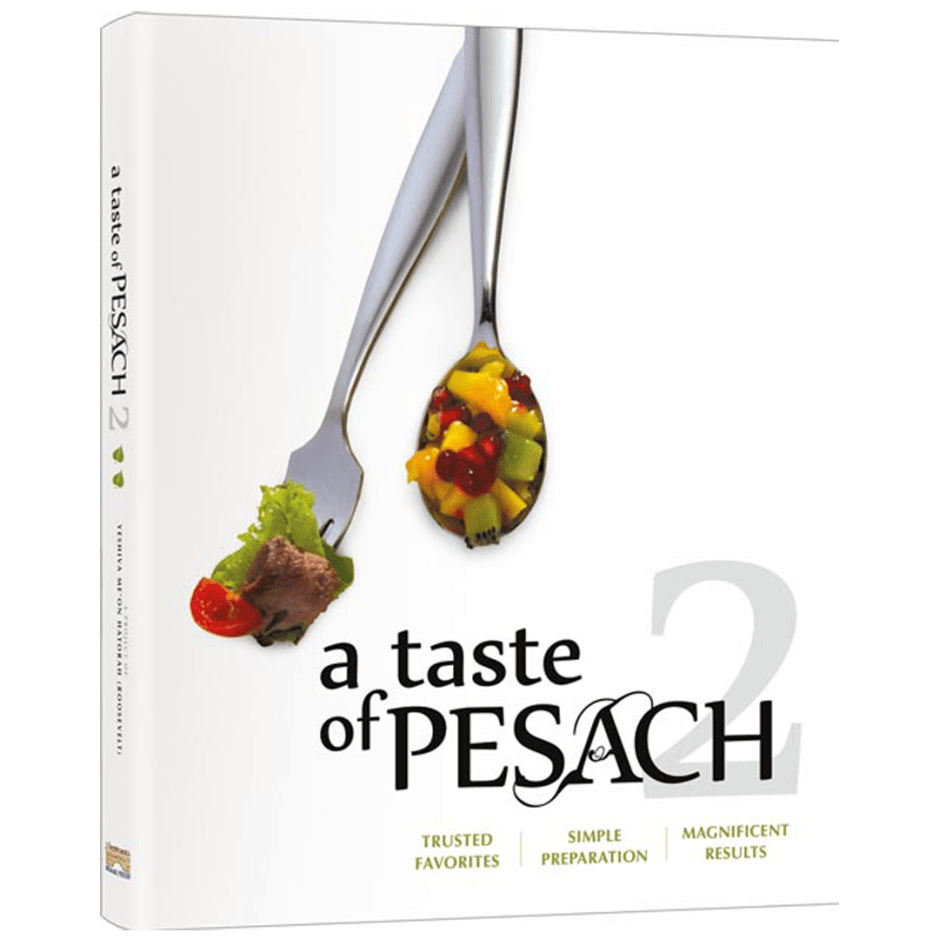
ArtScroll Speaks with Hindy Langer, a Committee Member on A Taste of Pesach 2

AS: What were the origins of the A Taste of Pesach cookbooks?

HL: We wanted to do a fundraising mailer for Yeshiva Meon Hatorah. We came up with the idea of mailing recipes — and hatt is something that works uniquely well for our team of volunteers. We have a super-talented graphic artist, a super-talented photographer, and some great cooks — and for the last 11 years, we have been working together to produce a yearly pamphlet of Pesach recipes. Two years ago, we collected many of our most popular recipes in A Taste of Pesach, and the cookbook, published by ArtScroll, became a huge bestseller.

AS: What do you think is the secret of your success?

HL: We are a diverse team with very different ways of thinking about food. Our tastes vary, but we all love to cook and serve great food — especially for Yom Tov. With so many different types of cooks, our cookbook has recipes that appeal to everyone. Also, we are in touch with our friends and families all year round to collect delicious, “normal” recipes that work. Finally, our stunning pictures are true-to-life. So when you make a recipe from our cookbook, you know what you are getting.

AS: Taste of Pesach 2 features a special “plating” section. Can you tell us a little about it?

HL: This was the brainchild of Raizy Greisman. People are not always in the mood of cooking fancy food. She wanted to offer people the opportunity to prepare simple food in a way that dazzles. We show how cooks can work with ingredients that they have in their pantry to produce show-stopping presentations that makes the seudos more exciting for kids and guests.

AS: What are the criteria used to choose recipes?

HL: Every person on the committee has different criteria — and that’s why the recipes are so varied! We sit together in a planning meeting right after Succos every year and we present recipes that we’ve tried and loved. Then we’ll prepare them for our tasting/photography session. We always prepare a few extra dishes, because some recipes are nixed at the tasting session.

AS: What are some of your personal favorites?

HL: Some of my favorites include: Chimichurri Lettuce Cups, Pastrami Egg Rolls, Salt-Encrusted Prime Roast, Apple-Apricot Kugel, Pecan Meringues, and Gooey Nut Clusters. The new book also includes some old favorites, such as Doughless Potato Knishes and Pickled Salmon.

“We all love to cook and serve great food — especially for Yom Tov!”

Get your own copy of the brand new A Taste of Pesach 2 HERE: Artscroll.com!

How I Got Through the Week: A look at Just One Word: Emunah

How I Got Through the Week:

A look at Just One Word: Emunah

It was one of those weeks. Lots of issues. Medical issues (serious) — a son hospitalized. Medical issues (annoying) — paperwork overload, a missing document, a hospital’s broken fax machine. Professional issues, homeowner issues, traffic and parking issues.

Yes, a tough week. But in the best “refuah lifnei ha’makah” tradition, Hashem sent me something that got me through it, sane and smiling.

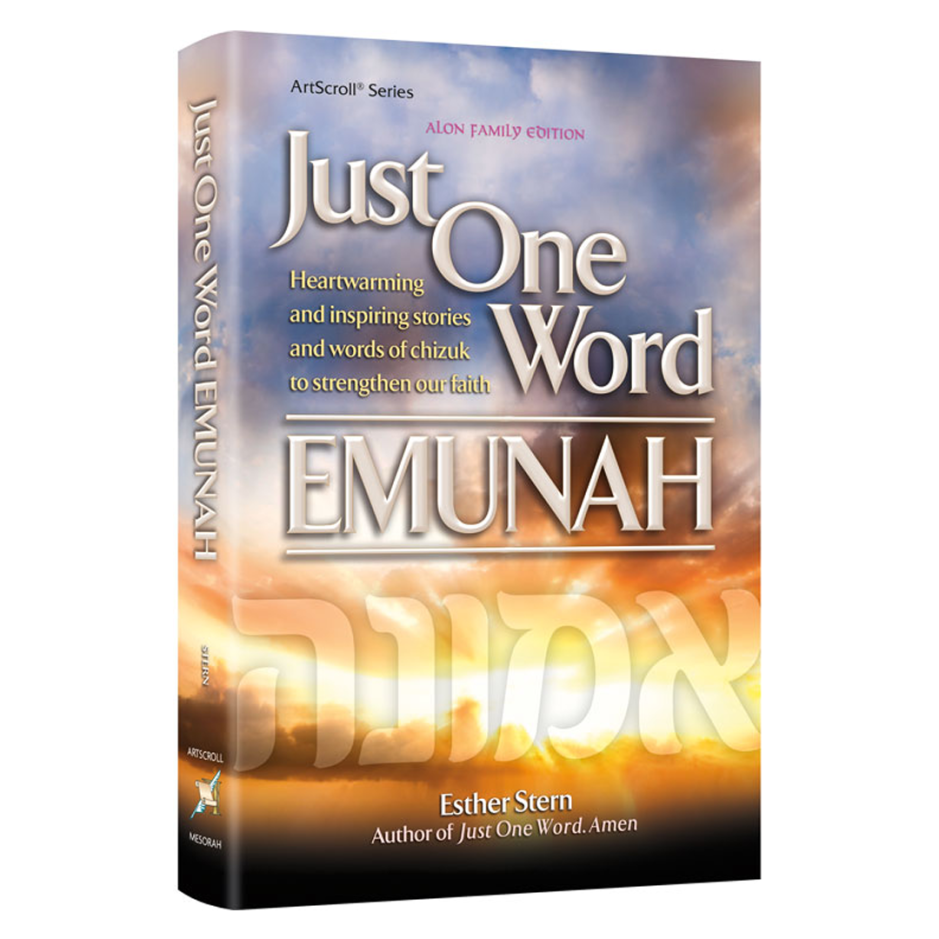
It’s called Just One Word: Emunah.

Remember the book that started a revolution: Just One Word. Amen, by Esther Stern? Mrs. Stern has a unique ability to inspire, to transmit Torah concepts, to illustrate those concepts with true stories, to show us how we can change our lives for the better.

In her new book, Just One Word: Emunah, she turns her attention to the topic that has riveted our generation: faith and trust in Hashem.

Back to my awful week. While the world was falling down around me, I was putting a few final editorial changes into her manuscript, and I read:

If a person would examine one of his life’s challenges and calculate how much of his suffering is the actual problem and how much is the accompanying worry, pain, anguish, and fear of the unknown, he would discover that often the problem itself is relatively small compared to the side effects that blow it up into a huge burden. With emunah there are no “side effects.” There is only the net problem.

And I realized — take away the angst and put emunah in its place, and most of my problems shrink down to manageable size.

Then I was berating myself for something I did and getting angry at someone else for something she didn’t do, and I read:

Every individual’s life situation is chosen for him down to the most minor detail, given to him by the only One Who is in charge: HaKadosh Baruch Hu. So we can calm down. We are not to blame, and neither is anyone else.

And on and on. For every problem, a story (there are over 80 true stories in the book!) that helped change frustration to acceptance. For every setback, a Chazal or classic mussar insight that transformed fear to tranquility.

The week came to an end, my son was b’H better. But there will be other weeks like this. And with Just One Word: Emunah — I’ll be much better prepared for whatever Hashem sends my way.

Click HERE to order your copy today from Artscroll.com!

You’re Never Too Young, You’re Never Too Old: Living Emunah books for the entire family

If you have made Living  Emunah a part of your life — and, with over 100,000 copies of the series in print, the odds are that you  have — you know that the gift of emunah is huge. The belief in Hashem’s goodness and in His infinite caring carries us through difficult times and energizes us when things are going well. Emunah is a ray of sunshine in stormy weather, a smile when all seems bleak; a hug, so to speak, from heaven. A gift indeed.

So here’s fantastic news for all Living Emunah devotees: Your children, whatever their ages, can now enjoy the same wonderful gift that you have, with books adapted from Living Emunah especially for them.

lemyh.jpg

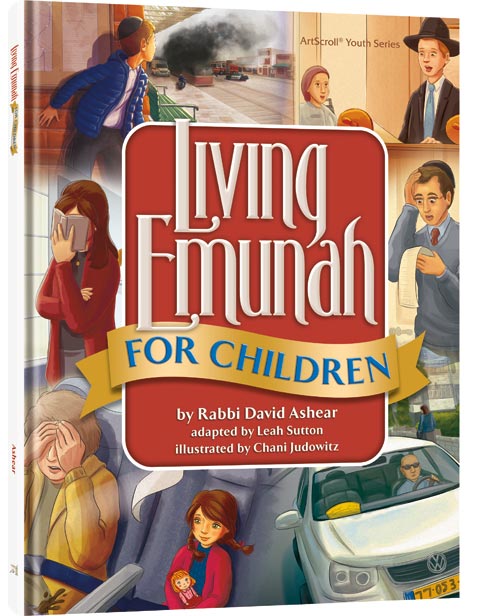
Living Emunah for Children: Who says emunah is just for big people? Kids need it too! It’s never too early to show our children how much Hashem loves them, and to let them know the incredible power of emunah and tefillah. And how even when things seem bad, they are really good, because Hashem is all goodness. Living Emunah for Children is a collection of fun and kid-friendly stories, carefully chosen and adapted by Leah Sutton for youngsters ages 4 – 8, with delightful, full-color pictures by Chani Judowitz. It makes a fabulous Chanukah gift that kids will want to read over and over — and one whose lessons will last them a lifetime.

Buy now for $17.99 $14.39 on artscroll.com!


lemth.jpg

Living Emunah for Teens: Today’s world is complex and often puzzling, and teens more than ever need something real to hold onto — emunah in Hashem and His care for us. In realistic scenarios and true stories adapted from Living Emunah especially for teens and reflecting their concerns, our teenagers will learn how emunah can change and enrich their lives, freeing them from anger or jealousy and helping them find the good in everything and everyone — including themselves. Every segment also includes a “Make it Real” guide to help bring the lessons of emunah into their lives.

Buy now for $25.99 $20.79 on artscroll.com!


lem3h.jpg

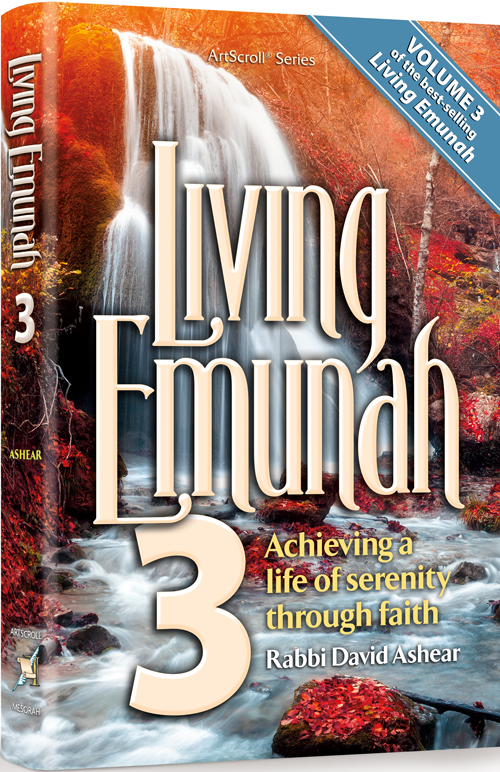
And while you’re gifting your children with emunah, we’ve got a special gift for you too:  Living Emunah Volume 3, with more chizuk, more stories, and more techniques to strengthen your own emunah. Over 10,000 copies have been sold in less than a month since its release — shouldn’t you be reading it too?

Buy now for $25.99 $20.79 on artscroll.com!


Because emunah is for everyone!

Don’t forget that ALL other books are on sale for 20% OFF! Click here to shop the ArtScroll Chanukah Sale!


Success! The Baltimore Community Dedication Of Yerushalmi Chagigah Crowdfunding Initiative Reaches Its Goal!

The publication of every volume in the Schottenstein Edition Yerushalmi is a cause for celebration, but next week’s release of Yerushalmi Chagigah is particularly special, as it marks the triumphant conclusion of a campaign by the Baltimore Jewish community to dedicate a volume in the Yerushalmi.

The project began two months ago, when a group of Baltimore’s lay leaders proposed a daring and exciting new idea – to raise the $100,000 needed to dedicate a volume in ArtScroll’s Yerushalmi series through a crowdfunding initiative that would include the entire Baltimore Jewish community. And Baltimore did it!
In a wonderful show of unity, rabbanim, businesspeople, professionals, retirees, and many shuls joined together to dedicate the Baltimore Community Edition of Yerushalmi Chagigah. With donations ranging from $10.00 to $18,000.00, it was truly a project that everyone could be a part of.
Appropriately, Baltimore’s Yerushalmi Chagigah has been published in memory of Rabbi Meir Zlotowitz z’l, the Torah publishing pioneer who founded and was the driving force behind ArtScroll’s many accomplishments. As noted author, speaker, and Baltimore resident Rabbi Yissocher Frand declared during the campaign, “My dear friend, Rabbi Meir Zlotowitz z’l, always felt that the Schottenstein Yerushalmi project was the crown jewel of ArtScroll. It is opening a portion of Torah that was closed to all but the greatest scholars for thousands of years.”
A crown jewel indeed. Each volume of the Yerushalmi is the product of the efforts of over 100 talmidei chachamim – ArtScroll’s legendary “Kollel without walls” – and it has unlocked for Klal Yisrael countless treasures of Torah understanding that were once only available to a fortunate few.
The Baltimore initiative has clearly proved that through united action everyone can have a part in the merit of important Torah projects. Give your community the opportunity to put itself on the map of Torah study and dedicate a major work, please contact Rabbi Naftali Miller at naftali@mesorah.com.

Get a FREE volume of Digital Makkos!

For a limited time, you can get a FREE digital edition of the ENTIRE Artscroll Hebrew or English Makkos!

If you already have the ArtScroll App Installed on your device:

You can get your free volume directly from the store in the ArtScroll App. 

  • Simply Open the app –   tap on Menu > Store 
  • Tap on ALL FREE Downloads  – Locate Makkos and download it to your device!

Or you can click one of these links and add it to your cart and check out for FREE – you will be emailed installation instructions:

 FREE Makkos Volume – English

 FREE Makkos Volume – Hebrew

If do not have have the ArtScroll App Installed on your device:

All you need to do is install the ArtScroll app and the FREE Makkos Volume will automatically be installed!

app-store-badge.pnggoogle-play-badge

Beautiful Article About the Candle Lighting Treasury and the 2017 Shabbos Project

The Shabbos Project: When One Candle Inspires Another

by Ariela Davis – October 26, 2017

The Shabbos Project. Ever since I saw the video about how the South African Jewish community, most of whom are not observant, came together to try out a Shabbos, I’ve been gripped by the idea. The pictures of hundreds of Jewish women baking challah on the streets of Johannesburg and the thousands that attended the Havdala concert, brought tears to my eyes. I loved the opportunity this initiative offered of a community coming together to try one Shabbos. Living in a community where Shabbos observance is far from the norm, the success of this project brought me hope that one day, maybe my community would be ready to try this.

But although we’ve tried to bring this project to Charleston and some have participated, we have not experienced the success that South Africa was blessed with. While many non-observant Jews are starting to see the appeal of powering down for 25 hours in order to focus on family and spirituality, it seems that for most, it is daunting to keep one whole Shabbos. Most Jews in our community do not have a background and learning all of the information Shabbos entails is overwhelming. And since very few families in Charleston keep Shabbos, it is hard to be different, especially when many kids’ activities and events take place on a Saturday.

I never quite comprehended this last point, until Fay-Novit Grabin (otherwise known as Bubbie Fay) told me her story. A legendary figure in Charleston, Bubbie Fay is in her 80’s and has more energy and passion for Judaism than anyone I know. In years gone by, she was the driving force in keeping our day school going; fundraising to keep the doors open and finding the Head of School who set our school on its track of excellence. She planned event after event for our shul in order to keep it vibrant; volunteered on the Chevra Kaddisha when that meant she had to sew the tachrichim (burial shrouds), and to this day, everyone knows you don’t mess with Bubbie Fay’s (actually, the shul’s) kitchen.

This woman who literally lives to strengthen Judaism in Charleston, was raised in Denmark, South Carolina, with no Jewish education, and aside from the presence of her grandmother’s candlesticks which her mother lit every week, little Jewish observance. When she got married and moved to Charleston, she slowly embraced yiddishkeit and together, she and her husband took on one mitzvah after the next until they were not only observant, but one of the backbones of the Jewish community.

Meeting this firebrand of a woman, no one would ever think she could be insecure about her Judaism, but she recently confided in me how difficult it was to be one of the only observant Jews among her friends. Many would go out to non-kosher restaurants while she was left behind; she was one of the few who was Shomer Shabbos, which cast her aside as “different”. A half century later, despite all that she’s accomplished, she still remembers how isolated she sometimes felt, and how painful it was.

Not everyone has the strength of a Bubbie Fay and hearing her story, I understand why it is so difficult for Jews in Charleston to try one Shabbos, no matter how intriguing an idea they may find it to be.  But as much as I get it, every year as The Shabbos Project rolls around and I see pictures on Facebook of communities that were able to pull it off, I feel inspired but also a little sad that our community is not among them.

And so this year, for the International Shabbos Project, we’ve decided to participate but try something different.

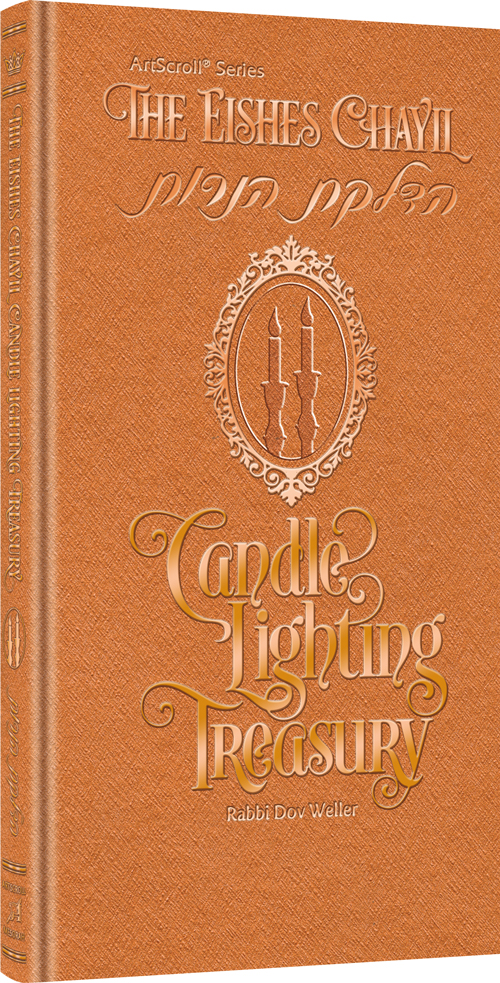
Sometime around Rosh Hashana, I received the Eishes Chayil Candle Lighting Treasury in the mail and after picking it up to read, I soon found myself unable to put the book down. The author, Rabbi Dov Weller, takes a mitzvah that I have always taken for granted and makes it fresh and meaningful by going into explanations about the customs and sharing moving stories.

Fifty years ago, most Jewish women, no matter how far removed they were from Judaism, lit Shabbos candles, which is perhaps why many conjure the image of a woman lighting candles as the emblem of Judaism. Nowadays, for whatever reason, many Jewish women do not light. But inspired by the book, this week, we are daring to attempt something tremendous: to encourage every Jewish household in Charleston to light Shabbos candles in honor of the Shabbos Project.

Despite the simplicity of the idea, I’ve feared that like other Shabbos initiatives we’ve tried to encourage, it won’t catch on. I was pleasantly surprised when many of the other Jewish organizations and synagogues in town agreed to encourage their congregants to join in. I was even more excited when a group of women came up to me in shul to tell me they had decided to join our initiative and bring in Shabbos with candles. A number of them admitted they had lit many years ago but for whatever reason, had stopped lighting. One woman told me she would need to dust off her grandmother’s candlesticks, but she was excited to bring this mitzvah to her home once more. Many spoke with nostalgia about watching their grandmothers light and the beauty it had brought to the home. These women were from across the spectrum of the Jewish community- Reform, Conservative, Orthodox, unaffiliated and their messages have infused me with hope that maybe we can really bring candle lighting back to our community, even if it is just for one week.

But ironically, there is one woman in our Jewish community who will not be lighting Shabbos candles this Friday: Fay Novit- Grabin. This Friday, Bubbie Fay will be having heart surgery and will be unable to light. And so many in our community have decided to dedicate the community candle lighting initiative in the merit of her refuah shlaima.

Nothing could be more fitting. Because there is a piece of Bubbie Fay’s story that I did not share. When women light Shabbos candles, the Tefilla we whisper is for us to merit to raise children and grandchildren who love and fear G-d, who illuminate the world with Torah and ma’asim tovim (good deeds). With all the of the challenges that Bubbie Fay endured to be frum, she was rewarded for her years of mesiras nefesh, (self-sacrifice) with the fruition of this Tefilla, in a way that is truly an anomaly in Charleston. This woman from Denmark, South Carolina is the proud grandmother of seven grandchildren, all frum and eighteen frum great-grandchildren. One of her grandchildren is Rabbi Dov Weller, author of the Candle Lighting Treasury, who has illuminated the world, with his insights on candle lighting, and who was the inspiration for the candle lighting initiative.

And so with the light that Bubbie Fay inspired within her own family and community, and through the powerful words of her grandson, may the light of the Jewish women’s candles in Charleston this week, be a merit for her complete recovery.

Please join the Charleston community and daven for Fayge Rochel bas Chaya Bayla at candle lighting.

Article reposted with permission from OU.org

To order your own copy of the amazing Eishes Chayil Candle Lighting Treasury by Rabbi Dov Weller, please click here!