
TESHUVAH INSPIRATION: Slow and Steady by Rabbi Nosson Muller

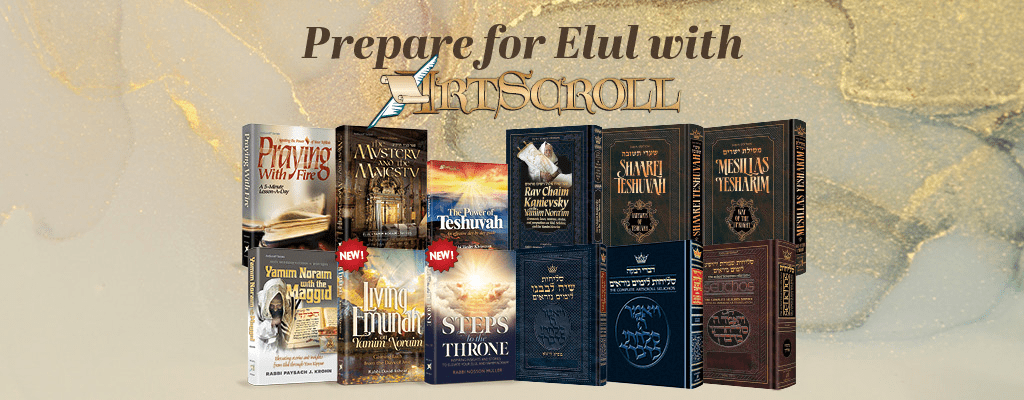
Adapted from: Steps to the Throne by Rabbi Nosson Muller

A man inspired to do teshuvah, as so many of us are on Erev Rosh Hashanah, aspires to immediate perfection. He sets lofty goals in every area of Jewish life, and promises himself that at this time next year, his slate will be impeccably clean.

The baalei mussar advised us against such an approach. It is impossible to fix everything overnight. Jumping too high and too fast will only lead to failure and frustration. Instead, they recommend a more measured process of teshuvah.

Make smaller resolutions, but make them ironclad. Setting realistically attainable goals gives a person a chance to actually follow through. One concrete step forward will lead to another.
Climbing the ladder rung by rung turns inspiration into reality.

The sefer Sass B’imrasecha illustrates the benefit of a gradual approach to teshuvah with a humorous parable.

Yankel was a simpleton, and to pass the long winter nights, the residents of his town would play a game with his mind.

Everyone took a seat around the table, with Yankel at the head. A row of bills was laid out — hundreds, fifties, twenties, and tens. Alongside the bills, they placed a shiny silver half-dollar coin.

“Choose one, dear Yankel,” the men said with glee. “Whichever you take is yours to keep.”

To everyone’s great amusement, he picked the shiny coin, night after night.

After a few weeks, someone called Yankel over to the side.

“I know you aren’t the world’s brightest fellow,” the man said, “but at this point, even you should realize what’s happening here. Can’t you see that everyone is laughing at you, that the choice you keep making is the wrong one to make?”

“I’m not as big a fool as you think,” Yankel replied with a smile. “Let me ask you a question, my friend. If I choose the hundred dollar bill, will there be a game the next night? Of course not! The men would never play with me again! Let the men have their fun, but every night, I get to add another half-dollar to my growing stash!”

Moving too fast at the outset of teshuvah is like choosing that hundred-dollar bill. Alarm bells sound, and the yetzer hara immediately enters the fray. He will do everything he possibly can to stop the inspired Jew in his tracks.

Go slowly!

It will allow your progress to fly under the radar. Your evil inclination will let you stay in the game, and every day, another half-dollar will be added to your growing pile.

Eventually, your net gains will far outweigh the value of a solitary one-hundred-dollar bill.

But there is a caveat.

A person who is impure is forbidden to enter the Beis HaMikdash. What if such a man sticks his finger into the airspace of the Temple courtyard while his body remains outside? Has he transgressed this commandment?

In Talmudical terms, this is called bi’ah b’miktzas, partial entry, and is the subject of extensive discussion as to whether it is forbidden. To avoid possibly transgressing this prohibition, many have the custom to refrain from placing their hands in the gaps between the stones of the Kosel HaMaaravi.

However, the Rebbe of Lublin, in his sefer Toras Chessed, disagrees with this custom. He writes that although partially entering a doorway is indeed forbidden, that is because a door’s intended use is to allow people to enter the area it opens into. Just standing in the doorway itself is enough to be considered as if they have already arrived.

The Lubliner Rav

A small gap, though, leads to nowhere. Merely placing a hand inside the tiny gap in the wall doesn’t reflect entry into the room behind it at all. The man remains entirely outside, and the law of partial entry does not apply.

A powerful message lies in this halachic distinction of the Lubliner Rebbe, says R’ Shaul Alter.

Everyone understands that complete repentance is not achieved overnight. It is a long journey, and begins with small and incremental improvements. However, this reality cannot change the overall goal.

If we are satisfied with just our small initial repairs, without any intention of continuing on as we grow, our spiritual location won’t change. When a partial entry is made without the intention of eventually going inside, we remain standing in the same place we were standing before. It will not be considered an entrance at all!

When a Jew undertakes small steps of teshuvah, he has partially entered the holy place he truly wishes to be. When the steps are taken with the goal of an eventual full entry in mind, it is immediately considered as if he has already arrived.


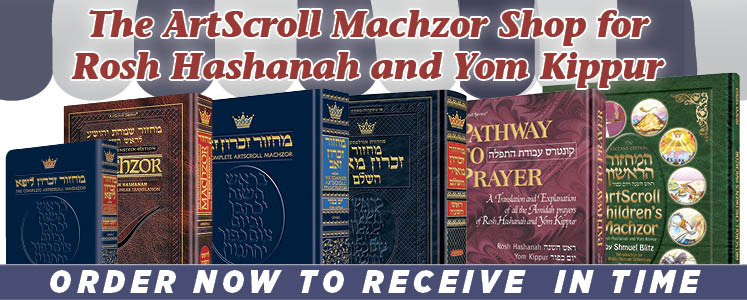
The ArtScroll “Machzor Shop”: Find the Machzor That’s Right for You!

This year has added so many new words to our vocabulary. Pandemic. Lockdown. Uptick. Flattening the curve, furloughs, social distancing. And, of course, Covid-19. Scary words, bitter and harsh, words that speak of suffering and fear that was almost unimaginable last Rosh Hashanah.

But though we’ve learned many new, nightmarish words, we also have cherished words of comfort, hope, and faith to turn to: the words of our tefillos.

There are many different ArtScroll machzorim, each one carefully designed help us understand the eternal words of tefillah, so that we can achieve greatness in our davening this Rosh Hashanah and Yom Kippur. Choose the one that meets your needs.

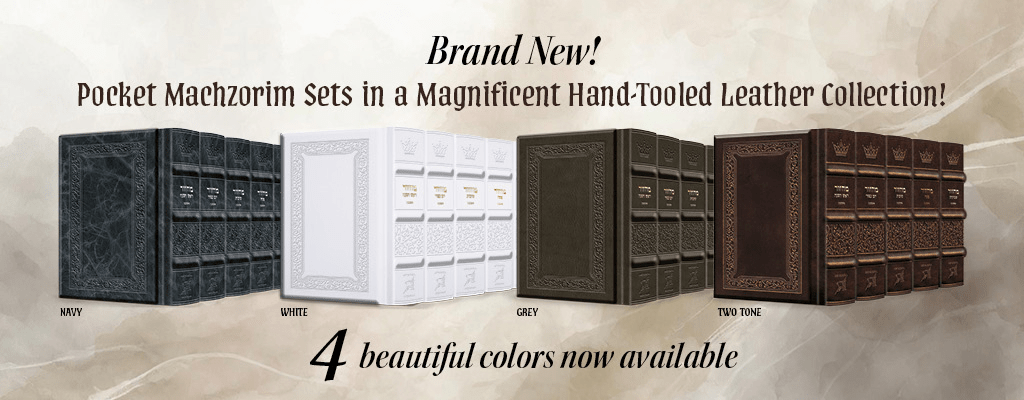
The Classic ArtScroll Machzor: With its lyrical and yet readable translation and engrossing commentary by Rabbi Nosson Scherman, beautiful graphics, and comprehensive directions, this is the work that started “the ArtScroll Machzor Revolution.” Available in Nusach Ashkenaz and Sefard, in hardcover and paperback, in full and pocket size, and in elegant leather binding.

The Schottenstein Edition Interlinear Machzor: The interlinear format is perfect for those who want to follow the Hebrew text but quickly access the English translation. The translation appears directly beneath the Hebrew, with ArtScroll’s patented arrow icon gently leading the eyes in the proper direction. Includes full commentary. Available in Nusach Ashkenaz and Sefard, in full and pocket size.

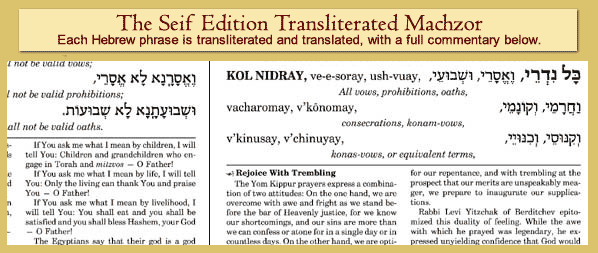
The Seif Edition Transliterated Machzor: The ideal choice for those less familiar with Hebrew, this machzor includes the Hebrew text, with phrase-by-phrase transliteration and translation, and a full commentary.

The ArtScroll Hebrew Machzor: For those prefer an all-Hebrew text, this beautifully typeset machzor is clear and easy to follow. Includes a choice of instructions in either Hebrew or English.

The Large Type Machzor: If you’re constantly putting on and taking off those reading glasses, this is the machzor for you! With extra-large, clear type, uncluttered pages, and a comfortable, manageable page size.

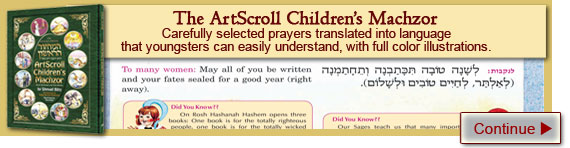
The ArtScroll Children’s Machzor: Kids are people too — and they also want to take part in Klal Yisrael’s tefillos. They can, with Shmuel Blitz’s bestselling ArtScroll Children’s Machzor, featuring evocative pictures, age-appropriate translations, and fascinating facts.

ArtScroll/Mesorah Publications Ltd. wishes all of our readers, and all of Klal Yisrael, a kesivah vachasimah tovah, and a successful and healthy New Year.

Prozbul Reminder – Free Download

Prozbul Reminder for Erev Rosh Hashanahprozbul_download3

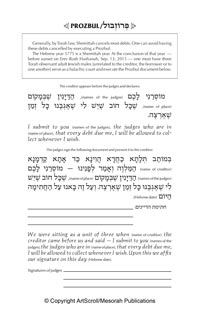
The Torah provides that outstanding loans between two Jews are automatically nullified atthe very end of the Shemittah [Sabbatical] year (Deuteronomy 15:2). Hillel the Elder observed that the wealthy, fearing their money would not be repaid, refused to lend to the poor prior to Shemittah. This not only caused a hardship for the poor, but was also a direct transgression of the Torah’s exhortation not to refrain from lending (ibid. 15:9-10).
To remedy this situation, Hillel enacted the prozbul, a legal document by means of which a creditor transfers his loans to a court. [Three knowledgeable laymen may constitute a court for this purpose.] Once the debts have been transferred to the court for collection, they are not nullified by Shemittah (Sheviis 10:2), as implied by Scripture.
Since Shemittah nullifies loans at the end of the year, it is advisable to delay writing the prozbul until Erev Rosh Hashanah, so that it will cover all loans made up to Rosh Hashanah. A prozbul should be made before Rosh Hashanah this year.

Click here to download.

The Newly Expanded ArtScroll Digital Library + Exciting New Features and a Free Download

Click here for instructions to download a free sample.

version-2-app
In the two years since its release, over fifty thousand users have discovered the ArtScroll App and the Wasserman Digital Initiative. With interactive features and the ability to carry multiple Talmud volumes in the palm of their hands, the Schottenstein Digital Edition Talmud Bavli has transformed the way people learn Talmud on the go.

And now, after years of development, we’re happy to announce that the Wasserman Digital Initiative is expanding. No longer is the ArtScroll Digital Library focused on the Talmud alone. With two new digital editions now available, and multiple new projects on the way, the ArtScroll App is opening the doors of learning and Torah study for hosts of new users.

Introducing

The Kleinman Digital Edition Kitzur Shulchan Aruch for iOS and Android devices:

Carry all five volumes of the renowned Kleinman Edition Kitzur Shulchan Aruch in the palm of your hand, while having access to the groundbreaking and interactive features of the ArtScroll digital library – at less than half the cost of the print edition.

and

The Jaffa Digital Edition Mesillas Yesharim/Way of the Upright for iOS and Android devices:

Combine the classic phrase-by-phrase translation and explanatory notes that the Jaffa Edition Mesillas Yesharim is known for with the state-of-the art innovative digital features of the ArtScroll app, for less than half the price of the print version.

In addition to the popular features of the print editions, such as the fully vowelized text, clear translations, detailed appendices, and ArtScroll’s trademark phrase-by-phrase elucidation, the new digital editions of the Kleinman Edition Kitzur Shulchan Aruch and the Jaffa Edition Mesillas Yesharim feature fantastic new interactive features:

  • Need the translation of a Hebrew word? Simply tap on the word and watch its translation appear.
  • Using the English translation and footnotes feature? Watch them scroll synchronously as you scroll through the Hebrew text.
  • When you look up an entry in the Table of Contents, you don’t need to scroll or flip to your desired page. Simply tap on the Table of Contents entry and you’ll go right to the page you want. This feature works for the footnotes and index as well.
  • Talmudic references don’t need to send you to the bookshelf to pull out another volume. Tap on a footnote and you can bring up the portion of the Talmud it references.
  • With the digital editions, you can add notes, bookmarks and highlights, and you can view them on your other devices.

Click here for instructions to download a free sample.

Click here for all available digital editions.

Future digital editions:

It doesn’t end here! Our team of programmers and scholars continues to collaborate on these upcoming projects:

Wasserman Digital Edition Siddur: a “super” smart siddur, coming to the ArtScroll Digital Library at the end of 2014

Stone Digital Edition Tanach: In development … stay tuned for details.

Sapirstein Digital Edition Chumash and Rashi: In development … stay tuned for details

Weekly Download: Let There Be Rain

ltrhWhat are you thankful for? When was the last time you really though about gratitude?

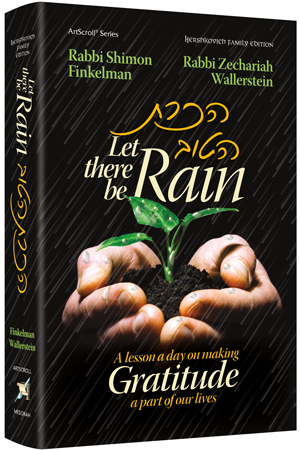
In this new release from ArtScroll, Let There Be Rain, popular teacher and lecturer Rabbi Zechariah Wallerstein teamed up with best-selling author Rabbi Shimon Finkelman to introduce the public to the lessons of gratitude and hakaras hatov in a deeper and more meaningful way than ever before. Conveniently arranged for daily study featuring both lessons and stories, this revolutionary volume will change your life…and the lives of those around you.

With the new year approaching, it’s a great time to take on a new daily learning commitment, and Let There Be Rain is a great option. You can experience the first week of  the powerful lessons of Rabbi Wallerstein and Rabbi Finkleman through our free weekly download series.

Click here to view, print or download a week’s worth of lessons from – Let there Be Rain.

Click here to buy a copy of Let There Be Rain.

Click here for all posts in our free weekly download series.


Make sure you never miss a post by subscribing to get blog emails. This can be done through the right sidebar on our blog.

Sunken Apples and Honey Tart from Kosher by Design

With Rosh Hashanah just two weeks away, many of you are probably cooking and baking for Rosh Hashanah, or at least thinking about your holiday menus. Well, with over 15 popular kosher cookbooks under our belts here at ArtScroll, we’re pretty well equipped to share a delicious Rosh Hashanah recipes!apples-and-honey-tart-from-Kosher-by-Design

Perhaps the most iconic of ArtScroll’s kosher cookbook collection is Kosher by Design, by Susie Fishbein. This book that was described by Publisher’s Weekly as “A beautiful volume that straddles that delicate line between modern and traditional, and between refined cuisine and everyday ease.” Its cover photo depicts the ultimate Rosh Hashanah dessert recipe, Sunken Apples and Honey Cake. Today we’re sharing this recipe with our blog readers.

Click here to download a printable recipe card for Sunken Apples and Honey Tart from Kosher By Design

Microsoft Word - sunken apples

Click here to purchase Kosher by Design

Click here to shop ArtScroll’s Kosher cookbook collection